Description


A diary of my mothing activity covering highlights and photos from my moth trapping activities. Mainly Norfolk (UK), occasionally beyond. I may mention other wildlife sightings here, especially insects, but for birds see my birding diary.
Showing posts with label Agapeta hamana. Show all posts

Saturday, 24 November 2018

Phalonidia manniana, new for the garden, plus a new site for a Red Data Book species

This summer has been mad, and I'm afraid blog posts have fallen by the wayside.  At last I'm ready to pick up where I left off.  It will take me a while to catch up, but now making a start...

The highlight of Thursday night, 31st May, was a new moth for the garden, Water-mint Conch Phalonidia manniana.


Water-mint Conch Phalnidia manniana (female, gen det), North Elmham, 31st May


A few others were new for the year including the marvellous Rough-winged Conch Phtheochroa rugosana, Common Yellow Conch Agapeta hamana, May Highflyer (just in time?), 2 Vine's Rustics and Burnished Brass.


Rough-winged Conch Phtheochroa rugosana, North Elmham, 31st May


Common Yellow Conch Agapeta hamana, North Elmham, 31st May


May Highflyer, North Elmham, 31st May


Vine's Rustic, North Elmham, 31st May


Burnished Brass, North Elmham, 31st May


Other moths were 5 Diamond-backs Plutella xylostella, 3 Buff Rush Case-bearers Coleophora caespititiella, 2 Little Dwarfs Elachista canapennella, Light Brown Apple-moth Epiphyas postvittana, 8 Common Marbles Celypha lacunana, Rush Marble Bactra lancealana, Crescent Bell Epinotia bilunana, Yellow-faced Bell Notocelia cynosbatella, Triple-blotched Bell Notocelia trimaculana, 4 Hook-streak Grass-veneers Crambus lathoniellus, Common Grey Scoparia ambigualis, 5 Small Magpies Anania hortulata, 2 Bee Moths Aphomia sociella, Pebble Hook-tip, 2 Blood-veins, 3 Silver-ground Carpets, 5 Green Carpets, Mottled Pug, 4 Common Pugs, Scorched Carpet, Brimstone Moth, Pale Oak Beauty, 2 Pale Tussocks, Orange Footman, 4 White Ermines, 2 Buff Ermines, 6 Heart and Darts, Setaceous Hebrew Character, Bright-line Brown-eye, 4 Common Wainscots, Brown Rustic, 8 Treble Lines, Spectacle and Straw Dot.

There was also a Pond Olive Cloeon dipterum (mayfly), another Dasytes aeratus following my first ever the previous night and, new for the year, Cantharis decipiens.

Cantharis decipiens, North Elmham, 31st May


Next morning I went up to Brancaster mainly to look for birds, though of course I can't help looking at invertebrates at the same time.  Moths along Gypsy Lane included Common Nettle-tap Anthophila fabriciana, Cocksfoot Moth Glyphipterix simpliciella, Plum Tortrix Hedya pruniana, Silver-ground Carpet and 15 Silver Ys. There were lots of moths on the golf-course too but the most unexpected was a lovely Tawny Wave, a Red Data Book species that is mainly found in the Brecks.  There are very few records indeed from the north Norfolk coast, except for Scolt Head where Neil records them regularly.  Looks like this was a good year for them there.  Not sure if this one hopped across the chanel from Scolt or if they're breeding here too.

Tawny Wave, Brancaster golf-course, 1st June


 Other moths here included 8 Plain Fanners Glyphipterix fuscoviridella, 26 Diamond-backs Plutella xylostella, Yellow-faced Bell Notocelia cynosbatella, 3 Hook-streak Grass-veneers Crambus lathoniellus, Yellow Shell, Green Carpet, 15 Cinnabars and 35 Silver Ys. Caterpillars included about 25 Brown-tails and a similar number of Garden Tigers.

Brown-tail caterpillar, Brancaster golf-course, 1st June


Garden Tiger caterpillar, Brancaster golf-course, 1st June


Among the butterflies Green Hairstreak was the highlight, along with Small Copper, c. 25 Common Blues, Painted Lady and about 25 Small Heaths.


Green Hairstreak, Brancaster golf-course, 1st June


I noticed a couple of masses of small dark insects clinging to the trunk of an Elder tree by the huts.  Turns out they were Elder Aphids Aphis sambuci, the first time I've noticed any of these.

Elder Aphids Aphis sambuci, Brancaster golf-course, 1st June


There's a really impressive display of Yellow Rattle here too.  This is a species I associate with damp meadows but apparently dry duneland habitat like this is good for it too.


Yellow Rattle, Brancaster golf-course, 1st June

Friday, 8 June 2018

Another kuhlweiniella

I found 30 moths of 13 species in a wander round the meadows on Monday 28th May.  Among the better ones was another Corn Moth Nemapogon granella, the first time I've recorded one outside.  Also for comparison a Cork Moth Nemapogon cloacella.

Corn Moth Nemapogon granella, North Elmham Cathedral Meadows, 28th May


Cork Moth Nemapogon cloacella, North Elmham Cathedral Meadows, 28th May


Perhaps even better was a Scarce Oak Midget Phyllonorycter kuhlweiniella.  I've only ever seen these on or around oak trees before so it was a great surprise to net this from the middle of one of the larger fields, at least 200m from the nearest Oak.

Scarce Oak Midget Phyllonorycter kuhlweiniella, North Elmham Cathedral Meadows, 28th May


The other moths were Carrion Moth Monopis weaverella, Daisy Bent-wing Bucculatrix nigricomella, 2 Diamond-backs Plutella xylostella, Common Yellow Conch Agapeta hamana, 4 Common Marbles Celypha lacunana, Rush Marble Bactra lancealana, Sharp-winged Drill Dichrorampha acuminatana, 8 Hook-streak Grass-veneers Crambus lathoniellus, Green Carpet and 7 Straw Dots.

Daisy Bent-wing Bucculatrix nigricomella, North Elmham Cathedral Meadows, 28th May


Common Yellow Conch Agapeta hamana, North Elmham Cathedral Meadows, 28th May


Sharp-winged Drill Dichrorampha acuminatana, North Elmham Cathedral Meadows, 28th May


Other insects included my first bush-cricket for the site, a nymph Dark Bush-cricket, two species of Scorpion Fly (Panorpa germanica and Panorpa communis), a Green Drake (mayfly) Ephemera danica, a Dock Bug and a copulating pair of Parent Bugs, the soldier beetles Cantharis livida and Cantharis rustica (the livida appears to be a new one for me, though I think I've tentatively identified them from photos before), a 7-spot Ladybird and a more straightforwardly-identified (compared to the last one) Tenthredo arcuata (sawfly).

Dark Bush-cricket nymph, North Elmham Cathedral Meadows, 28th May


Parent Bugs, North Elmham Cathedral Meadows, 28th May


Cantharis livida, North Elmham Cathedral Meadows, 28th May


Cantharis rustica, North Elmham Cathedral Meadows, 28th May


7-spot Ladybird, North Elmham Cathedral Meadows, 28th May


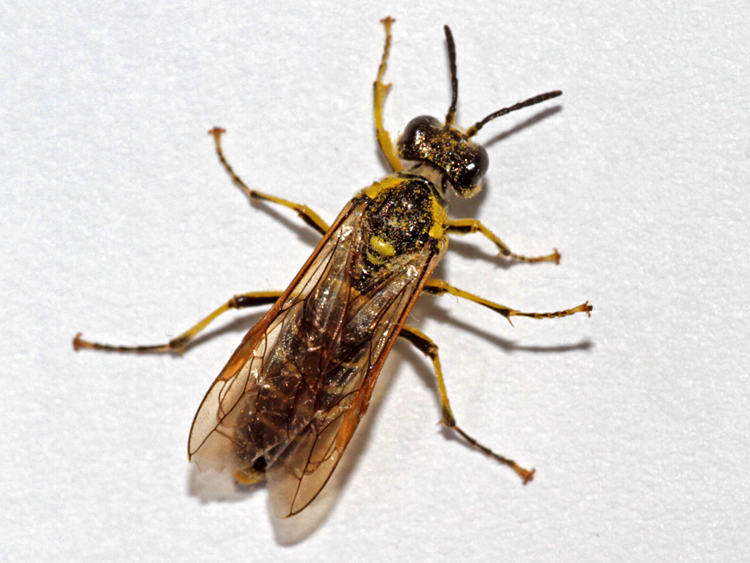
Tenthredo arcuata, North Elmham Cathedral Meadows, 28th May


I think this leaf-mine on Broad-leaved Dock may belong to the fly Pegomya bicolor, but I'm not sure if other species can be eliminated or not (let me know if you think it can be recorded confidently).

probable Pegomya bicolor leafmine, North Elmham Cathedral Meadows, 28th May


I kept seeing this apparent fungal growth on Cocksfoot grass and was reminded of a photo I'd seen someone post on Twitter just before I came out.  I looked at my Twitter feed to see if anyone had replied to identify it and top of my feed, having tweeted literally seconds before I looked, was a reply from James Emerson confirming that it was a fungus called Choke.  Apparently there may be several species according to the species it grows on, and this one would therefore be Epichloe typhina.  Not a very good example in this photo - others were thicker and more obvious (but evidently harder to photograph!).

Epichlioe typhina, North Elmham Cathedral Meadows, 28th May

Wednesday, 7 June 2017

Alabonia geoffrella and Dichrorampha sequana

A quick birding visit to the patch on Wednesday 24th May produced a few moths (2 Cocksfoot Moths Glyphipterix simpliciella, Common Marble Celypha lacunana and Brown Silver-line) but a bug was the highlight - my first Liocoris tripustulatus.


Liocoris tripustulatus, Bittering, 24th May


On to Ryburgh where I found this Square-spot Drill Dichrorampha sequana - a scarce moth in Norfolk with only about 20 records.


 Square-spoot Drill Dichrorampha sequana, Ryburgh, 24th May


Although striking it wasn't the best-looking moth, but then how could it be when there was a Common Tubic Alabonia geoffrella there.  Another moth where its name seems inappropriate as there is nothing common about it - uncommonly seen (by me at least, only my second ever) and anything but common in appearance.

Common Tubic Alabonia geoffrella, Ryburgh, 24th May


There were also 12 Plain Golds Micropterix calthella, 6 Common Nettle-taps Anthophila fabriciana, 3 Silver-ground Carpets, Green Carpet and Common Pug, as well as a variety of other common insects like this 22-spot Ladybird.

22-spot Ladybird, Ryburgh, 24th May


That evening Dave and I headed up to Gypsy Lane, Brancaster for some more mothing.  A good time was had but I'll save that for my next post.

Among the moths at home that night the following were new for the year at home: Little Ermel Swammerdamia pyrella, Hook-marked Straw Moth Agapeta hamana, Chalk Knot-horn Phycitodes maritima, Treble-bar, Scorched Wing, Light Brocade and Burnished Brass.

Little Ermel Swammerdamia pyrella, North Elmham, 24th May


Hook-marked Straw Moth Agapeta hamana, North Elmham, 24th May


Chalk Knot-horn Phycitodes maritima (male, gen det), North Elmham, 24th May


Treble-bar, North Elmham, 24th May


Scorched Wing, North Elmham, 24th May


Light Brocade, North Elmham, 24th May


Burnished Brass, North Elmham, 24th May


A Hawthorn Bent-wing Bucculatrix bechsteinella was arguably better than any of those following on from my first here last week.

Hawthorn Bent-wing Bucculatrix bechsteinella (male, gen det), North Elmham, 24th May


The others were 2 Light Brown Apple Moths Epiphyas postvittana, Common Marble Celypha lacunana, 3 Yellow-faced Bells Notocelia cynosbatella, Common Grey Scoparia ambigualis, Bee Moth Aphomia sociella, Common Swift, Chinese Character, 2 Silver-ground Carpets, Green Carpet, 3 Common Pugs, Light Emerald, Eyed Hawk-moth, Pale Prominent, Pale Tussock, 2 Orange Footmen, 4 White Ermines, Shears, Hebrew Character, Brown Rustic and 8 Treble Lines.

Common Grey Scoparia ambigualis, North Elmham, 24th May


I'd parked this beetle earlier as I'd failed to key it out accurately.  Having since had another one elsewhere which I eventually managed to name I went back to this one suspecting it was the same.  Indeed it was, a Black Clock Beetle Pterostichus madidus, and another new one for me.

Black Clock Beetle Pterostichus madidus, North Elmham, 22nd May