Description


A diary of my mothing activity covering highlights and photos from my moth trapping activities. Mainly Norfolk (UK), occasionally beyond. I may mention other wildlife sightings here, especially insects, but for birds see my birding diary.
Showing posts with label Bucculatrix bechsteinella. Show all posts

Wednesday, 17 February 2021

Review of 2019 and 2020 - Moths: Copper Ermel (Roeslerstammidae) and Bent-wings (Bucculatricidae)

COPPER ERMEL (ROESLERSTAMMIIDAE)


Copper Ermel Roeslerstammia erxlebella - None.  I've only ever recorded this species at home on a single occasion, in 2016.


-----------------------------------


BENT-WINGS (BUCCULATRICIDAE)


Crested Bent-wing Bucculatrix cristatella - None.  I've never seen this species but although it's scarce and hasn't been recorded close to here there's no reason why it shouldn't be here.  Plenty of Yarrow growing at the meadows.


Daisy Bent-wing Bucculatrix nigricomella - One in my garden moth trap on 31st July 2019 and an unprecedented 9 between 8th May and 1st August 2020 including 3 on 31st July.  I didn't catch any here in 2018 and had never caught more than 2 in a year here before.  Also one in next door's garden on 8th August 2019 and one at the meadows on 25th May 2020.

Daisy Bent-wing Bucculatrix nigricomella, North Elmham, 31st July 2019


Daisy Bent-wing Bucculatrix nigricomella, North Elmham, 8th May 2020


Saltern Bent-wing Bucculatrix maritima - None caught by me but I gen detted one for Geoff Turner who caught it at Weybourne between 30th June and 4th July 2019.  It was a considerably darker individual than some I've seen before.

female Saltern Bent-wing Bucculatrix maritima, collected by Geoff Turner at Weybourne between 30th June and 4th July 2019


Buckthorn Bent-wing Bucculatrix frangutella - None.  I've never seen the adult of this species.  There isn't much Buckthorn growing round here so perhaps not surprising that it hasn't yet been recorded locally.


Elm Bent-wing Bucculatrix albedinella - None.  I've never seen this species and although it's reasonably widespread (if also scarce) in Norfolk it hasn't yet been found in this 10k square or any of the neighbouring ones.


Alder Bent-wing Bucculatrix cidarella - One in my garden moth trap on 23rd June 2019 was a completely new moth for me.

male Alder Bent-wing Bucculatrix cidarella, North Elmham, 23rd June 2019


Lime Bent-wing Bucculatrix thoracella - None.  I've only ever seen one adult and it wasn't round here, but it's pretty widespread in Norfolk so should be a chance of finding it locally.


Oak Bent-wing Bucculatrix ulmella - 2 here on 1st June 2019 then another 4 between 26th July and 22nd August.  One here on 20th May 2020 followed by 23 between 18th July and 17th August, making it far and away my best year so far.  Also one next door, one at the meadows and 10 at Swanton Great Wood in 2019 and 6 mines found in a single leaf at the meadows in 2020.  Although worn individuals can be troublesome to identify (the same could be said for most things) fresh ones seem quite distinctive so I'm really not sure why this is Grade 4 (meaning records are only accepted if the genitalia have been examined).  Apparently Bucculatrix ulmifoliae (not yet found in Norfolk but recently discovered in Suffolk) is the main confusion species but even that looks like it's pretty easily separated from typical fresh examples of ulmella (which have an extensively orange vertex).

male Oak Bent-wing Bucculatrix ulmella, North Elmham, 29th July 2019


male Oak Bent-wing Bucculatrix ulmella, North Elmham, 6th August 2020


male Oak Bent-wing Bucculatrix ulmella, North Elmham, 11th August 2020


male Oak Bent-wing Bucculatrix ulmella, North Elmham, 12th August 2020


Hawthorn Bent-wing Bucculatrix bechsteinella - 3 in the garden trap between 2nd June and 10th August 2019 and 5 between 21st May and 11th August 2020.  I had 3 in 2017 too but none in any other year here.  Also one netted at the meadows on 12th May 2019 and 3 there on 25th May 2020.  As usually seems to be the case with most Bucculatrix that I catch, all were males.

male Hawthorn Bent-wing Bucculatrix bechsteinella, North Elmham, 12th May 2019


Birch Bent-wing Bucculatrix demaryella - None.  I've only ever seen this species once and it wasn't here.  Despite the abundance of its foodplants this species appears to be genuinely quite scarce in Norfolk and hasn't yet been recorded round here.


Next page: Gracillariidae


Saturday, 26 May 2018

A new ladybird, more Small Yellow Underwings and a ex-larva correction

A sunny afternoon walk round the Meadows on Friday afternoon was very productive.  I found 3 Small Yellow Underwings (same fields but different places to last time) though I'm still not really happy with my photos - I just can't seem to get things like this fully sharp using my 7D - not sure why.


Small Yellow Underwings, North Elmham Cathedral Meadows, 18th May


Other half-decent moths included Hawthorn Bent-wing Bucculatrix bechsteinella, Lead-coloured Drill Dichrorampha plumbana and my first migrant at the meadows, a Silver Y.

Hawthorn Bent-wing Bucculatrix bechsteinella, North Elmham Cathedral Meadows, 18th May


Lead-coloured Drill Dichrorampha plumbana (male, gen det), North Elmham Cathedral Meadows, 18th May


I counted at least 32 Cocksfoot Moths Glyphipterix simpliciella but they were everywhere and I expect I'd have found hundreds if not thousands if I'd looked hard enough.  Other moths were Plain Gold Micropterix calthella, Hawthorn Slender Parornix anglicella, 6 Common Nettle-taps Anthophila fabriciana and Red Twin-spot Carpet.

Plain Gold Micropterix calthella, North Elmham Cathedral Meadows, 18th May


Butterflies consisted of Small White, Green-veined White, 3 Orange-tips, Peacock and Speckled Wood, while my first Azure Damselfly of the year and 5 Large Red Damselflies made up the dragonflies.

Peacock, North Elmham Cathedral Meadows, 18th May


There were 2 Dock Bugs and my first 2 Red-and-black Froghoppers Cercopis vulnerata for the site.  Also a Leptopterna nymph, I suspect dolabrata but I don't think you can rule out ferrugata at this stage (let me know if I'm wrong about that).

Red-and-black Froghoppers Cercopis vulnerata, North Elmham Cathedral Meadows, 18th May


Leptopterna sp. nymph, North Elmham Cathedral Meadows, 18th May


Two beetles were both completely new species for me.  I've not been doing beetles that require microscopic examination for very long so new beetles are quite a regular feature for me, but one of these was a ladybird, the distinctive examples of which I have been identifying for quite a few years, so a new ladybird is a much more satisfying and exciting find.  It was a 24-spot Ladybird, a species with a scientific name that's way too long: Subcoccinella vigintiquattuorpunctata, though I see some sources transcribe it simply as Subcoccinella 24-punctata.


24-spot Ladybird, North Elmham Cathedral Meadows, 18th May


I don't think it's especially uncommon, but uncommon enough for me not to have noticed it before.  The other new beetle was one that required close examination, indeed I think I may have seen it before and misidentified it even after microscopic examination.  I eventually figured out that it was Polydrusus cervinus, a species that, unlike several other similar species, is not always a metallic green colour.  I was initially put off by its colour, thinking it must be one of the other Polydusus or Phyllobius species but in the end cervinus seemed to be the only species that ticked all the boxes, and it turns out they are quite often this green.  One or two of the other features were quite hard to see too, and I wonder if I may have got these wrong in the past as they're meant to be very common indeed.

Polydrusus cervinus, North Elmham Cathedral Meadows, 18th May


Hoverflies included another Melanostoma mellinum and a new species for me, Sphaerophoria interrupta.

Sphaerophoria interrupta, North Elmham Cathedral Meadows, 18th May


I found a number of ants on a tree trunk and then swept some more off some nearby Common Vetch.  I was sure they were not one of the two species I'd identified up to now and sure enough they proved to be Negro Ants Formica fusca.  There was also a Common Red Ant Myrmica rubra among them.


Negro Ants Formuca fusca, North Elmham Cathedral Meadows, 18th May


Bees included Flavous Nomad Bee Nomada flava, Red-tailed Bumblebee and Common Carder Bees.

Flavous Nomad Bee Nomada flava, North Elmham Cathedral Meadows, 18th May


This spider seems to be Tetragnatha montana I believe...

Tetragnatha montana, North Elmham Cathedral Meadows, 18th May


Some nice flowers too, including these Hedgerow Cranesbill and Star-of-Bethlehem.


Hedgerow Cranesbill, North Elmham Cathedral Meadows, 18th May


Star-of-Bethlehem, North Elmham Cathedral Meadows, 18th May


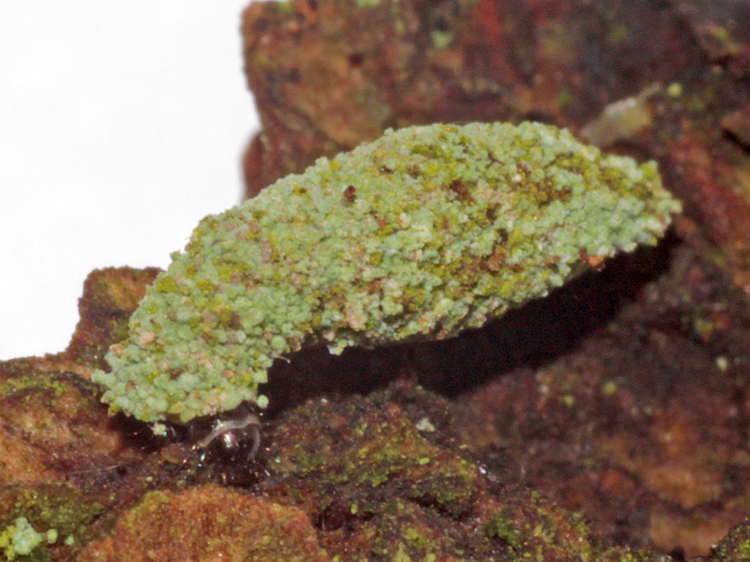
A while ago I posted about an algae-covered larva I found at Bittering on 13th April.  I'd initially identified it as either Virgin Bagworm Luffia ferchaultella or White-speckled Bagworm Narycia duplicella, both of which have similar algae-covered larvae.  For reasons that I can no longer recall or fathom, I eventually plumped for the former and recorded it as Luffia ferchaultella.

It soon ate all the algae on the bit of bark I collected it on, so I returned to gather some more and put it in the pot with it.  After a few days it stopped munching and remained still - I wasn't sure if it had died or pupated, but kept it sitting on my desk and checked it daily.  On 19th May I looked again and noticed a change - protruding from the tip of the case were what looked like clear wings.  There was no sign of life though and I wondered if it had died on emergence - I hadn't at that point noticed any live insect in the pot.  I checked a bit harder and was pleased to see a moth sitting still on the bark.  Now Luffia ferchaultella is a parthenogenetic species and only wingless females are known.  This insect had wings, so it wasn't ferchaultella after all - it was Narcycia duplicella.  Anyway a first for me, not only a new species but the first time I've ever successfully reared a moth from a larva.


White-speckled Bagworm Narycia duplicella larva, Bittering, 13th April


White-speckled Bagworm Narycia duplicella reared from the above larva, 19th May

Friday, 8 September 2017

Weybourne moths

One of the saddest events at the end of last year was the untimely death of Martin Preston.  He and Maureen created a wonderful bird and moth-rich garden at their home at Weybourne and I was fortunate to visit it on a number of occasions, usually to see an unusual bird that Martin had trapped.  On 21st July their son-in-law Ben set the moth traps in the garden once again, kindly inviting Dave and me to have a look through them with him the following morning.  One of the personal highlights was this Tawny Shears - I think one of the top 3 most common and widespread moths in Norfolk that I hadn't previously seen.

Tawny Shears, Weybourne, 21st July


Other macros I don't see very often included Bordered Beauty, Poplar Kitten, White-line Dart, 10 + Rosy Minors, Twin-spotted Wainscot and Brown-veined Wainscot.

Bordered Beauty, Weybourne, 21st July


Poplar Kitten, Weybourne, 21st July


White-line Dart, Weybourne, 21st July


Rosy Minor, Weybourne, 21st July


Twin-spotted Wainscot, Weybourne, 21st July


Brown-veined Wainscot, Weybourne, 21st July


I probably missed jotting down some of the macros I saw (Ben has a more complete list) but the others that I'm sure I saw were Drinker, Pebble Hook-tip, Chinese Character, Buff Arches, Blood-vein, Small Blood-vein, Least Carpet, Small Fan-footed Wave, Dwarf Cream Wave, Single-dotted Wave, Riband Wave, Red Twin-spot Carpet, Large Twin-spot Carpet, Shaded Broad-bar, Small Phoenix, Yellow-barred Brindle, Magpie Moth, Scorched Carpet, Brimstone Moth, Early Thorn, Purple Thorn, Scalloped Oak, Willow Beauty, Engrailed, Privet Hawk-moth, Pine Hawk-moth, Poplar Hawk-moth, Elephant Hawk-moth, Pebble Prominent, Swallow Prominent, Coxcomb Prominent, Brown-tail, Yellow-tail, Black Arches, Fen Wainscot, Rosy Footman, Dingy Footman, Scarce Footman, Common Footman, Garden Tiger, Ruby Tiger, Shuttle-shaped Dart, Flame Shoulder, Large Yellow Underwing, Lesser Broad-bordered Yellow Underwing, Double Square-spot, Nutmeg, Dot Moth, Bright-line Brown-eye, Brown-line Bright Eye, Southern Wainscot, Smoky Wainscot, Knot Grass, Dun-bar, Dark Arches, Cloaked Minor, Common Rustic agg., Dusky Sallow, Uncertain, Rustic, Nut-tree Tussock, Silver Y, Spectacle and Snout.

Knot Grass, Weybourne, 21st July


Due to the sheer number of moths trapped at this location relatively little attention has been paid to the micros, and so Dave and I were keen to record as many of these as possible.  Among them was my first adult Lime Bent-wing Bucculatrix thoracella.

Lime Bent-wing Bucculatrix thoracella, Weybourne, 21st July


There were also Daisy Bent-wing Bucculatrix nigricomella and Hawthorn Bent-wing Bucculatrix bechsteinella, bringing the total number of Bucculatrix species I saw that morning to four (including the Oak Bent-wing Bucculatrix ulmella that I had at home - see my last blog post) - which must be a record!

Daisy Bent-wing Bucculatrix nigricomella, Weybourne, 21st July


Hawthorn Bent-wing Bucculatrix bechsteinella (male, gen det), Weybourne, 21st July


Arguably the best record was 2 Spikenard Case-bearers Coleophora conyzae, a species only recorded in Norfolk 8 times previously and never on the north coast (previous records included one in my garden last year, 4 larval records from Foxley Wood and 3 records from the Brecks).

Spikenard Case-bearer Coleophora conyzae (male, gen det), Weybourne, 21st July


Other species I rarely see included 2 Copper Ermels Roeslerstammia erxlebella, White-legged Case-bearer Coleophora albitarsella, Long-winged Shade Cnephasia longana and 3 Pine Leaf-mining Moths Clavigesta purdeyi.

White-legged Case-bearer Coleophora albitarsella (male, gen det), Weybourne, 21st July


Long-winged Shade Cnephasia longana (male, gen det), Weybourne, 21st July


Pine Leaf-mining Moth Clavigesta purdeyi (male, gen det), Weybourne, 21st July


Probably the most numerous moth was Dingy Dowd Blastobasis adustella - I guesstimated over 100 of these, far more than I've ever seen before on one night.  Other species included Carrion Moth Monopis weaverella, White-triangle Slender Caloptilia stigmatella, Ribwort Slender Aspilapteryx tringipennella, Brown Birch Slender Parornix betulae, Golden Argent Argyresthia goedartella, Purple Argent Argyresthia albistria, Bird-cherry Ermine Yponomeuta evonymella, Wainscot Smudge Ypsolopha scabrella, Common Oak Case-bearer Coleophora lutipennella, Body-marked Case-bearer Coleophora clypeiferella, Golden-brown Tubic Crassa unitella, Common Flat-body Agonopterix heracliana, Burdock Neb Metzneria lappella, Dull Red Groundling Bryotropha senectella, Cinereous Groundling Bryotropha terrella, Orange Crest Helcystogramma rufescens, Four-spotted Obscure Oegoconia quadripuncta, Marbled Cosmet Mompha propinquella, Common Cosmet Mompha epilobiella, Burdock Conch Aethes rubigana, Black-headed Conch Cochylis atricapitana, Cnephasia sp., Barred Marble Celypha striana, Grey Poplar Bell Epinotia nisella, White-foot Bell Epiblema foenella, Hoary Bell Eucosma cana, Two-coloured Bell Eucosma obumbratana, Marbled Piercer Cydia splendana, Codling Moth Cydia pomonella, Round-winged Drill Dichrorampha simpliciana, Pearl Grass-veneer Catoptria pinella, Ringed China-mark Parapoynx stratiotata, Small Magpie Anania hortulata, Rosy Tabby Endotricha flammealis and Dotted Oak Knot-horn Phycita roborella.

All in all a pretty good showing, so thanks for having us Ben and Maureen.