Description


A diary of my mothing activity covering highlights and photos from my moth trapping activities. Mainly Norfolk (UK), occasionally beyond. I may mention other wildlife sightings here, especially insects, but for birds see my birding diary.
Showing posts with label Cercopis vulnerata. Show all posts

Tuesday, 25 May 2021

Review of 2019 and 2020 - Froghoppers, Planthoppers and Leafhoppers part 1 (Ledrinae and Cicadellinae)

RED-AND-BLACK FROGHOPPERS (CERCOPIDAE)


Red-and-black Froghopper Cercopis vulnerata - Seen at the Cathedral Meadows on 12th and 25th May 2019 and 2nd May 2020.

Red-and-black Froghopper Cercopis vulnerata, North Elmham Cathedral Meadows, 12th May 2019


-----------------------------------


OTHER FROGHOPPERS (APHROPHORIDAE)


Alder Spittlebug Aphrophora alni - One on White Willow at the meadows on 8th September 2019 and one caught in the garden moth trap on 31st July 2020.


Alder Spittlebug Aphrophora alni, North Elmham Cathedral Meadows, 8th September 2019


Alder Spittlebug Aphrophora alni, North Elmham, 31st July 2020


Common Froghopper Philaenus spumarius - Caught in my garden moth trap on 1st and 4th July and 26th August 2019 and on 29th June 2020.  Also to light at the meadows on 3rd September 2019 and 23rd June 2020 and one on Mugwort there on 3rd August.  Also what was probably one at Whitwell Street on 3rd September 2020 but this one escaped before I could confirm it.

Common Froghopper Philaeneus spumarius, North Elmham, 1st July 2019


Common Froghopper Philaeneus spumarius, North Elmham Cathedral Meadows, 23rd June 2020


Common Froghopper Philaeneus spumarius, North Elmham, 29th June 2020


Neophilaenus lineatus - None locally but one near Carsaig on Mull on 10th June 2019.  I had one at the Cathedral Meadows in 2018.

Neophilaenus lineatus, west of Carsaig, 10th June 2019


-----------------------------------


LEAFHOPPERS (CICADELLIDAE)


SUBFAMILY LEDRINAE


Eared Leafhopper Ledra aurita
- One in the garden moth trap on 30th July 2020.  None in 2019 but I had 4 here in 2016 and one in 2018.

Eared Leafhopper Ledra aurita, North Elmham, 30th July 2020


SUBFAMILY CICADELLINAE


Cicadella viridis - 2 in the moth trap on 25th July 2019 were new for the garden.  A male came to light at Swanton Great Wood on 27th August, my first of the dark-winged form (is that all males and only males?), and 2 seen at Thompson Common on 7th August 2020.

Cicadella viridis, North Elmham, 25th July 2019


Cicadella viridis, Swanton Great Wood, 27th August 2019


Next page: more Leafhoppers

Saturday, 26 May 2018

A new ladybird, more Small Yellow Underwings and a ex-larva correction

A sunny afternoon walk round the Meadows on Friday afternoon was very productive.  I found 3 Small Yellow Underwings (same fields but different places to last time) though I'm still not really happy with my photos - I just can't seem to get things like this fully sharp using my 7D - not sure why.


Small Yellow Underwings, North Elmham Cathedral Meadows, 18th May


Other half-decent moths included Hawthorn Bent-wing Bucculatrix bechsteinella, Lead-coloured Drill Dichrorampha plumbana and my first migrant at the meadows, a Silver Y.

Hawthorn Bent-wing Bucculatrix bechsteinella, North Elmham Cathedral Meadows, 18th May


Lead-coloured Drill Dichrorampha plumbana (male, gen det), North Elmham Cathedral Meadows, 18th May


I counted at least 32 Cocksfoot Moths Glyphipterix simpliciella but they were everywhere and I expect I'd have found hundreds if not thousands if I'd looked hard enough.  Other moths were Plain Gold Micropterix calthella, Hawthorn Slender Parornix anglicella, 6 Common Nettle-taps Anthophila fabriciana and Red Twin-spot Carpet.

Plain Gold Micropterix calthella, North Elmham Cathedral Meadows, 18th May


Butterflies consisted of Small White, Green-veined White, 3 Orange-tips, Peacock and Speckled Wood, while my first Azure Damselfly of the year and 5 Large Red Damselflies made up the dragonflies.

Peacock, North Elmham Cathedral Meadows, 18th May


There were 2 Dock Bugs and my first 2 Red-and-black Froghoppers Cercopis vulnerata for the site.  Also a Leptopterna nymph, I suspect dolabrata but I don't think you can rule out ferrugata at this stage (let me know if I'm wrong about that).

Red-and-black Froghoppers Cercopis vulnerata, North Elmham Cathedral Meadows, 18th May


Leptopterna sp. nymph, North Elmham Cathedral Meadows, 18th May


Two beetles were both completely new species for me.  I've not been doing beetles that require microscopic examination for very long so new beetles are quite a regular feature for me, but one of these was a ladybird, the distinctive examples of which I have been identifying for quite a few years, so a new ladybird is a much more satisfying and exciting find.  It was a 24-spot Ladybird, a species with a scientific name that's way too long: Subcoccinella vigintiquattuorpunctata, though I see some sources transcribe it simply as Subcoccinella 24-punctata.


24-spot Ladybird, North Elmham Cathedral Meadows, 18th May


I don't think it's especially uncommon, but uncommon enough for me not to have noticed it before.  The other new beetle was one that required close examination, indeed I think I may have seen it before and misidentified it even after microscopic examination.  I eventually figured out that it was Polydrusus cervinus, a species that, unlike several other similar species, is not always a metallic green colour.  I was initially put off by its colour, thinking it must be one of the other Polydusus or Phyllobius species but in the end cervinus seemed to be the only species that ticked all the boxes, and it turns out they are quite often this green.  One or two of the other features were quite hard to see too, and I wonder if I may have got these wrong in the past as they're meant to be very common indeed.

Polydrusus cervinus, North Elmham Cathedral Meadows, 18th May


Hoverflies included another Melanostoma mellinum and a new species for me, Sphaerophoria interrupta.

Sphaerophoria interrupta, North Elmham Cathedral Meadows, 18th May


I found a number of ants on a tree trunk and then swept some more off some nearby Common Vetch.  I was sure they were not one of the two species I'd identified up to now and sure enough they proved to be Negro Ants Formica fusca.  There was also a Common Red Ant Myrmica rubra among them.


Negro Ants Formuca fusca, North Elmham Cathedral Meadows, 18th May


Bees included Flavous Nomad Bee Nomada flava, Red-tailed Bumblebee and Common Carder Bees.

Flavous Nomad Bee Nomada flava, North Elmham Cathedral Meadows, 18th May


This spider seems to be Tetragnatha montana I believe...

Tetragnatha montana, North Elmham Cathedral Meadows, 18th May


Some nice flowers too, including these Hedgerow Cranesbill and Star-of-Bethlehem.


Hedgerow Cranesbill, North Elmham Cathedral Meadows, 18th May


Star-of-Bethlehem, North Elmham Cathedral Meadows, 18th May


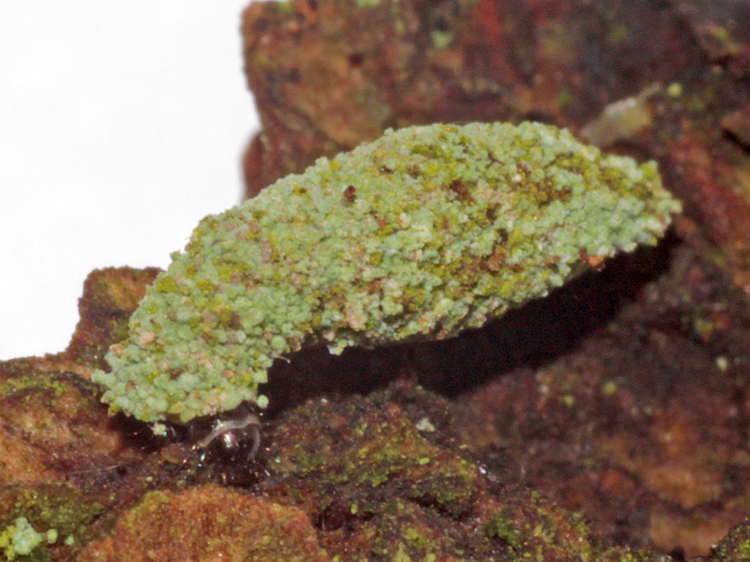
A while ago I posted about an algae-covered larva I found at Bittering on 13th April.  I'd initially identified it as either Virgin Bagworm Luffia ferchaultella or White-speckled Bagworm Narycia duplicella, both of which have similar algae-covered larvae.  For reasons that I can no longer recall or fathom, I eventually plumped for the former and recorded it as Luffia ferchaultella.

It soon ate all the algae on the bit of bark I collected it on, so I returned to gather some more and put it in the pot with it.  After a few days it stopped munching and remained still - I wasn't sure if it had died or pupated, but kept it sitting on my desk and checked it daily.  On 19th May I looked again and noticed a change - protruding from the tip of the case were what looked like clear wings.  There was no sign of life though and I wondered if it had died on emergence - I hadn't at that point noticed any live insect in the pot.  I checked a bit harder and was pleased to see a moth sitting still on the bark.  Now Luffia ferchaultella is a parthenogenetic species and only wingless females are known.  This insect had wings, so it wasn't ferchaultella after all - it was Narcycia duplicella.  Anyway a first for me, not only a new species but the first time I've ever successfully reared a moth from a larva.


White-speckled Bagworm Narycia duplicella larva, Bittering, 13th April


White-speckled Bagworm Narycia duplicella reared from the above larva, 19th May

Friday, 10 June 2016

Tens of thousands of moths

On Saturday morning I was up at Titchwell birding and swimming in Diamond-back Moths Plutella xylostella.  OK, perhaps that's an exaggeration, but there really were a lot of them.  They were everywhere, but some places were thick with them - you could see maybe 50-100 in some small patches of vegetation with more appearing if the vegetation was disturbed.  I put down 1000 in my records but that really was a very conservative estimate - just of the moths I'd seen.  I couldn't possibly guess how many were actually there.  Tens of thousands obviously, hundreds of thousands probably, millions mabye?  I wouldn't be surprised.

Not much else of lepidopteran note - a Common Nettle-tap Anthophila fabriciana and 2 Common Marbles Celypha lacunana were the only other moths I saw in the misty murk.  A Scorpion Fly proved to be Panorpa germanica (gen det).

Next I headed to Dersingham Bog.  I thought there might be fewer moths here with it being further inland, or at least further from a north/east facing coast.  But there were loads of Diamond-back Moths Plutella xylostella here too.  The heath itself was quite windswept and there weren't many here (although still kicking up a few every few steps) but in the shelter of the woodland above the heath there were hundreds.  I didn't spend long here and didn't cover that much ground, but even so I must have easily seen 500.

I managed a few other moths too: 2 Green Long-horns Adela reaumurella, Brassy Tortrix Eulia ministrana, Common Grey Scoparia ambigualis and 3 Common Heaths.


Common Heaths, Dersingham Bog, 4th June


A leafhopper turned out to be Chamaepsylla hartigii, a first for me.  A wildflower tick for me here too, which I might not have noticed if it wasn't for the display board telling me about it.  Cranberry.  The flowers aren't exactly tiny and they're bright pink, yet they were strangely hard to see even when looking down on them.  I must have walked past them before, here at least if not elsewhere.

I wish I'd spent longer trying to get a decent photo of an amazing insect that I found on a log pile close to where I parked.  Turned out none of my photos of it were in focus, which is a bit disappointing.  It was obviously an Ichneumon wasp, but what an Ichneumon!  It was a monster!  An absolute beast!  Off the top of my head I can't think of another insect I have ever seen anywhere in the world as long as this.  The body was probably well over an inch long, the antennae about as long on top and then the ovipositor!  Wow!  I believe it's something called Ephialtes manifestator.

Ephialtes manifestator, Dersingham Bog, 4th June


But good as this was, top trump goes to a hoverfly.  A large and very distinctive hoverfly that I was pretty sure I hadn't ever seen before.  Turns out it was Sericomyia lappona, a species with a relatively restricted range in Norfolk.  Looks like it occurs only in west and north-west Norfolk, and given its preference of boggy habitat I would hazard a guess that Dersingham Bog might be the best place to see it in this county.


Sericomyia lappona, Dersingham Bog, 4th June


To the untrained eye this Hoverfly looks even more distinctive, but alas there are 2-3 similar species and the quality of my photos is not high enough for me to be 100% certain of its ID.  Probably Helophilus pendulus.  Not a greatly significant record even if the ID was clinched (either way).

Helophilus sp., probably Helophilus pendulus, Dersingham Bog, 4th June


My next stop was a little further inland, a footpath close to the Babingley River just south of West Newton.  I've been meaning to explore this path for ages.  The path starts running down the edge of a crop field on one side and on the other, a strip of low vegetation, a dyke and then a hedgerow.  It goes on like this for maybe a third of a mile before crossing a sheepfield and then running alongside the river itself.  I only got as far as the sheepfield.  Being a bit further inland I didn't expect especially huge number of Diamond-backs, although with the numbers I'd seen elsewhere I knew it would hold a good few.  Well, it was spectacular.  I have never seen anything like it.  As soon as I opened my car door a cloud of Diamond-back Moths got up beside me.  But this was only the start - they continued all the way down the path.  Counting them was impossible but I was keen to document how many there were so set about to estiamte numbers as accurately (but conservatively) as possible.  To give you an idea, a single stinging-nettle held about 20 - and that was just the ones I could see without disturbing it.  There were a lot of stinging nettles, and a lot of other plants with moths on.  In just one small section in front of me I could see hundreds, and that went on for pretty much the whole footpath.  A very conservative estimate for just this small stretch of footpath was 10-15,000 Diamond-back Moths.

With so many moths present it was hard to pick out any that were different, but I did manage a few.  Best was a new moth for me, and a very attractive one too - White-barred Gold Micropterix aruncella.  They're not hugely rare (indeed my second followed a couple of days later) but a first is always exciting, especially when they're so stunning.

White-barred Gold Micropterix aruncella, Babingley River near West Newton, 4th June


I also found 5 Cocksfoot Moths Glyphipterix simpliciella, a Common Marble Celypha lacunana and a Drinker caterpillar, but an interesting-looking small Plume moth sadly evaded my net.  Bugs included a number of Hairy Shieldbugs and the striking Cercopis vulnerata.

Hairy Shieldbugs, Babingley River near West Newton, 4th June


Cercopis vulnerata, Babingley River near West Newton, 4th June


Dragonflies included at least 20 Azure Damselflies and about 3 Blue-tailed Damselflies.

Azure Damselfly, Babingley River near West Newton, 4th June


Next stop was Roydon Common where I was to join the Norfolk Moth Survey for an evening's trapping.  I got there early - a lot early - with Dave so as to give ourselves plenty of time to look for day-flying moths before the trapping started.  A good time was had, with thousands more Diamond-back Moths, but I'll save the details for my next post...