Description


A diary of my mothing activity covering highlights and photos from my moth trapping activities. Mainly Norfolk (UK), occasionally beyond. I may mention other wildlife sightings here, especially insects, but for birds see my birding diary.
Showing posts with label Cantharis rustica. Show all posts

Friday, 8 June 2018

Another kuhlweiniella

I found 30 moths of 13 species in a wander round the meadows on Monday 28th May.  Among the better ones was another Corn Moth Nemapogon granella, the first time I've recorded one outside.  Also for comparison a Cork Moth Nemapogon cloacella.

Corn Moth Nemapogon granella, North Elmham Cathedral Meadows, 28th May


Cork Moth Nemapogon cloacella, North Elmham Cathedral Meadows, 28th May


Perhaps even better was a Scarce Oak Midget Phyllonorycter kuhlweiniella.  I've only ever seen these on or around oak trees before so it was a great surprise to net this from the middle of one of the larger fields, at least 200m from the nearest Oak.

Scarce Oak Midget Phyllonorycter kuhlweiniella, North Elmham Cathedral Meadows, 28th May


The other moths were Carrion Moth Monopis weaverella, Daisy Bent-wing Bucculatrix nigricomella, 2 Diamond-backs Plutella xylostella, Common Yellow Conch Agapeta hamana, 4 Common Marbles Celypha lacunana, Rush Marble Bactra lancealana, Sharp-winged Drill Dichrorampha acuminatana, 8 Hook-streak Grass-veneers Crambus lathoniellus, Green Carpet and 7 Straw Dots.

Daisy Bent-wing Bucculatrix nigricomella, North Elmham Cathedral Meadows, 28th May


Common Yellow Conch Agapeta hamana, North Elmham Cathedral Meadows, 28th May


Sharp-winged Drill Dichrorampha acuminatana, North Elmham Cathedral Meadows, 28th May


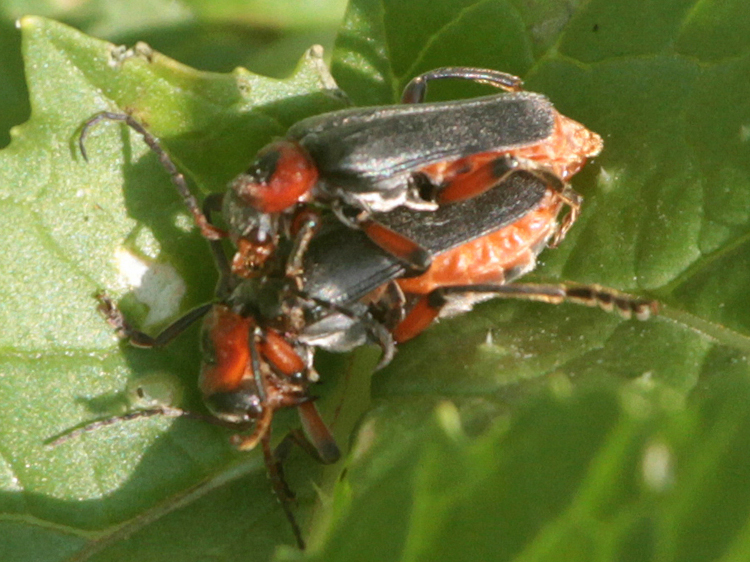
Other insects included my first bush-cricket for the site, a nymph Dark Bush-cricket, two species of Scorpion Fly (Panorpa germanica and Panorpa communis), a Green Drake (mayfly) Ephemera danica, a Dock Bug and a copulating pair of Parent Bugs, the soldier beetles Cantharis livida and Cantharis rustica (the livida appears to be a new one for me, though I think I've tentatively identified them from photos before), a 7-spot Ladybird and a more straightforwardly-identified (compared to the last one) Tenthredo arcuata (sawfly).

Dark Bush-cricket nymph, North Elmham Cathedral Meadows, 28th May


Parent Bugs, North Elmham Cathedral Meadows, 28th May


Cantharis livida, North Elmham Cathedral Meadows, 28th May


Cantharis rustica, North Elmham Cathedral Meadows, 28th May


7-spot Ladybird, North Elmham Cathedral Meadows, 28th May


Tenthredo arcuata, North Elmham Cathedral Meadows, 28th May

I think this leaf-mine on Broad-leaved Dock may belong to the fly Pegomya bicolor, but I'm not sure if other species can be eliminated or not (let me know if you think it can be recorded confidently).

probable Pegomya bicolor leafmine, North Elmham Cathedral Meadows, 28th May


I kept seeing this apparent fungal growth on Cocksfoot grass and was reminded of a photo I'd seen someone post on Twitter just before I came out.  I looked at my Twitter feed to see if anyone had replied to identify it and top of my feed, having tweeted literally seconds before I looked, was a reply from James Emerson confirming that it was a fungus called Choke.  Apparently there may be several species according to the species it grows on, and this one would therefore be Epichloe typhina.  Not a very good example in this photo - others were thicker and more obvious (but evidently harder to photograph!).

Epichlioe typhina, North Elmham Cathedral Meadows, 28th May

Monday, 8 June 2015

A day at Burnham Overy

I spent much of Friday birding Burnham Overy but as always kept an eye out for moths and other insects, especially when more of them become active towards dusk.

There has been a noticeable immigration of Painted Ladies - hard to know how many but I reckon I saw at least 25-30.  Other butterflies included Wall Brown, Holly Blue and my first Red Admiral of the year.

Painted Lady, Burnham Overy, 5th June


Holly Blue, Burnham Overy, 5th June


I suspect this Azure Damselfly in the dunes had been blown there from inland rather than being an immigrant.

Azure Damselfly, Burnham Overy, 5th June


The dusking for moths wasn't as successful as I'd hoped, largely due to the wind.  A couple of things got away and I recorded Bordered Carl Coptotriche marginea, 2 Hook-streaked Grass-Veneers Crambus lathoniellus and Yellow Shell. This next moth really had me stumped though.  A small greyish-brown Tortrix with big pale spots... what on earth was it?


At an impasse I started to question whether it reall was a Tortrix, after all it was quite small.  I checked various options from other families and wondered for a while if it might be a very worn example of a larger Incurvaria species, or even Lampronia.  Some of them shared some of the pale spots, most prominent on the dorsum and along the costa, though most lacked the pale spot in the middle of the wing.  Eventually I found a picture of Lampronia splendidella that seemed to show a similar pattern - but that's not a British species (though not from very far east of Britain, so perhaps not completely inconceivable).  Under the microscope it didn't seem to have much of a tongue which I think is good for these families but I wasn't convinced by the antennae which were simple, lacking any hint of pectinations.  Then after it had expired it stuck its tongue out - it did have a long proboscis after all, so I was back with the Tortricidae.  Only then did I notice through the microscope that it had just a very few yellow and orangey coloured scales on its wings.  Not many, but enough to make me think that when fresh this would perhaps have been a yellow and orange species.  And then at last the penny dropped - it was just another Downland Conch Aethes tesserana.  Compare this picture from Lepiforum with mine below:

Downland Conch Aethes tesserana, Burnham Overy, 5th June


Beetle action included a few Catharis rustica...

Catharis rustica, Burnham Overy, 5th June


This fly is quite distinctive and quite attractive as flies go - Coastal Silver-stiletto apparently, although the abdomen wasn't quite as stiletto-shaped as it is in most pics...

Coastal Silver-stiletto, Burnham Overy, 5th June


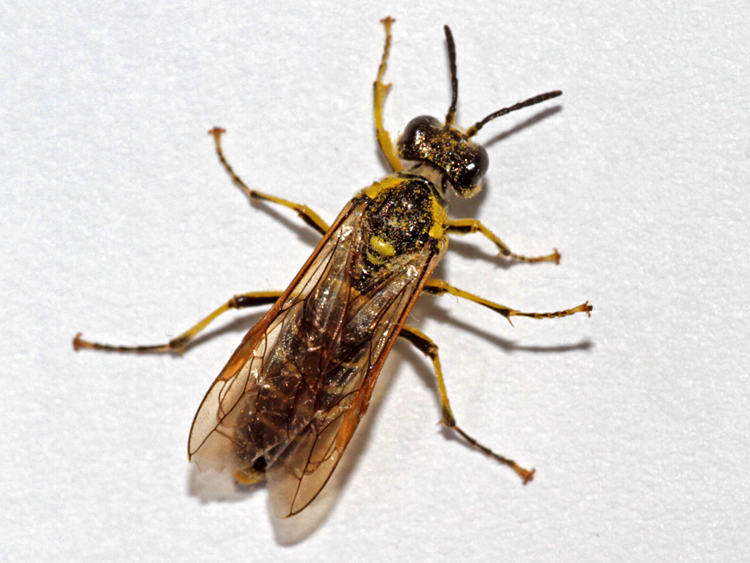
There were loads of these Turnip Sawflies on the Alexanders - don't recall seeing this species before.


Turnip Sawfly, Burnham Overy, 5th June


Here's another beetle I can't identify - let me know if you recognise it.

unidentified Beetle, Burnham Overy, 5th June


Some nice plants here too, like these.

Houndstongue, Burnham Overy, 5th June


Yellow Horned-poppy, Burnham Overy, 5th June


Not all the plants were doing so well... these Spindle trees were covered in green leaves last visit with just a few small tents of Spindle Ermine Yponomeuta cagnagella larvae visible.  Now they are completely stripped.


Spindle trees stripped by Spindle Ermine Yponomeuta cagnagella caterpillars, Burnham Overy, 5th June