Description


A diary of my mothing activity covering highlights and photos from my moth trapping activities. Mainly Norfolk (UK), occasionally beyond. I may mention other wildlife sightings here, especially insects, but for birds see my birding diary.
Showing posts with label Sprawler. Show all posts

Thursday, 8 April 2021

Review of 2019 and 2020 - Moths: Noctuids (Noctuidae) part 3: Copper Underwings, Sprawler, Marbled Beauty and their allies

NOCTUIDS (NOCTUIDAE) (continued)


Copper Underwing Amphipyra pyramidea - Totals of 11 trapped in the garden between 1st August and 22nd September 2019 and 16 between 26th July and 19th September 2020.  I average about 10 a year here and 16 equalled my best total.  Elsewhere 4 at the meadows, 3 at Whitwell Street and 3 in Cornwall.

Copper Underwing, North Elmham Cathedral Meadows, 22nd August 2019


male Copper Underwing, North Elmham, 7th August 2020


male Copper Underwing, North Elmham, 8th August 2020


Svensson's Copper Underwing Amphipyra berbera - One in the garden on 25th July 2019 and 4 between  15th August and 7th September 2020.  I'd only caught 6 here previously and never more than 3 in a year.  Also one next door on 7th August 2019.

Svensson's Copper Underwing, North Elmham, 25th July 2019


male Svensson's Copper Underwing, North Elmham, 15th August 2020


male Svensson's Copper Underwing, North Elmham, 23rd August 2020


male Svensson's Copper Underwing, North Elmham, 7th September 2020


Mouse Moth Amphipyra tragopoginis - Totals of 7 caught here between 24th July and 10th September 2019 and 5 between 14th August and 16th September 2020.  This species is remarkably consistent here, with between 5 and 7 every year since 2014.  Elsewhere one at the meadows and one at Bintree Wood.

Mouse Moth, North Elmham Cathedral Meadows, 4th August 2019


Sprawler Asteroscopus sphinx - Totals of 30 trapped in the garden between 20th October and 20th November 2019 and 34 between 16th October and 23rd November 2020, slightly below the average of 36.

Sprawler, North Elmham, 20th October 2019


Sprawler, North Elmham, 6th November 2020


Green-brindled Crescent Allophyes oxyacanthae - Totals of 17 caught in the garden between 24th September and 2nd November 2019 and 38 between 10th and 30th October 2020.  I avereage 43 a year - 2019 was my worst year so far.

Green-brindled Crescent, North Elmham, 1st October 2019
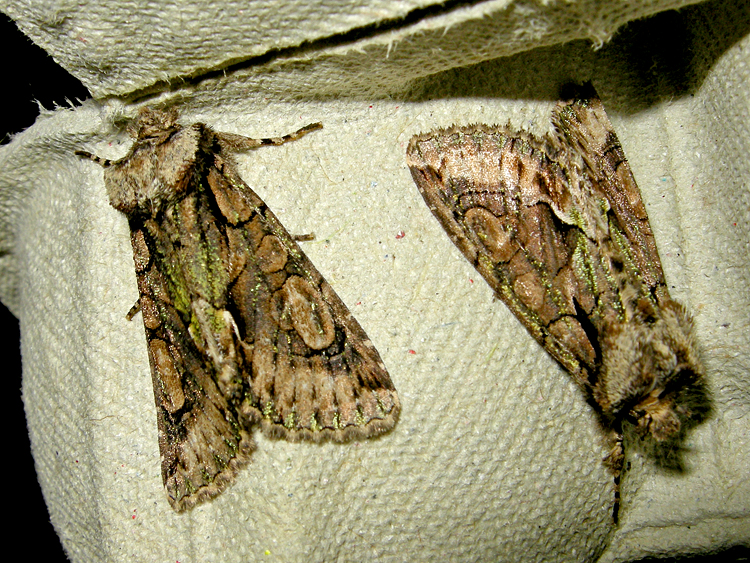

Green-brindled Crescents, North Elmham, 10th October 2020


Green-brindled Crescent, North Elmham, 20th October 2020


Early Grey Xylocampa areola - Totals of 9 caught in the garden between 15th March and 9th May and 16 between 13th March and 26th April 2020.  I've averaged 27 a year here and 2019's total was my worst yet.

Early Grey, North Elmham, 15th March 2019


Early Grey, North Elmham, 13th March 2020


Bordered Sallow Pyrrhia umbra - None.  I'm still waiting for my first example of this species.  Although most records are from the coast and it hasn't been recorded in this 10km square yet I think I've got a realistic chance of catching one someday as there have been a few records elsewhere in mid Norfolk.


Marbled Clover Heliothis viriplaca - None.  Although a red data book species this is widespread in Norfolk and has been recorded just down the road at Worthing, including one in 2020.  I await my first but feel like I missed a good chance in 2020 when there were much larger numbers than usual recorded around the county.


Bordered Straw Heliothis peltigera - None.  Most years this migrant species is very hard to come by but in good years there's a chance I might catch one locally, though I didn't manage in the last good year, 2015.  Indeed I've never found this species in the UK.


Scarce Bordered Straw Heliothis peltigera - None.  Despite the name this species is considerably less scarce than the previous species in Norfolk.  I've recorded it once in my garden, during the 2017 influx.


Tree-lichen Beauty Crypgia algae - This new colonist has only recently colonised Norfolk and records have sky-rocketed in 2018 and 2019.  I caught my first at the meadows on 4th August 2019 followed by another in next door's garden on 8th August, but despite coming so close, I had to wait another year before catching one in my own garden - one on 15th August, the only one I caught in 2020.

Tree-lichen Beauty, North Elmham Cathedral Meadows, 4th August 2019


Tree-lichen Beauty, North Elmham, 8th August 2019


Tree-lichen Beauty, North Elmham, 15th August 2020


Marbled Beauty Crypgia algae - 3 in the garden trap between 20th and 29th July 2019 and 4 between 23rd July and 8th August 2020 - 3 a year is average here.  I only ever saw 2 of these when I lived in Bawdeswell but prior to that when I lived in Norwich I recorded up to 10 in a night - and that was before I was really into moths and had no special equipment: I just tried to identify what came in to my bedroom through the open window when the light was on.  Elsewhere one at the meadows on 26th July 2019, which is the first I've ever caught away from somewhere I live.

Marbled Beauty, North Elmham Cathedral Meadows, 26th July 2019


Marbled Green Nyctobrya muralis - None.  I've never caught this species but there have been a few recent records at widespread localities and though none have been particularly close to here they don't seem to be specific to any special habitat, so must be a fair chance of getting one here.


Next page: more Noctuidae

Sunday, 28 April 2019

Sprawling Sprawlers and the last of the Turnips

The best moth of the night of 25th October was a Grey Shoulder-knot, my first autumn example since 2014.  The Shoulder-knot I expect to see in October is Blair's Shoulder-knot but in 2018 I didn't catch a single one.

Grey Shoulder-knot, North Elmham, 25th October


Other things were 6 Narrow-winged Greys Eudonia angustea, Common Plume Emmelina monodactyla, 2 November Moths, 3 Pale November Moths, Feathered Thorn, 2 Sprawlers, 2 Green-brindled Crescents, Yellow-line Quaker and the caddisfly Mottled Sedge Glyphotaelius pellucidus.

There were only 3 moths the following night: 2 Narrow-winged Greys Eudonia angustea and Yellow-line Quaker.  The following day was very windy and that night there were just 2 Pale November Moths, and then on 28th Narrow-winged Grey Eudonia angustea and Pale November Moth.

On 29th there was a Merveille du Jour and 2 Yellow-line Quakers and the low numbers continued with Narrow-winged Grey Eudonia angustea, Feathered Thorn and the caddisfly Brown Sedge Anabolia nervosa on 30th.

There was a bit more on 31st including an unprecedented count of 10 Pale November Moths.  Others were 2 November Moths, a female November Moth agg., Feathered Thorn, Mottled Umber, White-point, 2 Sprawlers, Satellite, Yellow-line Quaker, the caddisflies Limnephilus lunatus and Limnephilus vittatus and the mirid bug Pinalitus cervinus.

The following night there were November Moth, 3 Pale November Moths, Feathered Thorn, Sprawler, 2 Green-brindled Crescents, Brick, the green lacewing Chrysoperla carnea and the mirid bug Pinalitus cervinus.

A wander round the Cathedral Meadows on 2nd November turned up a few bits and pieces.  The White Willow still held at least one Willow Flea Beetle Crepidodera aurata and also had the leafhopper Lindbergina aurovittata.

Lindbergiana aurovittata, North Elmham Cathedral Meadows, 2nd November


A quick sweep of the Broom produced 3 Broom Psyllids Arytaina genistae, the barklouse Ectopsocus petersi and a new weevil for me, Pirapion immune. Apparently the latter is more commonly recorded on Gorse - well, there is a little bit of gorse amongst the Broom, and a fair bit more only a little distance away.

Pirapion immune, North Elmham Cathedral Meadows, 2nd November


Ectopsocus petersi, North Elmham Cathedral Meadows, 2nd November


Found a few occupied leafmines in fallen Oak leaves along the railway including 3 Five-spot Pigmies Ectoedemia quinquella (in one leaf) and White-banded Pigmy Ectoedemia albifasciella.


occupied leadfmines of Five-spot Pigmies Ectoedemia quinquella, North Elmham Cathedral Meadows, 2nd November


occupied leadfmine of White-banded Pigmy Ectoedemia albifasciella, North Elmham Cathedral Meadows, 2nd November


I found these galls on Goat/Grey Willow leaves but can't quite make up my mind if they are made by the fly Iteomyia capreaea or the mite Aculus laevis.  I didn't have the gall book at the time and I didn't retain the leaf for checking more detail.  Hopefully I'll find them again this year.


unidentified galls, apparently either Iteomyia capreae or Aculus laevis, North Elmham Cathedral Meadows, 2nd November


That night there were 2 Sprawlers and a Yellow-line Quaker in the garden moth trap.

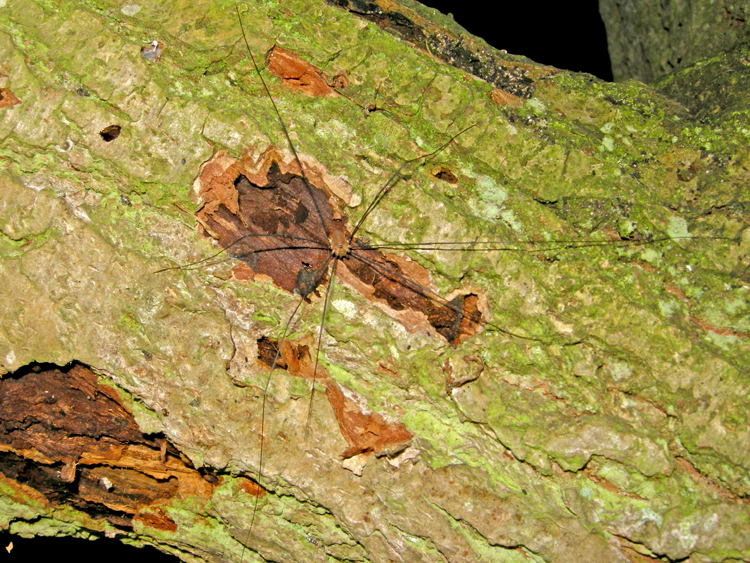
I think this harvestman that I photographed in the house must be Leiobunum blackwalli, the first I've identified.


Leiobunum blackwalli, North Elmham, 3rd November


A few more moths in the trap that night, but not much variety: 3 Feathered Thorns, 7 Sprawlers and a Chestnut.

The following night the moth trap produced my first new moths for the year for over 2 weeks, 2 December Moths.

December Moths, North Elmham, 4th November


It wasn't a bad catch by November standards with 4 Narrow-winged Greys Eudonia angustea, Mallow, 2 November Moths, 3 Pale November Moths, 9 Feathered Thorns, Mottled Umber, Turnip Moth, 15 Sprawlers, 2 Green-brindled Crescents, Chestnut, Brick and Yellow-line Quaker.

Sprawler, North Elmham, 4th November


An early morning walk round the meadows didn't produce much on 5th - a 7-spot Ladybird being the only non-avian thing I noted.  But I went back after dark with the headtorch and found a few bits and pieces. I could hear what I suspected was a Dark Bush-cricket as I walked down the track and whereas previous attempts to find calling bush-crickets had not fared well this one did eventually give itself up.  It was indeed a Dark Bush-cricket.


Dark Bush-cricket, North Elmham Cathedral Meadows, 5th November


It was a little too cold for most insects but I did find a couple of Feathered Thorns and the ground beetle Harpalus affinis.  I also noted Walnut Orb Weaver Nuctenea umbratica, Common Shiny Woodlouse Oniscus asellus and White-legged Snake Millipede Tachypodoiulus niger.

Feathered Thorn, North Elmham Cathedral Meadows, 5th November


Harpalus affinis, North Elmham Cathedral Meadows, 5th November


That night the garden moth trap produced 15 Sprawlers again...

15 Sprawlers, North Elmham, 5th November


It was a good year for Turnip Moths.  I never do very well for this species compared to many other moth trappers.  My previous best year here was a total of 13 individuals in 2015, with just 4 in 2016 and only one or two in 2017.  On 5th November I recorded my last of 2018 - my 51st individual, so about 4 times more than my previous best.

Turnip Moth, North Elmham, 5th November


Other things that night included Garden Midget Phyllonorycter messaniella, London Dowd Blastobasis lacticolella, 5 Narrow-winged Greys Eudonia angustea, Common Plume Emmelina monodactyla, 3 Pale November Moths, 4 other November Moth aggs. (3 unidentifiable females and a male that seemed intermediate but I felt was most likely an extreme Pale), 6 Feathered Thorns, 2 Shuttle-shaped Darts, White-point, Green-brindled Crescent, Yellow-line Quaker, 2 of the green lacewing Chrysoperla carnea and 2 of the caddisfly Limnephilus lunatus.

There were 15 Sprawlers for the third consecutive night on 6th - I don't think they were the same moths both nights, at least there was certainly a fair bit of change-over with the other insects.  Other moths were Narrow-winged Grey Eudonia angustea, December Moth, November Moth, 4 Pale November Moths, 7 Feathered Thorns, Mottled Umber, Shuttle-shaped Dart, 2 White-points, Green-brindled Crescent, Chestnut and Yellow-line Quaker. Non-moths included 2-3 of the green lacewings Chrysoperla carnea, the caddisflies Limnephilus affinis and 3 Limnephilus lunatus, the bugs Lygus pratensis and Pinalitus cervinus, an Edwardsiana leafhopper sp. and the barkfly Ectopsocus briggsi.

A Dark Chestnut the following night was my first of the year, belatedly perhaps.

Dark Chestnut, North Elmham, 7th November


Apart from the Orchard Ermine Yponomeuta padella complex, which cannot be identified on external features or genitalia, and apart from female Epirrita spp., it's pretty unusual nowadays for me to catch a moth that I cannot identify one way or another.  But here's one I'm not entirely sure about.  Once I would have seen the strongly pale-edged median band and the dark lines delineating some of the cells within the median band and called it a Spruce Carpet, but it's not as easy as that.  Apparently Grey Pine Carpet can be as grey and contrasty as this, and as it doesn't have much of a postmedian line I think that has to remain in the frame.  I kept hold of it, hoping it would be a male so I could check its antennae (males of the two species have different-shaped segments of the antennae) but alas it's a female.  I suspect some people would call this one way or the other, and if you know what you're talking about and are convinced it is identifiable then please let me know, but for now I shall leave it unidentified.

Spruce or Grey Pine Carpet (female), North Elmham, 7th November


Other moths were Diamond-back Plutella xylostella, 3 Narrow-winged Greys Eudonia angustea, Pale November Moth, 6 Sprawlers, 2 Bricks and 2 Yellow-line Quakers. There was also a green Llacewing Chrysoperla carnea agg., 5 of the caddisfly Limnephilus lunatus and the barkfly Graphopsocus cruciatus in the trap and a Common Heart-shield beetle Nebria brevicollis on the ground.

Graphopsocus cruciatus, North Elmham, 7th November


Common Heart-shield Nebria brevicollis, North Elmham, 7th November

Monday, 22 April 2019

Phyllonorycter trifasciella and other mid October moths

An evening stroll round the meadows on 17th October was worthwhile.  I caught a couple of Garden Midgets Phyllonorycter messaniella at dusk but it got more productive after dark.  One of the better moths was another Phyllonorycter, found resting on a leaf by torchlight - a Honeysuckle Midget Phyllonorycter trifasciella.  This is a species I don't encounter very often.

Garden Midget Phyllonorycter messaniella, North Elmham Cathedral Meadows, 17th October


Honeysuckle Midget Phyllonorycter trifasciella, North Elmham Cathedral Meadows, 17th October


Other moths were 3 Long-horned Flat-bodies Carcina quercana, Common Flat-body Agonopterix heracliana, London Dowd Blastobasis lacticolella, 3 Common Plumes Emmelina monodactyla, 2 November Moths, 2 Green-brindled Crescents and Yellow-line Quaker.

Long-borned Flat-body Carcina quercana, North Elmham Cathedral Meadows, 17th October


Green-brindled Crescent, North Elmham Cathedral Meadows, 17th October


There were two of the darker flower bugs on Oak trunks but as I subsequently identified both confusus and nemoralis along here it isn't safe to name these without a specimen.  An easier bug to identify was Pinalitus cervinus.

Pinalitus cervinus, North Elmham Cathedral Meadows, 17th October


A new beetle for me was the rove beetle Ocypus brunnipes.  Also a 7-spot Ladybird.

Ocypus brunnipes, North Elmham Cathedral Meadows, 17th October


Finally I photographed this harvestman in the hope of working out its ID.  I think I have - Leiobunum rotundum.


Leiobunum rotundum, North Elmham Cathedral Meadows, 17th October


Not a great deal in the moth trap at home that night: 3 Narrow-winged Greys Eudonia angustea, 2 November Moths, 2 Feathered Thorns, Shuttle-shaped Dart, 2 Large Yellow Underwings, 3 Green-brindled Crescents, Red-line Quaker, Yellow-line Quaker, Beaded Chestnut and Lunar Underwing.

The following night was very poor with Narrow-winged Grey Eudonia angustea, November Moth, Green-brindled Crescent, Chestnut and the caddisfly Halesus radiatus. The 19th was even worse with just November Moth, 2 Green-brindled Crescents and Beaded Chestnut.

A fungus foray at Beeston Common on 20th October was extremely interesting, the first I've ever been on.  A Brown Rat was above head height in the hedge by the entrance to the common - I don't ever recall seeing one so high up before.  We also saw an Adder, but of course these delights weren't what we were there for.  Expertly led by Tony Leech I learnt an enormous amout about fungi.  I took a lot of photos but quickly and badly, so they really aren't worth sharing here.  I did it mainly with the intention of helping me learn what I was seeing, recording the names as I did so.

A couple I think are worth mentioning were the Gorse Cramp Ball Daldinia fissa, a species that only occurs on gorse that has been burnt. and the Ergot Claviceps purpurea, which was once a very problematic contaminant of rye used in bread-making.

Gorse Cramp Ball Daldinia fissa, Beeston Common, 20th October


Ergot Claviceps purpurea, Beeston Common, 20th October


I am very grateful to Tony and the others who helped find and identify fungi - a very educational event that will not be my last fungus foray.

Afterwards I went to Beeston Priory for a drink with the Mrs.  There was Common Darter here, and this thing.  It's quite aphid-like but lacks obvious siphuncular cones shown by most aphids.  I think some lack them though, so maybe an aphid, or perhaps a nymph of a bug of some sort.


unidentified bug, Beeston Priory, 20th October


A small selection of moths in the garden trap that night included the first Mottled Umber of the autumn, and Garden Rose Tortrix Acleris variegana, 8 Narrow-winged Greys Eudonia angustea, 5 November Moths, 7 Feathered Thorns, Sprawler, 3 Green-brindled Crescents, 2 Bricks and Snout.   There were also the caddisflies Limnephilus lunatus and 2 Halesus radiatus, and the beetle Lagria hirta.


Mottled Umber, North Elmham, 20th October


Sprawler, North Elmham, 20th October


Brick, North Elmham, 20th October


There was a bigger and better selection of moths the following night: London Dowd Blastobasis lacticolella, 2 Privet Tortrixes Clepsis consimilana, 2 Light Brown Apple-moths Epiphyas postvittana, Rhomboid Tortrix Acleris rhombana, 9 Narrow-winged Greys Eudonia angustea, Spruce Carpet, 13 November Moths, 3 Pale November Moths (and 1 other Epirrita sp.), 4 Feathered Thorns, White-point, Sprawler, 3 Green-brindled Crescents, 2 Bricks, Red-line Quaker, 5 Yellow-line Quakers and Vine's Rustic.  Caddisflies were Brown Sedge Anabolia nervosa, 3 Limnephilus auricula and Limnephilus lunatus.  There was also one bug, Pinalitus cervinus and the barkfly Ectopsocus briggsi.

Ectopsocus briggsi (male), North Elmham, 21st October


There was much less again the following night with Narrow-winged Grey Eudonia angustea, Pale November Moth, Feathered Thorn, Red-line Quaker and 4 Yellow-line Quakers.

The following night's selection was 2 Garden Midgets Phyllonorycter messaniella, 7 Narrow-winged Greys Eudonia angustea, November Moth, 4 Pale November Moths, 2 Feathered Thorns, Turnip Moth, 2 Sprawlers, 6 Green-brindled Crescents, Red-line Quaker and 2 Yellow-line Quakers. Caddisflies were Limnephilus auricula, 3 Limnephilus lunatus and Halesus radiatus, and there was a Tarnished Plant Bug Lygus rugulipennis.

Next day a Hornet was the only insect noted at the Cathedral Meadows.  Fungi included this Jelly Ear.

Jelly Ear, North Elmham Cathedral Meadows, 24th October


That night the garden moth trap produced Garden Midget Phyllonorycter messaniella, Light Brown Apple-moth Epiphyas postvittana, 5 Narrow-winged Greys Eudonia angustea, Double-striped Tabby Hypsopygia glaucinalis, 3 Pale November Moths, 4 Feathered Thorns, 2 Sprawlers, Red-line Quaker, Yellow-line Quaker and the caddisfly Halesus radiatus.