
Description


A diary of my mothing activity covering highlights and photos from my moth trapping activities. Mainly Norfolk (UK), occasionally beyond. I may mention other wildlife sightings here, especially insects, but for birds see my birding diary.
Showing posts with label Turnip Moth. Show all posts

Thursday, 8 April 2021

Review of 2019 and 2020 - Moths: Noctuids (Noctuidae) part 13: Darts to True Lover's Knot

NOCTUIDS (NOCTUIDAE) (continued)


Pearly Underwing Peridroma saucia - None.  I've caught this migrant species here twice, in 2014 and 2015.


White-line Dart Euxoa tritici - One at Weybourne on 5th July 2019; none in 2020.  This species is relatively scarce inland and I've only caught one candidate here.  That individual appeared to be a clear-cut White-line Dart based on all exterior criteria but the genitalia were a clear match for (female) Garden Dart.  It is said that there may be 2-3 species currently lumped together as White-line Dart - I wonder if that may explain the confusion with that example?

White-line Dart, Weybourne, 5th July 2019


Garden Dart Euxoa nigricans - None.  I have never seen a convincing example of this species but I must stand a fair chance of catching one round here sometime.


Heart and Dart Agrotis exclamationis - 2019 was my best year for this species despite being away for a week during the middle of their peak flight period, with a total of 230 between 22nd May and 26th July, including my highest day-count (or rather night-count) of 17 on 7th June.  By contrast 2020 was one of my poorer years with 70 here between 19th May and 26th June.  My average annual total is 120.  Elsewhere 11 at the meadows, one at Bintree Wood, 6 in Hellesdon, 2 at Weybourne, one in Keswick and 6 at Carsaig (Mull).

Heart and Dart, North Elmham Cathedral Meadows, 23rd June 2019


female Heart and Dart, North Elmham, 26th July 2019 - I'd thought this one might be a Heart and Club or possibly Turnip Moth but dissected it to confirm - it was in fact a Heart and Dart


Heart and Dart, North Elmham, 19th May 2020


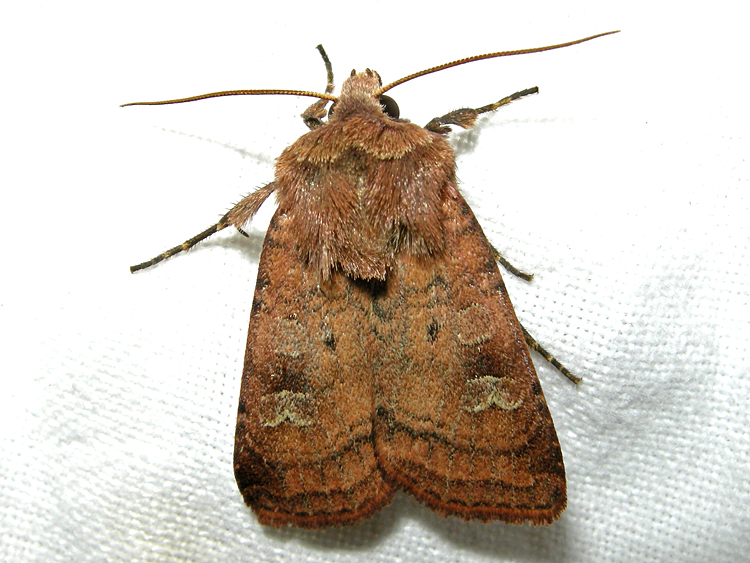
Turnip Moth Agrotis segetum - Really good years for this species - by far my best with at least 139 between 22nd May (my earliest ever) and 2nd November 2019 and 111 between 22nd May and 30th August 2020 (including a record 14 on 5th August).  During 2019's flight period I was away for a week and there were 4 nights when I didn't count them, so the true total would have been a bit higher still.  I'd caught 51 in 2018 but prior to that only 26 between August 2014 and the end of 2017.  Elsewhere recorded next door on 4 nights, 17 at the meadows (over 5 nights), 2 at Row Heath (West Runton) and 2 in Cornwall.  I have often found separating these from Heart and Club to be quite troublesome and have dissected quite a few to check I'm on the right track (including all those shown below) - though I must be gaining more confidence after a couple of good years as I didn't check very many in 2020.

female Turnip Moth, North Elmham, 2nd June 2019


male Turnip Moth, North Elmham, 17th June 2019

male Turnip Moth, North Elmham, 2nd July 2019


male Turnip Moth, North Elmham, 21st July 2019


male Turnip Moth, North Elmham, 27th July 2019


male Turnip Moth, North Elmham, 7th August 2019


Heart and Club Agrotis clavis - Total of 37 in the garden trap between 22nd June and 13th July 2019 and 18 between 10th June and 11th July 2020.  The two years were either side of the average annual tally here of 26, and included a record count of 7 on 30th June 2019.  Elsewhere one at the meadows, one at Bintree Wood and 3 at Weybourne.  The second example shown below was quite unlike any other I recall having seen before though I caught another similar example in 2020 (third one shown below).

female Heart and Club, North Elmham, 27th June 2019


male Heart and Club, North Elmham, 28th June 2019


male Heart and Club, North Elmham, 10th June 2020


Archer's Dart Agrotis vestigialis - None.  I've only ever found this species at the coast but it was apparently recorded twice in 2019 at a site that I think is less than 2 miles away.


Sand Dart Agrotis ripae - None.  One at Brancaster on 2nd July 2020.  This coastal species is rather unlikely to turn up here, though there are a few inland records including one as far inland as I am in 2020.

Sand Dart, Brancaster, 2nd July 2020


Shuttle-shaped Dart Agrotis puta - A total of 40 in the garden between 23rd April and 5th June 2019 and then at least 18 between 23rd July and 27th September (but not counted on 9 dates so likely a few more than that).  Allowing for those few extras this was a pretty average total.  In 2020 just 6 in spring between 8th and 17th May but then 66 between 14th July and 22nd September including a record count of 15 on 31st July.  Elsewhere recorded next door on 3 nights and at the meadows on 5 nights (total 12 moths).

Shuttle-shaped Dart, North Elmham Cathedral Meadows, 22nd April 2019


Shuttle-shaped Darts, North Elmham Cathedral Meadows, 25th May 2019


Shuttle-shaped Dart, North Elmham Cathedral Meadows, 7th August 2020


Dark Sword-grass Agrotis ipsilon - One at the meadows on 23rd June 2020 and one at Brancaster on 2nd July 2020; none in 2019.  I've seen 3 of these migrant moths here in the garden, all in 2017-18.

Dark Sword-grass, North Elmham Cathedral Meadows, 23rd June 2020


Flame Axylia putris - A total of 25 trapped here between 1st June and 25th July 2019, easily my worst total here up to then (had averaged 58 a year from 2015 to 2018), but 3 times better than 2020 when just 8 caught here between 3rd June and 22nd July.  Elsewhere 2 at the meadows, 6 at Weybourne and one at Carsaig (Mull), all in 2019.

Flame, North Elmham Cathedral Meadows, 23rd June 2019


Flame Shoulder Ochropleura plecta - Totals of 45 caught in the garden between 25th May and 3rd September 2019 and 39 between 9th May and 8th September 2020, my worst totals here.  I've not recorded less than 100 before, even in 2014 when I didn't move in until the second week of August.  Elsewhere recorded next door on all 4 nights, 14 at the meadows (10 nights), one at Whitwell Street, one at Sculthorpe Moor on 26th April, 2 at Swanton Great Wood, one at Hills and Holes and 8 on Mull.

Flame Shoulder, North Elmham, 9th May 2020


Radford's Flame Shoulder Ochropleura leucogaster - One came to light at Tresidder in Cornwall on 9th October 2020, the highlight of my week in Cornwall and a new moth for me.  Until recently an extremely rare vagrant to the UK but now this species seems to be turning up quite regularly on the south coast (and with the first in Suffolk in 2019 perhaps we can expect one in Norfolk before too long?).

Radford's Flame Shoulder, Tresidder (Cornwall), 9th October 2020


Purple Clay Diarsia brunnea - A total of 10 trapped at our accommodation at Carsaig on Mull between 9th and 13th June 2019.  One at Bintree Wood on 13th June 2020 was the only one I caught in Norfolk in 2019-20 but previously I have caught 4 in the garden here, all between 2015 and 2017.  Most of the individuals I've caught in Norfolk in previous years were pretty worn but fresh examples like these are really quite magnificent.


Purple Clays, Carsaig (Mull), 9th June 2019


Purple Clay, Bintree Wood, 13th June 2020


Ingrailed Clay Diarsia mendica - Totals of 23 caught in the garden moth trap between 14th May (my earliest ever) and 26th June 2019 and 20 between 26th May and 20th June 2020.   These were my worst showings - I averaged around 35 a year here.  Elsewhere one at Bintree Wood and one at Weybourne on the later date of 5th July 2019.

Ingrailed Clay, North Elmham, 14th May 2019


male Ingrailed Clay, Bintree Wood, 13th June 2020


Small Square-spot Diarsia rubi - Just 2 in the garden here in 2019, on 25th and 27th August, and 8 between 1st June and 16th September 2020 - a long way off the 73 that I caught here in 2015.  Looking at the last 5-6 years in isolation and you might think this species is in real trouble but like so many moths, it's a species that shows a clear pattern of peaks and troughs and we can still be optimistic that it will climb back out of the current downturn.  Elsewhere one at the meadows on 31st May 2019 and one at Swanton Great Wood.
Small Square-spot, North Elmham Cathedral Meadows, 31st May 2019


Small Square-spot, North Elmham, 1st June 2020


Red Chestnut Cerastis rubricosa - 8 in the garden between 23rd March and 24th April 2019 and 4 between 18th and 27th March 2020.  2019 was my joint best year (with 2018, and following a blank year in 2017).  Elsewhere one at the meadows and my earliest ever at Cranwich Heath on 14th March 2020.


Red Chestnut, North Elmham, 23rd March 2019


Red Chestnut, North Elmham, 24th March 2020


True Lover's Knot Lycophotia porphyrea - 5 caught on Mull between 9th and 13th June 2019 (my earliest ever records) and one at Weybourne on 5th July 2019.  None in 2020.  I've never recorded this species locally but it has been found very close to here so maybe I will do one day...

True Lover's Knot, Carsaig (Mull), 9th June 2019


Next page: more Noctuidae

Sunday, 28 April 2019

Sprawling Sprawlers and the last of the Turnips

The best moth of the night of 25th October was a Grey Shoulder-knot, my first autumn example since 2014.  The Shoulder-knot I expect to see in October is Blair's Shoulder-knot but in 2018 I didn't catch a single one.

Grey Shoulder-knot, North Elmham, 25th October


Other things were 6 Narrow-winged Greys Eudonia angustea, Common Plume Emmelina monodactyla, 2 November Moths, 3 Pale November Moths, Feathered Thorn, 2 Sprawlers, 2 Green-brindled Crescents, Yellow-line Quaker and the caddisfly Mottled Sedge Glyphotaelius pellucidus.

There were only 3 moths the following night: 2 Narrow-winged Greys Eudonia angustea and Yellow-line Quaker.  The following day was very windy and that night there were just 2 Pale November Moths, and then on 28th Narrow-winged Grey Eudonia angustea and Pale November Moth.

On 29th there was a Merveille du Jour and 2 Yellow-line Quakers and the low numbers continued with Narrow-winged Grey Eudonia angustea, Feathered Thorn and the caddisfly Brown Sedge Anabolia nervosa on 30th.

There was a bit more on 31st including an unprecedented count of 10 Pale November Moths.  Others were 2 November Moths, a female November Moth agg., Feathered Thorn, Mottled Umber, White-point, 2 Sprawlers, Satellite, Yellow-line Quaker, the caddisflies Limnephilus lunatus and Limnephilus vittatus and the mirid bug Pinalitus cervinus.

The following night there were November Moth, 3 Pale November Moths, Feathered Thorn, Sprawler, 2 Green-brindled Crescents, Brick, the green lacewing Chrysoperla carnea and the mirid bug Pinalitus cervinus.

A wander round the Cathedral Meadows on 2nd November turned up a few bits and pieces.  The White Willow still held at least one Willow Flea Beetle Crepidodera aurata and also had the leafhopper Lindbergina aurovittata.

Lindbergiana aurovittata, North Elmham Cathedral Meadows, 2nd November


A quick sweep of the Broom produced 3 Broom Psyllids Arytaina genistae, the barklouse Ectopsocus petersi and a new weevil for me, Pirapion immune. Apparently the latter is more commonly recorded on Gorse - well, there is a little bit of gorse amongst the Broom, and a fair bit more only a little distance away.

Pirapion immune, North Elmham Cathedral Meadows, 2nd November


Ectopsocus petersi, North Elmham Cathedral Meadows, 2nd November


Found a few occupied leafmines in fallen Oak leaves along the railway including 3 Five-spot Pigmies Ectoedemia quinquella (in one leaf) and White-banded Pigmy Ectoedemia albifasciella.


occupied leadfmines of Five-spot Pigmies Ectoedemia quinquella, North Elmham Cathedral Meadows, 2nd November


occupied leadfmine of White-banded Pigmy Ectoedemia albifasciella, North Elmham Cathedral Meadows, 2nd November


I found these galls on Goat/Grey Willow leaves but can't quite make up my mind if they are made by the fly Iteomyia capreaea or the mite Aculus laevis.  I didn't have the gall book at the time and I didn't retain the leaf for checking more detail.  Hopefully I'll find them again this year.


unidentified galls, apparently either Iteomyia capreae or Aculus laevis, North Elmham Cathedral Meadows, 2nd November


That night there were 2 Sprawlers and a Yellow-line Quaker in the garden moth trap.

I think this harvestman that I photographed in the house must be Leiobunum blackwalli, the first I've identified.


Leiobunum blackwalli, North Elmham, 3rd November


A few more moths in the trap that night, but not much variety: 3 Feathered Thorns, 7 Sprawlers and a Chestnut.

The following night the moth trap produced my first new moths for the year for over 2 weeks, 2 December Moths.

December Moths, North Elmham, 4th November


It wasn't a bad catch by November standards with 4 Narrow-winged Greys Eudonia angustea, Mallow, 2 November Moths, 3 Pale November Moths, 9 Feathered Thorns, Mottled Umber, Turnip Moth, 15 Sprawlers, 2 Green-brindled Crescents, Chestnut, Brick and Yellow-line Quaker.

Sprawler, North Elmham, 4th November


An early morning walk round the meadows didn't produce much on 5th - a 7-spot Ladybird being the only non-avian thing I noted.  But I went back after dark with the headtorch and found a few bits and pieces. I could hear what I suspected was a Dark Bush-cricket as I walked down the track and whereas previous attempts to find calling bush-crickets had not fared well this one did eventually give itself up.  It was indeed a Dark Bush-cricket.


Dark Bush-cricket, North Elmham Cathedral Meadows, 5th November


It was a little too cold for most insects but I did find a couple of Feathered Thorns and the ground beetle Harpalus affinis.  I also noted Walnut Orb Weaver Nuctenea umbratica, Common Shiny Woodlouse Oniscus asellus and White-legged Snake Millipede Tachypodoiulus niger.

Feathered Thorn, North Elmham Cathedral Meadows, 5th November


Harpalus affinis, North Elmham Cathedral Meadows, 5th November


That night the garden moth trap produced 15 Sprawlers again...

15 Sprawlers, North Elmham, 5th November


It was a good year for Turnip Moths.  I never do very well for this species compared to many other moth trappers.  My previous best year here was a total of 13 individuals in 2015, with just 4 in 2016 and only one or two in 2017.  On 5th November I recorded my last of 2018 - my 51st individual, so about 4 times more than my previous best.

Turnip Moth, North Elmham, 5th November


Other things that night included Garden Midget Phyllonorycter messaniella, London Dowd Blastobasis lacticolella, 5 Narrow-winged Greys Eudonia angustea, Common Plume Emmelina monodactyla, 3 Pale November Moths, 4 other November Moth aggs. (3 unidentifiable females and a male that seemed intermediate but I felt was most likely an extreme Pale), 6 Feathered Thorns, 2 Shuttle-shaped Darts, White-point, Green-brindled Crescent, Yellow-line Quaker, 2 of the green lacewing Chrysoperla carnea and 2 of the caddisfly Limnephilus lunatus.

There were 15 Sprawlers for the third consecutive night on 6th - I don't think they were the same moths both nights, at least there was certainly a fair bit of change-over with the other insects.  Other moths were Narrow-winged Grey Eudonia angustea, December Moth, November Moth, 4 Pale November Moths, 7 Feathered Thorns, Mottled Umber, Shuttle-shaped Dart, 2 White-points, Green-brindled Crescent, Chestnut and Yellow-line Quaker. Non-moths included 2-3 of the green lacewings Chrysoperla carnea, the caddisflies Limnephilus affinis and 3 Limnephilus lunatus, the bugs Lygus pratensis and Pinalitus cervinus, an Edwardsiana leafhopper sp. and the barkfly Ectopsocus briggsi.

A Dark Chestnut the following night was my first of the year, belatedly perhaps.

Dark Chestnut, North Elmham, 7th November


Apart from the Orchard Ermine Yponomeuta padella complex, which cannot be identified on external features or genitalia, and apart from female Epirrita spp., it's pretty unusual nowadays for me to catch a moth that I cannot identify one way or another.  But here's one I'm not entirely sure about.  Once I would have seen the strongly pale-edged median band and the dark lines delineating some of the cells within the median band and called it a Spruce Carpet, but it's not as easy as that.  Apparently Grey Pine Carpet can be as grey and contrasty as this, and as it doesn't have much of a postmedian line I think that has to remain in the frame.  I kept hold of it, hoping it would be a male so I could check its antennae (males of the two species have different-shaped segments of the antennae) but alas it's a female.  I suspect some people would call this one way or the other, and if you know what you're talking about and are convinced it is identifiable then please let me know, but for now I shall leave it unidentified.

Spruce or Grey Pine Carpet (female), North Elmham, 7th November


Other moths were Diamond-back Plutella xylostella, 3 Narrow-winged Greys Eudonia angustea, Pale November Moth, 6 Sprawlers, 2 Bricks and 2 Yellow-line Quakers. There was also a green Llacewing Chrysoperla carnea agg., 5 of the caddisfly Limnephilus lunatus and the barkfly Graphopsocus cruciatus in the trap and a Common Heart-shield beetle Nebria brevicollis on the ground.

Graphopsocus cruciatus, North Elmham, 7th November


Common Heart-shield Nebria brevicollis, North Elmham, 7th November