
Description


A diary of my mothing activity covering highlights and photos from my moth trapping activities. Mainly Norfolk (UK), occasionally beyond. I may mention other wildlife sightings here, especially insects, but for birds see my birding diary.
Showing posts with label Sand Dart. Show all posts

Thursday, 8 April 2021

Review of 2019 and 2020 - Moths: Noctuids (Noctuidae) part 13: Darts to True Lover's Knot

NOCTUIDS (NOCTUIDAE) (continued)


Pearly Underwing Peridroma saucia - None.  I've caught this migrant species here twice, in 2014 and 2015.


White-line Dart Euxoa tritici - One at Weybourne on 5th July 2019; none in 2020.  This species is relatively scarce inland and I've only caught one candidate here.  That individual appeared to be a clear-cut White-line Dart based on all exterior criteria but the genitalia were a clear match for (female) Garden Dart.  It is said that there may be 2-3 species currently lumped together as White-line Dart - I wonder if that may explain the confusion with that example?

White-line Dart, Weybourne, 5th July 2019


Garden Dart Euxoa nigricans - None.  I have never seen a convincing example of this species but I must stand a fair chance of catching one round here sometime.


Heart and Dart Agrotis exclamationis - 2019 was my best year for this species despite being away for a week during the middle of their peak flight period, with a total of 230 between 22nd May and 26th July, including my highest day-count (or rather night-count) of 17 on 7th June.  By contrast 2020 was one of my poorer years with 70 here between 19th May and 26th June.  My average annual total is 120.  Elsewhere 11 at the meadows, one at Bintree Wood, 6 in Hellesdon, 2 at Weybourne, one in Keswick and 6 at Carsaig (Mull).

Heart and Dart, North Elmham Cathedral Meadows, 23rd June 2019


female Heart and Dart, North Elmham, 26th July 2019 - I'd thought this one might be a Heart and Club or possibly Turnip Moth but dissected it to confirm - it was in fact a Heart and Dart


Heart and Dart, North Elmham, 19th May 2020


Turnip Moth Agrotis segetum - Really good years for this species - by far my best with at least 139 between 22nd May (my earliest ever) and 2nd November 2019 and 111 between 22nd May and 30th August 2020 (including a record 14 on 5th August).  During 2019's flight period I was away for a week and there were 4 nights when I didn't count them, so the true total would have been a bit higher still.  I'd caught 51 in 2018 but prior to that only 26 between August 2014 and the end of 2017.  Elsewhere recorded next door on 4 nights, 17 at the meadows (over 5 nights), 2 at Row Heath (West Runton) and 2 in Cornwall.  I have often found separating these from Heart and Club to be quite troublesome and have dissected quite a few to check I'm on the right track (including all those shown below) - though I must be gaining more confidence after a couple of good years as I didn't check very many in 2020.

female Turnip Moth, North Elmham, 2nd June 2019


male Turnip Moth, North Elmham, 17th June 2019

male Turnip Moth, North Elmham, 2nd July 2019


male Turnip Moth, North Elmham, 21st July 2019


male Turnip Moth, North Elmham, 27th July 2019


male Turnip Moth, North Elmham, 7th August 2019


Heart and Club Agrotis clavis - Total of 37 in the garden trap between 22nd June and 13th July 2019 and 18 between 10th June and 11th July 2020.  The two years were either side of the average annual tally here of 26, and included a record count of 7 on 30th June 2019.  Elsewhere one at the meadows, one at Bintree Wood and 3 at Weybourne.  The second example shown below was quite unlike any other I recall having seen before though I caught another similar example in 2020 (third one shown below).

female Heart and Club, North Elmham, 27th June 2019


male Heart and Club, North Elmham, 28th June 2019


male Heart and Club, North Elmham, 10th June 2020


Archer's Dart Agrotis vestigialis - None.  I've only ever found this species at the coast but it was apparently recorded twice in 2019 at a site that I think is less than 2 miles away.


Sand Dart Agrotis ripae - None.  One at Brancaster on 2nd July 2020.  This coastal species is rather unlikely to turn up here, though there are a few inland records including one as far inland as I am in 2020.

Sand Dart, Brancaster, 2nd July 2020


Shuttle-shaped Dart Agrotis puta - A total of 40 in the garden between 23rd April and 5th June 2019 and then at least 18 between 23rd July and 27th September (but not counted on 9 dates so likely a few more than that).  Allowing for those few extras this was a pretty average total.  In 2020 just 6 in spring between 8th and 17th May but then 66 between 14th July and 22nd September including a record count of 15 on 31st July.  Elsewhere recorded next door on 3 nights and at the meadows on 5 nights (total 12 moths).

Shuttle-shaped Dart, North Elmham Cathedral Meadows, 22nd April 2019


Shuttle-shaped Darts, North Elmham Cathedral Meadows, 25th May 2019


Shuttle-shaped Dart, North Elmham Cathedral Meadows, 7th August 2020


Dark Sword-grass Agrotis ipsilon - One at the meadows on 23rd June 2020 and one at Brancaster on 2nd July 2020; none in 2019.  I've seen 3 of these migrant moths here in the garden, all in 2017-18.

Dark Sword-grass, North Elmham Cathedral Meadows, 23rd June 2020


Flame Axylia putris - A total of 25 trapped here between 1st June and 25th July 2019, easily my worst total here up to then (had averaged 58 a year from 2015 to 2018), but 3 times better than 2020 when just 8 caught here between 3rd June and 22nd July.  Elsewhere 2 at the meadows, 6 at Weybourne and one at Carsaig (Mull), all in 2019.

Flame, North Elmham Cathedral Meadows, 23rd June 2019


Flame Shoulder Ochropleura plecta - Totals of 45 caught in the garden between 25th May and 3rd September 2019 and 39 between 9th May and 8th September 2020, my worst totals here.  I've not recorded less than 100 before, even in 2014 when I didn't move in until the second week of August.  Elsewhere recorded next door on all 4 nights, 14 at the meadows (10 nights), one at Whitwell Street, one at Sculthorpe Moor on 26th April, 2 at Swanton Great Wood, one at Hills and Holes and 8 on Mull.

Flame Shoulder, North Elmham, 9th May 2020


Radford's Flame Shoulder Ochropleura leucogaster - One came to light at Tresidder in Cornwall on 9th October 2020, the highlight of my week in Cornwall and a new moth for me.  Until recently an extremely rare vagrant to the UK but now this species seems to be turning up quite regularly on the south coast (and with the first in Suffolk in 2019 perhaps we can expect one in Norfolk before too long?).

Radford's Flame Shoulder, Tresidder (Cornwall), 9th October 2020


Purple Clay Diarsia brunnea - A total of 10 trapped at our accommodation at Carsaig on Mull between 9th and 13th June 2019.  One at Bintree Wood on 13th June 2020 was the only one I caught in Norfolk in 2019-20 but previously I have caught 4 in the garden here, all between 2015 and 2017.  Most of the individuals I've caught in Norfolk in previous years were pretty worn but fresh examples like these are really quite magnificent.


Purple Clays, Carsaig (Mull), 9th June 2019


Purple Clay, Bintree Wood, 13th June 2020


Ingrailed Clay Diarsia mendica - Totals of 23 caught in the garden moth trap between 14th May (my earliest ever) and 26th June 2019 and 20 between 26th May and 20th June 2020.   These were my worst showings - I averaged around 35 a year here.  Elsewhere one at Bintree Wood and one at Weybourne on the later date of 5th July 2019.

Ingrailed Clay, North Elmham, 14th May 2019


male Ingrailed Clay, Bintree Wood, 13th June 2020


Small Square-spot Diarsia rubi - Just 2 in the garden here in 2019, on 25th and 27th August, and 8 between 1st June and 16th September 2020 - a long way off the 73 that I caught here in 2015.  Looking at the last 5-6 years in isolation and you might think this species is in real trouble but like so many moths, it's a species that shows a clear pattern of peaks and troughs and we can still be optimistic that it will climb back out of the current downturn.  Elsewhere one at the meadows on 31st May 2019 and one at Swanton Great Wood.
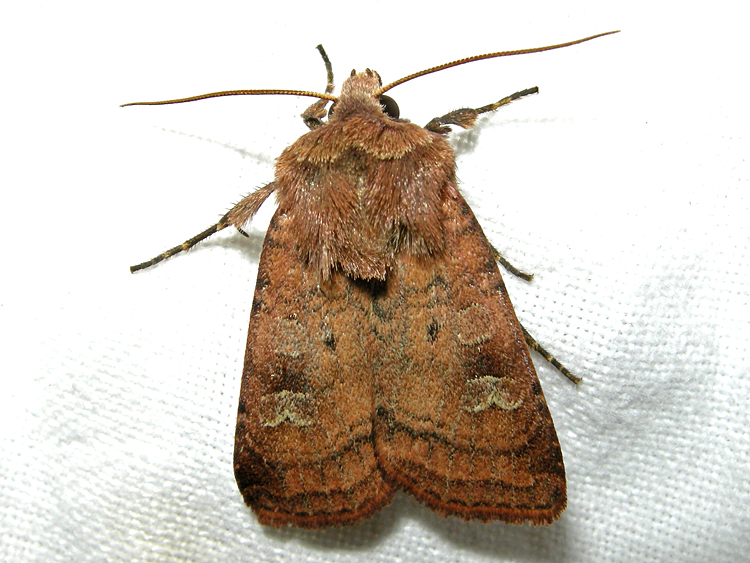
Small Square-spot, North Elmham Cathedral Meadows, 31st May 2019


Small Square-spot, North Elmham, 1st June 2020


Red Chestnut Cerastis rubricosa - 8 in the garden between 23rd March and 24th April 2019 and 4 between 18th and 27th March 2020.  2019 was my joint best year (with 2018, and following a blank year in 2017).  Elsewhere one at the meadows and my earliest ever at Cranwich Heath on 14th March 2020.


Red Chestnut, North Elmham, 23rd March 2019


Red Chestnut, North Elmham, 24th March 2020


True Lover's Knot Lycophotia porphyrea - 5 caught on Mull between 9th and 13th June 2019 (my earliest ever records) and one at Weybourne on 5th July 2019.  None in 2020.  I've never recorded this species locally but it has been found very close to here so maybe I will do one day...

True Lover's Knot, Carsaig (Mull), 9th June 2019


Next page: more Noctuidae

Wednesday, 12 August 2015

Winterton mothing: a rare migrant & a rare breeder

Saturday 11th July saw a Norfolk Moth Survey event in south Norfolk which I'd been hoping to go to.  Rob had been too, but had overlooked it when arranging with Tim Hodge to go mothing at Winterton instead.  So I had the choice of going to the event or joining Rob and Tim at Winterton.  Both were attractive options, but being late out of the door (arriving when it was virtually dark) and hoping for migrants I settled on Winterton.  The guys at the NMS event had a good time but I think I chose right - we had a great time at Winterton.

There was one slight disappointment though - we didn't find the hoped for migrants, or at least not many. A Dark Sword-grass was good, and White-point and 3 Silver Ys were likely migrants, but we had hoped for more. But that disappointment dissipated after the event when Rob checked his photos and identified a Willow Knot-horn Sciota adelphella.  I think we'd overlooked it among various other similar moths, or at least we didn't identify it at the time, and when I heard about Rob's ID I wondered whether or not I had even seen it.  Well, by the time I came to work through my photos I got my answer... I had seen it, and photographed it.  This species has recently colonised the Dungeness peninsular in Kent but I understand records elsewhere are attributed to migrants, and there have been just two previous Norfolk records.

Willow Knot-horn Sciota adelphella, Winterton, 11th July


We saw a number of Phycitodes-like moths during the evening which we were sure weren't the usual Phycitodes binaevella.  They turned out to be Scarce Clouded Know-horn Homoeosoma nimbella, a proposed Red Data Book species that's known mainly from the north Suffolk/south Norfolk coastline, with others recorded on the south coast in the SW.  It is known from Winterton already, but hadn't been recorded here or anywhere in the county this millenium.  The ID is tricky - gen det narrowed the options and made nimbella look likely but it was the wing-venation that clinched it: the first time I've used wing-venation to identify a moth.

Scarce Clouded Knot-horn Homoeosoma nimbella (female, wing venation plus gen det), Winterton, 11th July


Another good local moth which is equally scarcely recorded in Norfolk, mainly from the same area, shares the same foodplant, Sheep's-bit.  This one's status is Nationally Scarce A, Sheep's-bit Conch Cochylis pallidana.  We had at least two.

Sheep's-bit Conch Cochylis pallidana, Winterton, 11th July


A dash of colour was provided by another good moth, also new for me: 2 Purple-bordered Golds.


Purple-bordered Golds, Winterton, 11th July


Less colourful, but equally good, was my first Brown Flat-body Depressaria badiella.

Brown Flat-body Depressaria badiella (male, gen det), Winterton, 11th July


One that was easier to identify and was an exciting new moth for me was this Reed Leopard:

Reed Leopard, Winterton, 11th July


This tatty Sharp-angled Peacock was an interesting ID challenge.  Habitat suggested this was the likely ID, which would be new for me, but externally visible characters were equivocal, some favouring Sharp-angled and others favouring ordinary Peacock.  Gen det confirmed it.

Sharp-angled Peacock (male, gen det), Winterton, 11th July


Not unexpectedly we saw 3 Sand Darts, another lifer for me.


Sand Darts, Winterton, 11th July


I'd never seen either of the Shark species before so was pleased when we found one.  Time of year made Shark more likely than the similar Chamomile Shark but this individual was too worn to make the ID straightforward.  Fortunately a second fresher individual was then discovered, and now we were able to confirm they were Sharks.


Sharks, Winterton, 11th July


One other moth briefly masqueraded as a lifer but then I identified one I'd caught at home a few days earlier: Painted Neb Eulamprotes wilkella.  We saw at least 4 - a lot less unexpected here at Winterton than the one I found at home.

Painted Neb Eulamprotes wilkella, Winterton, 11th July


Similarly I wasn't aware I'd seen Sandhill Knot-horn Anerastia lotella before but I later identified a moth Dave and I had seen at Brancaster at the end of June as this species.  I'm not sure how many of these we saw at Winterton but there were at least 3 among my photos.


Sandhill Knot-horn Anerastia lotella, Winterton, 11th July


The most obvious moth during the evening was one I'd only previously seen once - the last time Rob and I came mothing at Winterton.  There were loads of Long-legged Tabbies Synaphe punctalis everywhere.  I put down 100+ but Tim thought there were more like hundreds.  He may well have been right - they were certainly abundant!

Long-legged Tabby Synaphe punctalis, Winterton, 11th July


Quite a few other moths that I haven't often seen including 2 Dusky Groundlings Aroga velocella, Beautiful Groundling Caryocolum marmorea, 2 Scarce Obscures Oegoconia deauratella, Rusty Birch Button Acleris notana, 2 Banded Grass-veneers Pediasia fascelinella, Hook-tipped Grass-veneer Platytes alpinella, Fox Moth, Puss Moth, Bordered Pug, 2 Kent Black Arches, Archer's Dart, 3 Brown-tails, 6 White Satins, 4 True Lover's Knots, Striped Wainscot, 2 Shore Wainscots, Miller, Suspected, Dingy Shears and Lunar-spotted Pinion,

Dusky Groundling Aroga velocella, Winterton, 11th July


Beautiful Groundling Caryocolum marmorea, Winterton, 11th July


Scarce Obscure Oegoconia deauratella (male, gen det), Winterton, 11th July


Rusty Birch Button Acelris notana (male, gen det), Winterton, 11th July


Banded Grass-veneer Pediasia fascelinella, Winterton, 11th July


Puss Moth, Winterton, 11th July


Kent Black Arches, Winterton, 11th July


Suspected, Winterton, 11th July


Miller, Winterton, 11th July


White Satin, Winterton, 11th July


Fox Moth, Winterton, 11th July


True Lover's Knot, Winterton, 11th July


Dingy Shears, Winterton, 11th July


Shore Wainscot, Winterton, 11th July


Striped Wainscot, Winterton, 11th July


Loads more too!  These were the rest of the micros: Cypress Tip Moth Argyresthia cupressella, 2 Gold-ribbon Argents Argyresthia brockeella, 6 Bird-cherry Ermines Yponomeuta evonymella, 3 Meadow Dwarfs Elachista triatomea, Saltern Groundling Scrobipalpa instabilella, Dingy Dowd Blastobasis adustella, Hook-marked Straw Moth Agapeta hamana, Timothy Tortrix Aphelia paleana, Brown-barred Tortrix Epagoge grotiana, 3 Yellow Oak Buttons Aleimma loeflingiana, Maple Button Acleris forsskaleana, Cock's-head Bell Zeiraphera isertana, White Cloaked Shoot Gypsonoma sociana, 2 Garden Grass-veneers Chrysoteuchia culmella, 2 Grass-veneers Crambus pascuella, Yellow Satin Veneer Crambus perlella, Pearl Grass-veneer Catoptria pinella, Chequered Grass-veneer Catoptria falsella,  50 Water Veneers Acentria ephemerella, 2 Meadow Greys Scoparia pyralella, 6 Little Greys Eudonia lacustrata, Small Grey Eudonia mercurella, Ringed China-mark Parapoynx stratiotata, 2 Small Magpies Eurrhypara hortulata, Fenland Pearl Anania perlucidalis, Double-striped Tabby Hypsopygia glaucinalis, 2 Rosy Tabbies Endotricha flammealis, 3 Heather Knot-horns Pempelia palumbella and Twin-barred Knot-horn Homoeosoma sinuella.

Gold-ribbon Argent Argyresthia brockeella, Winterton, 11th July


Heather Knot-horn Pampelia palumbella, Winterton, 11th July


Saltern Groundling Scrobipalpa instabilella (female, gen det), Winterton, 11th July
  

Six species of Hawkmoth is never bad: 2 Privet Hawkmoths, 2 Lime Hawkmoths, 2 Poplar Hawkmoths, 2 Eyed Hawkmoths, 2 Elephant Hawkmoths and 3 Small Elephant Hawkmoths. One of at least 3 Peppered Moths was this dark form:

Peppered Moth, Winterton, 11th July


These were the other macros: 2 Ghost Moths, Common Swift, Scalloped Hook-tip, Pebble Hook-tip, 2 Buff Arches, 2 Large Emeralds, Common Emerald, Treble Brown Spot, Barred Yellow, 2 July Highflyers, Common Pug, Green Pug, Small Yellow Wave, Clouded Border, Brimstone Moth, Willow Beauty, Pale Oak Beauty, 2 Common White Waves, Common Wave, 2 Clouded Silvers, Sallow Kitten, Iron Prominent, 2 Pebble Prominents, 3 Coxcomb Prominents, Buff-tip, Yellow-tail, Black Arches, 3 Rosy Footmen, Scarce Footman, Common Footman, 2 Heart and Darts, 2 Flames, Flame Shoulder, 2 Large Yellow Underwings, 2 Broad-bordered Yellow Underwings, 2 Nutmegs, Dot Moth, 2 Bright-line Brown-eyes, Clay, Smoky Wainscot, Shoulder-striped Wainscot, Sycamore, 50 Dark Arches, 2 Light Arches, 2 Tawny Marbled Minors, Common Rustic, Uncertain, Rustic, 2 Cream-bordered Green Peas, 4 Green Silver-lines, Spectacle, Beautiful Hook-tip, Snout and Fan-foot.

Sallow Kitten, Winterton, 11th July


Tawny Marbled Minors (female above, male below, both gen det), Winterton, 11th July


With all these moths I didn't pay all that much attention to non-lepidopteran insect-life, but I did take this Stenodema calcarata home with me, by accident I think.

Stenodema calcarata, Winterton, 11th July