
Description


A diary of my mothing activity covering highlights and photos from my moth trapping activities. Mainly Norfolk (UK), occasionally beyond. I may mention other wildlife sightings here, especially insects, but for birds see my birding diary.
Showing posts with label Svensson's Copper Underwing. Show all posts

Thursday, 8 April 2021

Review of 2019 and 2020 - Moths: Noctuids (Noctuidae) part 3: Copper Underwings, Sprawler, Marbled Beauty and their allies

NOCTUIDS (NOCTUIDAE) (continued)


Copper Underwing Amphipyra pyramidea - Totals of 11 trapped in the garden between 1st August and 22nd September 2019 and 16 between 26th July and 19th September 2020.  I average about 10 a year here and 16 equalled my best total.  Elsewhere 4 at the meadows, 3 at Whitwell Street and 3 in Cornwall.

Copper Underwing, North Elmham Cathedral Meadows, 22nd August 2019


male Copper Underwing, North Elmham, 7th August 2020


male Copper Underwing, North Elmham, 8th August 2020


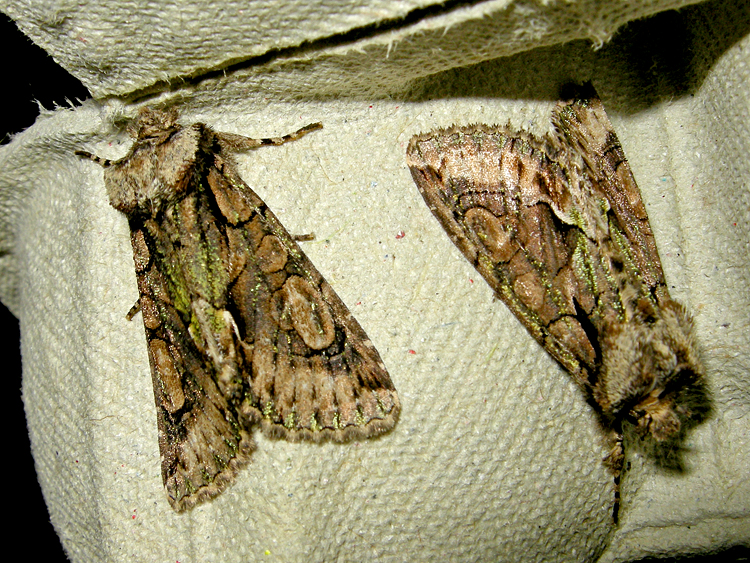
Svensson's Copper Underwing Amphipyra berbera - One in the garden on 25th July 2019 and 4 between  15th August and 7th September 2020.  I'd only caught 6 here previously and never more than 3 in a year.  Also one next door on 7th August 2019.

Svensson's Copper Underwing, North Elmham, 25th July 2019


male Svensson's Copper Underwing, North Elmham, 15th August 2020


male Svensson's Copper Underwing, North Elmham, 23rd August 2020


male Svensson's Copper Underwing, North Elmham, 7th September 2020


Mouse Moth Amphipyra tragopoginis - Totals of 7 caught here between 24th July and 10th September 2019 and 5 between 14th August and 16th September 2020.  This species is remarkably consistent here, with between 5 and 7 every year since 2014.  Elsewhere one at the meadows and one at Bintree Wood.

Mouse Moth, North Elmham Cathedral Meadows, 4th August 2019


Sprawler Asteroscopus sphinx - Totals of 30 trapped in the garden between 20th October and 20th November 2019 and 34 between 16th October and 23rd November 2020, slightly below the average of 36.

Sprawler, North Elmham, 20th October 2019


Sprawler, North Elmham, 6th November 2020


Green-brindled Crescent Allophyes oxyacanthae - Totals of 17 caught in the garden between 24th September and 2nd November 2019 and 38 between 10th and 30th October 2020.  I avereage 43 a year - 2019 was my worst year so far.

Green-brindled Crescent, North Elmham, 1st October 2019

Green-brindled Crescents, North Elmham, 10th October 2020


Green-brindled Crescent, North Elmham, 20th October 2020


Early Grey Xylocampa areola - Totals of 9 caught in the garden between 15th March and 9th May and 16 between 13th March and 26th April 2020.  I've averaged 27 a year here and 2019's total was my worst yet.

Early Grey, North Elmham, 15th March 2019


Early Grey, North Elmham, 13th March 2020


Bordered Sallow Pyrrhia umbra - None.  I'm still waiting for my first example of this species.  Although most records are from the coast and it hasn't been recorded in this 10km square yet I think I've got a realistic chance of catching one someday as there have been a few records elsewhere in mid Norfolk.


Marbled Clover Heliothis viriplaca - None.  Although a red data book species this is widespread in Norfolk and has been recorded just down the road at Worthing, including one in 2020.  I await my first but feel like I missed a good chance in 2020 when there were much larger numbers than usual recorded around the county.


Bordered Straw Heliothis peltigera - None.  Most years this migrant species is very hard to come by but in good years there's a chance I might catch one locally, though I didn't manage in the last good year, 2015.  Indeed I've never found this species in the UK.


Scarce Bordered Straw Heliothis peltigera - None.  Despite the name this species is considerably less scarce than the previous species in Norfolk.  I've recorded it once in my garden, during the 2017 influx.


Tree-lichen Beauty Crypgia algae - This new colonist has only recently colonised Norfolk and records have sky-rocketed in 2018 and 2019.  I caught my first at the meadows on 4th August 2019 followed by another in next door's garden on 8th August, but despite coming so close, I had to wait another year before catching one in my own garden - one on 15th August, the only one I caught in 2020.

Tree-lichen Beauty, North Elmham Cathedral Meadows, 4th August 2019


Tree-lichen Beauty, North Elmham, 8th August 2019


Tree-lichen Beauty, North Elmham, 15th August 2020


Marbled Beauty Crypgia algae - 3 in the garden trap between 20th and 29th July 2019 and 4 between 23rd July and 8th August 2020 - 3 a year is average here.  I only ever saw 2 of these when I lived in Bawdeswell but prior to that when I lived in Norwich I recorded up to 10 in a night - and that was before I was really into moths and had no special equipment: I just tried to identify what came in to my bedroom through the open window when the light was on.  Elsewhere one at the meadows on 26th July 2019, which is the first I've ever caught away from somewhere I live.

Marbled Beauty, North Elmham Cathedral Meadows, 26th July 2019


Marbled Green Nyctobrya muralis - None.  I've never caught this species but there have been a few recent records at widespread localities and though none have been particularly close to here they don't seem to be specific to any special habitat, so must be a fair chance of getting one here.


Next page: more Noctuidae

Wednesday, 18 October 2017

Tricky truncicollela

The highlight on Monday 28th August a Rush Veneer Nomophila noctuella, a migrant species and new for the year.

Rush Venner Nomophila noctuella, North Elmham, 28th August


Also new for the year was this Svensson's Copper Underwing.

Svensson's Copper Underwing (male, gen det), North Elmham, 28th August


Otherwise it was a marginal improvement on the previous couple of nights but fairly mediocre: Beech Midget Phyllonorycter maestingella, Apple/Orchard/Spindle Ermine agg. Yponomeuta padella/malinellus/cagnagella agg., Dingy Dowd Blastobasis adustella, Light Brown Apple Moth Epiphyas postvittana, 2 Dark-triangle Buttons Acleris laterana, 2 Garden Rose Tortrixes Acleris variegana, 6 Common Marbles Celypha lacunana, 2 Common Grass-veneers Agriphila tristella, 2 Elbow-stripe Grass-veneers Agriphila geniculea, Marsh Grey Eudonia pallida, 2 Narrow-winged Greys Eudonia angustea, Ringed China-mark Parapoynx stratiotata, Common Plume Emmelina monodactyla, 3 Chinese Characters, 2 Single-dotted Waves, 3 Brimstone Moths, Dusky Thorn, Willow Beauty, 5 Flame Shoulders, Large Yellow Underwing, 4 Lesser Yellow Underwings, Small Square-spot, 2 Setaceous Hebrew Characters, 2 Six-striped Rustics, 6 Square-spot Rustics, 6 Common Wainscots, Mouse Moth, 6 Flounced Rustics, Straw Dot, Snout and Pinion-streaked Snout.

Three mayflies were all different species, though the commonest species here: Lake Olive Cloeon simile, Pale Evening Dun Procloeon bifidum and Blue-winged Olive Serratella ignita.  A variety of caddisflies consisted of Oxyethira flavicornis, 2 Hydropsyche siltalai, 4 Hydropsyche pellucidula and another Small Silver Sedge Lepidostoma hirtum.   There were also 3 Birch Shieldbugs, 5 Forest Bugs and 2 Aphodius rufipes.

Next day I found Case-bearing Clothes Moth Tinea pellionella and the leafhopper Kleidocerys resedae inside the house.  There were 2 more new moths for the year that night, Purple Argent Argyresthia albistria and Dark Ash Bud Moth Prays ruficeps.

Purple Argent Argyresthia albistria, North Elmham, 29th August


Dark Ash Bud Moth Prays ruficeps, North Elmham, 29th August


The male genitalia of Eudonia truncicolella and Eudonia mercurella are rather similar to one another but the two moths' outward appearance is so different this does not usually present a problem.  I am usually dissecting mercurella to separate from lacustrata and truncicolella to separate from one of the other larger species, not to separate them from one another.  I often dissect mercurella from home but so far have not had any candidates for truncicolella at home (they seem to be common on heathlands but not so much in garden habitat).  A Eudonia sp. trapped this night was retained as it was too worn to identify with confidence and when I went to dissect it I noticed it seemed to have that scratchy coarsely-marked appearance I associate more with truncicolla (shared with Scoparia basistrigalis to some degree but that's easy to eliminate on dissection if not before) - might this be my first garden truncicollela?  Well the genitalia confirmed we were dealing with Eudonia and taking other factors into account mercurella and truncicolella are the only feasible options.  What's left of the wing pattern seems to me to be a better fit for truncicolella than mercurella, but given how worn it is I am not confident.  Size would often be a help here but though this is comfortably in range for truncicolella it's also within range for a large mercurella.  You can separate murana from truncicolella by the presence or absence of a hamus, a little structure near the base of the forewing.  This lacked a hamus like truncicollela but I can't find any references that say whether mercurella should have a hamus or not.  I could check this myself when I trap some more but that probably won't be until next year now.  It's a bit on the late side for mercurella but there are still truncicollela flying - however it's not too late for mercurella.  All things considered I regard this as a possible Ground-moss Grey Eudonia truncicolella, but I am not certain enough to add it to my garden list yet.  Maybe in due course I will be able to find suffiicient differences in the genitalia to enable a confident ID and then, or if I ever find mercurella does have a hamus, I might be able to retrospectively record it, but for now I shall await a fresher specimen or a female.

 possible Ground-moss Grey Eudonia truncicolella, North Elmham, 29th August


Although I didn't get a positive ID out of this the experience has taught me one thing that's useful.  I was under the impression that murana was a north-western species that would be highly unlikely to occur in Norfolk.  I also thought that they were a bit more obviously different than they really are (judging by some photos I have now seen) and so haven't ever bothered critically checking specimens of truncicolella to eliminate murana.  In researching this moth I find that there is a record of murana from Suffolk and a suggestion on the Suffolk Moths website that the species is "probably not very rare".  If that's really the case in Suffolk then it's probably true in Norfolk too (though no records to date), so I should probably be looking at truncicolella more carefully in future.

Other moths were 2 Light Brown Apple Moths Epiphyas postvittana, Dark-triangle Button Acleris laterana, 4 Garden Rose Tortrixes Acleris variegana, 7 Common Marbles Celypha lacunana, Blotched Marble Endothenia quadrimaculana, Smoky-barred Marble Lobesia abscisana, 3 Common Grass-veneers Agriphila tristella, 4 Elbow-stripe Grass-veneers Agriphila geniculea, 2 Narrow-winged Greys Eudonia angustea, Ringed China-mark Parapoynx stratiotata, Mother of Pearl Pleuroptya ruralis, 2 Chinese Characters, 4 Blood-veins, 2 Small Dusty Waves, Single-dotted Wave, Dark-barred Twin-spot Carpet, Garden Carpet, Common Carpet, Common Marbled Carpet, 3 Green Carpets, Currant Pug, Treble-bar, 7 Brimstone Moths, Willow Beauty, 7 Light Emeralds, Coxcomb Prominent, Flame Shoulder, 7 Large Yellow Underwings, 15 Lesser Yellow Underwings, Lesser Broad-bordered Yellow Underwing, 3 Setaceous Hebrew Characters, 2 Six-striped Rustics, 3 Square-spot Rustics, Feathered Gothic, 9 Common Wainscots, Copper Underwing, Straw Underwing, 9 Flounced Rustics, Rosy Rustic, 2 Vine's Rustics, 2 Burnished Brasses, Straw Dot, 7 Snouts and Pinion-streaked Snout.

Blotched Marble Endothenia quadrimaculana, North Elmham, 29th August


Mayflies consisted of 2 Pond Olives Cloeon dipterum and a Pale Evening Dun Procloeon bifidum.  A good selection of caddisflies too: 2 Polycentropus flavomaculatus, Hydropsyche siltalai, 9 Hydropsyche pellucidula, Small Silver Sedge Lepidostoma hirtum, Mottled Sedge Glyphotaelius pellucidus, Grammotaulius nigropunctatus, Limnephilus auricula, 9 Limnephilus lunatus and Limnephilus marmoratus.  Also 3 Aphodius rufipes (dung-beetles).

The following night was quite poor: Garden Rose Tortrix Acleris variegana, 2 Common Grass-veneers Agriphila tristella, Elbow-stripe Grass-veneer Agriphila geniculea, 3 Narrow-winged Greys Eudonia angustea, Blood-vein, 2 Light Emeralds, Coxcomb Prominent, 4 Large Yellow Underwings, 11 Lesser Yellow Underwings, 2 Setaceous Hebrew Characters, 2 Square-spot Rustics, 2 Common Wainscots, 9 Flounced Rustics, Rosy Rustic, Straw Dot and Snout; also the caddisflies  Limnephilus lunatus and 2 Limnephilus marmoratus.

The next night wasn't much better: Little Dwarf Elachista canapennella, White-shouldered House Moth Endrosis sarcitrella, 2 Light Brown Apple Moths Epiphyas postvittana, 2 Garden Rose Tortrixes Acleris variegana, Common Grass-veneer Agriphila tristella, 3 Narrow-winged Greys Eudonia angustea, Brimstone Moth, Common White Wave, 5 Light Emeralds, 3 Lesser Yellow Underwings, Lesser Broad-bordered Yellow Underwing, Setaceous Hebrew Character, Six-striped Rustic, 3 Square-spot Rustics, 3 Common Wainscots, 9 Flounced Rustics, 2 Vine's Rustics and Snout; also 3 Limnephilus lunatus (caddis) and Aphodius rufipes (beetle).

September kicked off with my first Centre-barred Sallow of the year.

Centre-barred Sallow, North Elmham, 1st September


Again not a huge catch that night: 5 Garden Rose Tortrixes Acleris variegana, 5 Common Marbles Celypha lacunana, Common Grass-veneer Agriphila tristella, 2 Elbow-stripe Grass-veneers Agriphila geniculea, Chinese Character, Dark-barred Twin-spot Carpet, Green Carpet, Sharp-angled Carpet, Brimstone Moth, Engrailed, 4 Light Emeralds, Poplar Hawk-moth, Large Yellow Underwing, 8 Lesser Yellow Underwings, 7 Square-spot Rustics, Common Wainscot, Mouse Moth, 9 Flounced Rustics, 2 Burnished Brasses, 3 Snouts, Hydropsyche pellucidula, Limnephilus lunatus and Aphodius rufipes.

Next day I was at Minsmere where in addition to Small Copper and Common Blue butterflies we found a Frosted Orange feeding on Fleabane and a Copper Underwing in the Bittern hide.  Moths in the garden that night consisted of 2 Light Brown Apple Moths Epiphyas postvittana, Dark-triangle Button Acleris laterana, Garden Rose Tortrix Acleris variegana, Elbow-stripe Grass-veneer Agriphila geniculea, Narrow-winged Grey Eudonia angustea, Common Plume Emmelina monodactyla, Double-striped Pug, Light Emerald, 2 Lesser Yellow Underwings, 2 Square-spot Rustics and 12 Flounced Rustics.

Monday, 3 October 2016

Gorse Groundling

After a couple of poor nights 10th August picked up just a little bit.  Only one new for the year: a Square-spotted Clay.

Square-spotted Clay, North Elmham, 10th August


Other macros were Large Emerald, Small Fan-footed Wave, 3 Single-dotted Waves, Riband Wave, 3 Common Carpets, Yellow-barred Brindle, Canary-shouldered Thorn, Dusky Thorn, Scalloped Oak, Lesser Swallow Prominent, Swallow Prominent, Pale Prominent, 2 Yellow-tails, 2 Black Arches, Dingy Footman, 2 Flame Shoulders, 15 Lesser Broad-bordered Yellow Underwings, Least Yellow Underwing, Setaceous Hebrew Character, Clay, 2 Straw Underwings, Dun-bar, 5 Common Rustics, 5 Lesser Common Rustics and 2 Straw Dots.

Common Rustic (male, gen det), North Elmham, 10th August


Lesser Common Rustic (male, gen det), North Elmham, 10th August


The micros consisted of Garden Midget Phyllonorycter messaniella, Little Ermel Swammerdamia pyrella, 5 Diamond-back Moths Plutella xylostella, Common Flat-body Agonopterix heracliana, Dark Groundling Bryotropha affinis, 2 Cinereous Groundlings Bryotropha terrella, Four-spotted Obscure Oegoconia quadripuncta, Dark Fruit-tree Tortrix Pandemis heparana, Heather Tortrix Argyrotaenia ljungiana, Light Brown Apple Moth Epiphyas postvittana, Maple Button Acleris forsskaleana, Marbled Piercer Cydia splendana, 7 Pearl Veneers Agriphila straminella, 5 Common Grass-veneers Agriphila tristella, Small Grey Eudonia mercurella, 2 Garden Pebbles Evergestis forficalis, Dusky Pearl Udea prunalis, 4 Mother of Pearls Pleuroptya ruralis and Grey Knot-horn Acrobasis advenella.

11th August was better with over 150 moths of 66 species, the best being Gorse Groundling Mirificarma mulinella, new for the house and my third anywhere.

Gorse Groundling Mirificarma mulinella, North Elmham, 11th August


New for the year on 11th were Dark-triangle Button Acleris laterana, Svensson's Copper Underwing and Rosy Rustic.

Dark-triangle Button Acleris laterana (male, gen det), North Elmham, 11th August


Svensson's Copper Underwing (male, gen det), North Elmham, 11th August


Rosy Rustic, North Elmham, 11th August


Other micros that night were New Oak Slender Caloptilia robustella, Ribwort Slender Aspilapteryx tringipennella, Garden Midget Phyllonorycter messaniella, 2 Golden Argents Argyresthia goedartella, 2 Bird-cherry Ermines Yponomeuta evonymella, Little Ermel Swammerdamia pyrella, 3 Diamond-back Moths Plutella xylostella, Small Dingy Tubic Borkhausenia fuscescens, Long-horned Flat-body Carcina quercana, 2 Cinereous Groundlings Bryotropha terrella, Dingy Dowd Blastobasis adustella, Heather Tortrix Argyrotaenia ljungiana, 2 Privet Tortrixes Clepsis consimilana, 4 Light Brown Apple Moths Epiphyas postvittana, Yellow-spot Tortrix Pseudargyrotoza conwagana, Dover Shade Cnephasia genitalana, 2 Barred Marbles Celypha striana, Bud Moth Spilonota ocellana, 13 Pearl Veneers Agriphila straminella, 11 Common Grass-veneers Agriphila tristella, 2 Pearl Grass-veneers Catoptria pinella, Water Veneer Acentria ephemerella, 2 Small Greys Eudonia mercurella, 8 Ringed China-marks Parapoynx stratiotata, Garden Pebble Evergestis forficalis, 12 Mother of Pearls Pleuroptya ruralis, Rosy Tabby Endotricha flammealis, Ash-bark Knot-horn Euzophera pinguis and Common Plume Emmelina monodactyla.

The other macros were 2 Orange Swifts, Pebble Hook-tip, Small Blood-vein, 6 Single-dotted Waves, Riband Wave, Common Carpet, 4 Small Rivulets, Maple Pug, Yellow-barred Brindle, 2 Canary-shouldered Thorns, 2 Dusky Thorns, Scalloped Oak, 2 Willow Beauties, Poplar Hawkmoth, Iron Prominent, Pebble Prominent, 2 Lesser Swallow Prominents, Yellow-tail, Black Arches, 4 Dingy Footmen, Buff Ermine, Shuttle-shaped Dart, Flame Shoulder, Large Yellow Underwing, 10 Lesser Broad-bordered Yellow Underwings, Setaceous Hebrew Character, Dark Arches, Cloaked Minor, Common Rustic, Lesser Common Rustic, Small Rufous, Nut-tree Tussock and 9 Straw Dots.

Lacewings consisted of Chrysoperla carnea and Dichochrysa flavifrons.  Bugs included 3 Forest Bugs (Red-legged shieldbugs) and a Phytocoris varipes.

Phytocoris varipes, North Elmham, 11th August

Tuesday, 3 November 2015

Hornets have a penchant for Orange Swifts

This Feathered Gothic would have been a new moth for me when I checked the trap at home after the night of 29th August, except that I'd been trapping at Cranwich Heath early that evening and caught 4 there (more on that excursion in this post I did nearer the time).

Feathered Gothic, North Elmham, 29th August


A strange thing happened this night.  I often get the odd Hornet in the moth trap and they often predate some of the moths while they're in there.  This evening I had 5 Hornets (and 2 wasps) and true to form they'd gobbled up some of the moths.  But what was a bit weird was that they appear to have very particular taste.  There were 5 dead moths in the trap, 4 showing clear signs of predation (i.e. wings removed and bodies gone).  Out of 165 moths in the trap they had killed all 5 Orange Swifts (or at least 4 of them) and ignored everything else.  What's so special about Orange Swifts?

A count of 37 Flounced Rustics was my highest ever while other macros in the trap were Green Carpet, Sharp-angled Carpet, Treble-bar, 9 Brimstone Moths, 2 Willow Beauties, Common Wave, Light Emerald, 32 Large Yellow Underwings, 7 Lesser Yellow Underwings, 3 Lesser Broad-bordered Yellow Underwings, Small Square-spot, Setaceous Hebrew Character, Square-spotted Clay, Six-striped Rustic, 8 Square-spot Rustics, Common Wainscot, Svensson's Copper Underwing, 2 Burnished Brasses, Silver Y, Spectacle, 8 Straw Dots and Snout.

Svensson's Copper Underwing, North Elmham, 29th August


Among the micros  2 Narrow-winged Greys Eudonia angustea were the first of the autumn generation.  The others were Brown Birch Slender Parornix betulae, Little Ermel Swammerdamia pyrella, Long-horned Flat-body Carcina quercana, House Groundling Bryotropha domestica, 2 Dark-triangle Buttons Acleris laterana, 3 Garden Rose Tortrices Acleris variegana, 3 Common Marbles Celypha lacunana, Rush Marble Bactra lancealana, Sharp-winged Drill Dichrorampha acuminatana, Pearl Veneer Agriphila straminella, 2 Common Grass-veneers Agriphila tristella, 15 Elbow-stripe Grass-veneers Agriphila geniculea, Chequered Grass-veneer Catoptria falsella, Garden Pebble Evergestis forficalis, Small Purple and Gold (Mint Moth) Pyrausta aurata, 2 Pale Straw Pearls Udea lutealis and 3 Mother of Pearls Pleuroptya ruralis.

One of the geniculea was interesting, showing more dark than usual between the two cross-lines.  I did check the insides just to make sure it wasn't anything else...


Elbow-striped Grass-veneer Agriphila geniculea (male, gen det), North Elmham, 29th August


This caterpillar has evaded certain identification so far.  I found a pic of a Beaded Chestnut that was similar but there seems to be so much variation with this and other related species I'm not confident one of the other Xyleninae tribe isn't the correct ID.  Let me know if you can help!


unidentified caterpillar (probably something in the Xyleninae tribe?), North Elmham, 29th August


On the sheet next to the trap was this frog.  You don't get the impression of size in the photos but I can tell you it was huge!  Biggest frog I've ever seen!


Common Frog, North Elmham, 29th August


30th August was rather uneventful with 4 Common Marbles Celypha lacunana, 2 Common Grass-veneers Agriphila tristella, 2 Elbow-stripe Grass-veneers Agriphila geniculea, Chequered Grass-veneer Catoptria falsella, Narrow-winged Grey Eudonia angustea, Ringed China-mark Parapoynx stratiotata, 3 Mother of Pearls Pleuroptya ruralis, Maiden's Blush, 2 Green Carpets, 3 Brimstone Moths, Light Emerald, 21 Large Yellow Underwings, 4 Lesser Yellow Underwings, Lesser Broad-bordered Yellow Underwing, Setaceous Hebrew Character, Six-striped Rustic, 5 Square-spot Rustics, Common Wainscot, 19 Flounced Rustics and 4 Straw Dots.

The clear highlight on 31st August was my second ever confirmed Yellow-triangle Slender Caloptilia alchimiella. Only ever had robustella confirmed at home before.

 Yellow-triangle Slender Caloptilia alchimiella (male, gen det), North Elmham, 31st August


Not a great deal else that day: Light Brown Apple Moth Epiphyas postvittana, Dark-triangle Button Acleris laterana, Garden Rose Tortrix Acleris variegana, Barred Marble Celypha striana, 3 Common Marbles Celypha lacunana, Pearl Veneer Agriphila straminella, Common Grass-veneer Agriphila tristella, 9 Elbow-stripe Grass-veneers Agriphila geniculea, Narrow-winged Grey Eudonia angustea, Mother of Pearl Pleuroptya ruralis, 2 Common Plumes Emmelina monodactyla, Maiden's Blush, Riband Wave, 3 Brimstone Moths, Light Emerald, 2 Flame Shoulders, 16 Large Yellow Underwings, 4 Lesser Yellow Underwings, Small Square-spot, 5 Square-spot Rustics, Common Wainscot, 6 Flounced Rustics and 4 Straw Dots.