Description


A diary of my mothing activity covering highlights and photos from my moth trapping activities. Mainly Norfolk (UK), occasionally beyond. I may mention other wildlife sightings here, especially insects, but for birds see my birding diary.
Showing posts with label Centre-barred Sallow. Show all posts

Thursday, 8 April 2021

Review of 2019 and 2020 - Moths: Noctuids (Noctuidae) part 9: Satellite to Dark Brocade

NOCTUIDS (NOCTUIDAE) (continued)


Satellite Eupsilia transversa - In 2019 one caught in the garden on 9th February and then singles on 5th and 26th October.  In 2020 singles on 17th March and 1st April and 3 between 20th October and 25th November.  I average about 6 a year here and have never had less than 3.  At the meadows singles on 4th October 2019, 29th September 2020 (my earliest ever autumn record) and 8th November.

Satellite, North Elmham Cathedral Meadows, 4th October 2019


Satellite, North Elmham, 17th March 2020
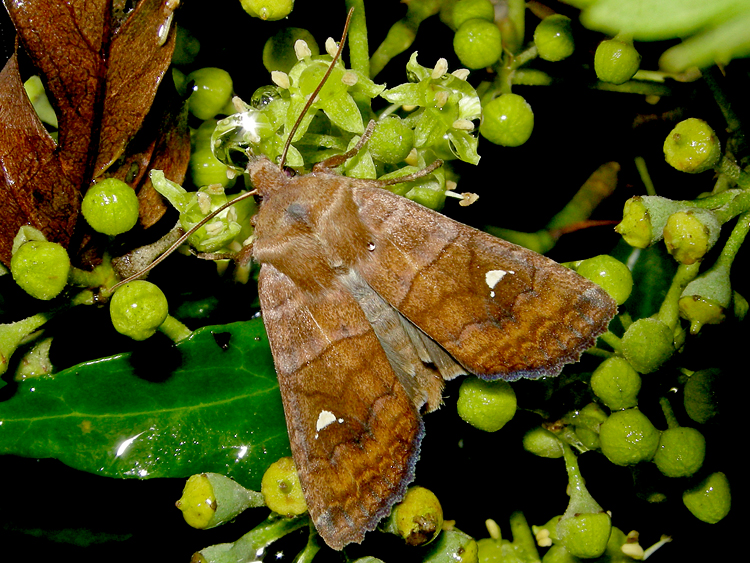

Satellite, North Elmham Cathedral Meadows, 29th September 2020


Satellite, North Elmham Cathedral Meadows, 8th November 2020


Olive Ipimorpha subtusa - None.  Apparently some people catch these regularly but I've only ever caught one, here in 2018.


Lesser-spotted Pinion Cosmia affinis
- Singles in the garden on 4th August 2019 and 1st August 2020, my first ever records of this species anywhere.


Lesser-spotted Pinion, North Elmham, 4th August 2019


Lesser-spotted Pinion, North Elmham, 1st August 2020


Dun-bar Cosmia trapezina - At least 10 between 12th and 31st July 2019 (not counted on one night but unlikely to have been much more than one) and 20 between 10th July and 10th August 2020.  2019 was my worst year here for this species - on average I catch around 28 a year.  Elsewhere singles at the meadows on 3 dates and one at Bintree Wood.

Dun-bar, North Elmham Cathedral Meadows, 26th July 2019


Dun-bar, North Elmham Cathedral Meadows, 7th August 2020


Lunar-spotted Pinion Cosmia pyralina - Singles trapped in the garden on 16th and 24th July 2019.  I've caught exactly 2 here in 4 out of the 6 years I've lived here (but none in 2017 or 2020).


Centre-barred Sallow Atethmia centrago - 2019 was my worst year for this species with just 2 singles caught on consecutive nights 2nd and 3rd September; 7 in 2020 between 5th and 15th September.  The average annual tally is 9-10.  Elsewhere 10 at Whitwell Street on 3rd September 2020 and one at the meadows.

Centre-barred Sallow, North Elmham Cathedral Meadows, 8th September 2020


Minor Shoulder-knot Brachylomia viminalis - None.  I had never recorded this species anywhere until 2018 and still haven't found it locally, which is surprising given the large numbers that occur in Foxley Wood, for example (which had a direct line of sight to my light when I lived in Bawdeswell).  Surely it will turn up here sometime...


Suspected Parastichtis suspecta - None.  I caught this species twice when I lived in Bawdeswell but so far haven't found it here in North Elmham.


Dingy Shears Apterogenum ypsillon - One in the garden on 10th July 2019, the 5th I've caught here in 5 years but none here in 2020.  Elsewhere one at Weybourne on 5th July 2019 and one at the meadows on 18th July 2020.

Dingy Shears, Weybourne, 5th July 2019


Dingy Shears, North Elmham, 10th July 2019


Dingy Shears, North Elmham Cathedral Meadows, 18th July 2020


Merveille du Jour Griposia aprilina - 5 trapped in the garden between 16th October and 2nd November 2019 and 14 between 11th and 22nd October 2020 including a record count of 4 on the last date.  I average 9-10 a year

Merveille du Jour, North Elmham, 16th October 2019


Merveille du Jour, North Elmham, 23rd October 2019


Merveille du Jour, North Elmham, 11th October 2020


Merveille du Jour, North Elmham, 16th October 2020


Merveille du Jour, North Elmham, 19th October 2020


Brindled Green Dryobotodes eremita - None in 2019 but 3 here on consecutive nights from 18th to 20th October 2020 (they appeared to all be different individuals, certainly the first two were).  This species is surprisingly scarce here - before 2020 I'd only caught 4 in 6 years.  I used to get more when I lived in Bawdeswell.  Elsewhere one at the meadows on 8th September 2020.

Brindled Green, North Elmham Cathedral Meadows, 8th September 2020


Brindled Green, North Elmham, 18th October 2020


Deep-brown Dart Aporophyla lutulenta - None.  I've never seen this species and records in mid Norfolk are few and far between.  Not out of the question that I could find one round here though.


Black Rustic Aporophyla nigra - Totals of 17 in the garden between 25th September and 1st November 2019, my worst year since 2014, and 28 between 15th September and 22nd October 2020 (during which period I was away for a week).  I've averaged 32-33 a year here.  Elsewhere one at the meadows on 4th October 2019 and 32 in Cornwall.

Black Rustic, North Elmham, 25th September 2019


Feathered Ranunculus Polymixis lichenea - None in 2019; 42 at Tresidder in Cornwall between 3rd and 9th October 2020.  I've never seen this species in Norfolk and as it's almost only found at the coast and in the Norwich area I don't particularly expect to find one locally.  But there have been a couple of records not all that far away (e.g. Stibbard) so maybe there are a few knocking around this part of Norfolk too...

Feathered Ranunculus, Tresidder (Cornwall), 3rd October 2020


Feathered Ranunculus, Tresidder (Cornwall), 6th October 2020


Large Ranunculus Polymixis flavicincta - None.  Some people catch these regularly but I've only ever caught one here in North Elmham, in 2016, and just a small number elsewhere.


Dark Brocade Mniotype adusta - This must be one of the most widespread moths in Norfolk to have avoided me - there's even been a record in my road.  But until 2019 I'd never seen one, and I've still not found one in Norfolk.  It's perhaps a bit commoner on Mull where I caught 3 at Ceann Chnocain on 13th June 2019.


Dark Brocades, Ceann Chnocain (Mull), 13th June 2019


Next page: more Noctuidae

Friday, 15 February 2019

A new bug and several new moths and bugs for the year

I think of Ashy Button Acleris sparsana as being a late autumn species so it was a surprise to find one in my moth trap on 16th August.  But although they peak in October it's actually quite normal for the first ones to fly in August.  It was my earliest though, albeit only by a week or so.

Ashy Button Acleris sparsana, North Elmham, 16th August


Otherwise it wasn't a very eventful night with 63 moths of 24 species.  The others were Common Oak Pigmy Stigmella roborella, Red Hazel Midget Phyllonorycter nicellii, Garden Rose Tortrix Acleris variegana, Barred Marble Celypha striana, Common Marble Celypha lacunana, 18 Common Grass-veneers Agriphila tristella, 2 Elbow-stripe Grass-veneers Agriphila geniculea, 4 Garden Pebbles Evergestis forficalis, Mother of Pearl Pleuroptya ruralis, Beautiful Plume Amblyptilia acanthadactyla, Single-dotted Wave, Double-striped Pug, 3 Brimstone Moths, Canary-shouldered Thorn, Poplar Hawk-moth, 2 Swallow Prominents, 3 Flame Shoulders, 2 Lesser Broad-bordered Yellow Underwings, Six-striped Rustic, Common Rustic, 13 Flounced Rustics, Rosy Rustic and Straw Dot.

The following night was a bit better, with Figure of Eighty new for the year - my only one last year as it turned out (I average one a year here).

Figure of Eighty, North Elmham, 17th August


My third and final Butterbur of the year was good.  I had 3 in 2016 too but those 6 are the only ones I've ever seen anywhere.  Indeed they're a pretty scarce species in Norfolk - there was only one other record in 2016, three in total in 2017 and two others in 2018.  They are usually pretty obvious, not only because they're ginormous compared to the average Rosy Rustic, but the structure is different and the colour too.  I think there's also a slight difference in the curvature of the crossline too, but I haven't quite worked out how diagnostic that is.  But although size is usually pretty obvious, this is by no means a reliable means of identifying them.  I also caught a Rosy Rustic on this occasion, and it happened to be the largest Rosy Rustic I've ever seen.  In the photo below it appears to be even bigger than the Butterbur.  To be honest I don't think it was, quite (it's standing higher off the ground in the photo so is nearer the camera), but it was very very close.

Butterbur (top right) and Rosy Rustic (bottom left), North Elmham, 17th August


One of two Garden Rose Tortrixes Acleris variegana was the all-dark form f. caeruleaoatrana.  Quite a nice moth when fresh...


Garden Rose Tortrix Acleris variegana (f. caeruleoatrana), North Elmham, 17th August


Other moths were Hawthorn Slender Parornix anglicella, Diamond-back Plutella xylostella, Barred Marble Celypha striana, 4 Common Marbles Celypha lacunana, 35 Common Grass-veneers Agriphila tristella, 2 Elbow-stripe Grass-veneers Agriphila geniculea, Ringed China-mark Parapoynx stratiotata, 2 Mother of Pearls Pleuroptya ruralis, Ermine Knot-horn Phycitodes binaevella, 3 Common Plumes Emmelina monodactyla, Maiden's Blush, Blood-vein, 2 Single-dotted Waves, Lime-speck Pug, Tawny Speckled Pug, Double-striped Pug, 4 Brimstone Moths, Canary-shouldered Thorn, 2 Dusky Thorns, Flame Shoulder, 2 Lesser Broad-bordered Yellow Underwings, 2 Setaceous Hebrew Characters, 3 Six-striped Rustics, 14 Flounced Rustics, 3 Straw Dots and Snout.

Mayflies and lacewings consisted of 2 Pond Olives Cloeon dipterum and Chrysopa commata respectively, and caddisflies were 2 Hydropsyche siltalai and Medium Sedge Goera pilosa.  2 Nicrophorus investigator and an Aphodius rufipes represented the beetles and there were 3 Hornets and a Common Frog.

The following night saw an improvement with 5 new moths for the year.  One of these was a Pale Thistle Case-bearer Coleophora peribenanderi, my first for a couple of years.

Pale Thistle Case-bearer Coleophora peribenanderi (male, gen det), North Elmham, 18th August


I've seen rather more Birch Marbles Apotomis betuletana, but not at home - this was my first trapped at home since 2015.

Birch Marble Apotomis betuletana, North Elmham, 18th August


2 Square-spot Rustics, Centre-barred Sallow and Frosted Orange were also new species for the year.

Square-spot Rustic, North Elmham, 18th August


Centre-barred Sallow, North Elmham, 18th August


Frosted Orange, North Elmham, 18th August


Other moths were Carrion Moth Monopis weaverella, Bird’s-nest Moth Tinea trinotella, Dark Neb Bryotropha affinis, Dingy Dowd Blastobasis adustella, Light Brown Apple-moth Epiphyas postvittana, Dark-triangle Button Acleris laterana, 2 Garden Rose Tortrixes Acleris variegana, Barred Marble Celypha striana, 5 Common Marbles Celypha lacunana, Marbled Piercer Cydia splendana, 46 Common Grass-veneers Agriphila tristella, 4 Elbow-stripe Grass-veneers Agriphila geniculea, Ringed China-mark Parapoynx stratiotata, 2 Garden Pebbles Evergestis forficalis, Pale Straw Pearl Udea lutealis, 2 Mother of Pearls Pleuroptya ruralis, Grey Knot-horn Acrobasis advenella, 2 Common Plumes Emmelina monodactyla, Orange Swift, Maiden's Blush, Single-dotted Wave, Garden Carpet, Common Carpet, Lime-speck Pug, Double-striped Pug, 4 Brimstone Moths, Canary-shouldered Thorn, 2 Dusky Thorns, Rosy Footman, Flame Shoulder, 2 Lesser Broad-bordered Yellow Underwings, Small Square-spot, Setaceous Hebrew Character, 12 Flounced Rustics and 3 Straw Dots.

A Green Drake Ephemera danica was the only mayfly. Among the green lacewings, Chrysopa perla was new for the garden.  It's a very common species that I've recorded up the road at the meadows before, but apparently it's a species that doesn't turn up in gardens all that often.  Other lacewings were Chrysopa commata, Chrysoperla carnea, 2 Hemerobius lutescens and Micromus variegatus.

Chrysopa perla, North Elmham, 18th August


There was a selection of caddisflies: Cyrnus flavidus, Polycentropus flavomaculatus, 2 Hydropsyche pellucidula, Hydropsyche siltalai and Limnephilus marmoratus.  Beetles were 4 Bradycellus verbasci, a Nicrophorus investigator and another Curculio venosus.

It was a good night for bugs too, with one completely new species and two new for the year.  I've seen several of the Psallus species in the garden but they can be pretty tricky to identify.  This one keyed out to either Psallus flavellus or Psallus lepidus, either of which would be new to me, but I wasn't entirely confident I had adequately eliminated all of the other species, especially falleni (which, as it flies later than others was really quite a likely contender from the start).  The only way to resolve it was to check its genitalia, and this placed it as Psallus flavellus.

Psallus flavellus (male, gen det), North Elmham, 18th August


The two other bugs that were new for the year were the striking Campyloneura virgula and Neolygus contaminatus.  Other bugs were Birch Shieldbug, 5 Forest Bugs, 2 Tarnished Plant Bugs Lygus rugulipennis and the leafhopper Empoasca vitis

Campyloneura virgula, North Elmham, 18th August


Neolygus contaminatus, North Elmham, 18th August

Wednesday, 18 October 2017

Tricky truncicollela

The highlight on Monday 28th August a Rush Veneer Nomophila noctuella, a migrant species and new for the year.

Rush Venner Nomophila noctuella, North Elmham, 28th August


Also new for the year was this Svensson's Copper Underwing.

Svensson's Copper Underwing (male, gen det), North Elmham, 28th August


Otherwise it was a marginal improvement on the previous couple of nights but fairly mediocre: Beech Midget Phyllonorycter maestingella, Apple/Orchard/Spindle Ermine agg. Yponomeuta padella/malinellus/cagnagella agg., Dingy Dowd Blastobasis adustella, Light Brown Apple Moth Epiphyas postvittana, 2 Dark-triangle Buttons Acleris laterana, 2 Garden Rose Tortrixes Acleris variegana, 6 Common Marbles Celypha lacunana, 2 Common Grass-veneers Agriphila tristella, 2 Elbow-stripe Grass-veneers Agriphila geniculea, Marsh Grey Eudonia pallida, 2 Narrow-winged Greys Eudonia angustea, Ringed China-mark Parapoynx stratiotata, Common Plume Emmelina monodactyla, 3 Chinese Characters, 2 Single-dotted Waves, 3 Brimstone Moths, Dusky Thorn, Willow Beauty, 5 Flame Shoulders, Large Yellow Underwing, 4 Lesser Yellow Underwings, Small Square-spot, 2 Setaceous Hebrew Characters, 2 Six-striped Rustics, 6 Square-spot Rustics, 6 Common Wainscots, Mouse Moth, 6 Flounced Rustics, Straw Dot, Snout and Pinion-streaked Snout.

Three mayflies were all different species, though the commonest species here: Lake Olive Cloeon simile, Pale Evening Dun Procloeon bifidum and Blue-winged Olive Serratella ignita.  A variety of caddisflies consisted of Oxyethira flavicornis, 2 Hydropsyche siltalai, 4 Hydropsyche pellucidula and another Small Silver Sedge Lepidostoma hirtum.   There were also 3 Birch Shieldbugs, 5 Forest Bugs and 2 Aphodius rufipes.

Next day I found Case-bearing Clothes Moth Tinea pellionella and the leafhopper Kleidocerys resedae inside the house.  There were 2 more new moths for the year that night, Purple Argent Argyresthia albistria and Dark Ash Bud Moth Prays ruficeps.

Purple Argent Argyresthia albistria, North Elmham, 29th August


Dark Ash Bud Moth Prays ruficeps, North Elmham, 29th August


The male genitalia of Eudonia truncicolella and Eudonia mercurella are rather similar to one another but the two moths' outward appearance is so different this does not usually present a problem.  I am usually dissecting mercurella to separate from lacustrata and truncicolella to separate from one of the other larger species, not to separate them from one another.  I often dissect mercurella from home but so far have not had any candidates for truncicolella at home (they seem to be common on heathlands but not so much in garden habitat).  A Eudonia sp. trapped this night was retained as it was too worn to identify with confidence and when I went to dissect it I noticed it seemed to have that scratchy coarsely-marked appearance I associate more with truncicolla (shared with Scoparia basistrigalis to some degree but that's easy to eliminate on dissection if not before) - might this be my first garden truncicollela?  Well the genitalia confirmed we were dealing with Eudonia and taking other factors into account mercurella and truncicolella are the only feasible options.  What's left of the wing pattern seems to me to be a better fit for truncicolella than mercurella, but given how worn it is I am not confident.  Size would often be a help here but though this is comfortably in range for truncicolella it's also within range for a large mercurella.  You can separate murana from truncicolella by the presence or absence of a hamus, a little structure near the base of the forewing.  This lacked a hamus like truncicollela but I can't find any references that say whether mercurella should have a hamus or not.  I could check this myself when I trap some more but that probably won't be until next year now.  It's a bit on the late side for mercurella but there are still truncicollela flying - however it's not too late for mercurella.  All things considered I regard this as a possible Ground-moss Grey Eudonia truncicolella, but I am not certain enough to add it to my garden list yet.  Maybe in due course I will be able to find suffiicient differences in the genitalia to enable a confident ID and then, or if I ever find mercurella does have a hamus, I might be able to retrospectively record it, but for now I shall await a fresher specimen or a female.

 possible Ground-moss Grey Eudonia truncicolella, North Elmham, 29th August


Although I didn't get a positive ID out of this the experience has taught me one thing that's useful.  I was under the impression that murana was a north-western species that would be highly unlikely to occur in Norfolk.  I also thought that they were a bit more obviously different than they really are (judging by some photos I have now seen) and so haven't ever bothered critically checking specimens of truncicolella to eliminate murana.  In researching this moth I find that there is a record of murana from Suffolk and a suggestion on the Suffolk Moths website that the species is "probably not very rare".  If that's really the case in Suffolk then it's probably true in Norfolk too (though no records to date), so I should probably be looking at truncicolella more carefully in future.

Other moths were 2 Light Brown Apple Moths Epiphyas postvittana, Dark-triangle Button Acleris laterana, 4 Garden Rose Tortrixes Acleris variegana, 7 Common Marbles Celypha lacunana, Blotched Marble Endothenia quadrimaculana, Smoky-barred Marble Lobesia abscisana, 3 Common Grass-veneers Agriphila tristella, 4 Elbow-stripe Grass-veneers Agriphila geniculea, 2 Narrow-winged Greys Eudonia angustea, Ringed China-mark Parapoynx stratiotata, Mother of Pearl Pleuroptya ruralis, 2 Chinese Characters, 4 Blood-veins, 2 Small Dusty Waves, Single-dotted Wave, Dark-barred Twin-spot Carpet, Garden Carpet, Common Carpet, Common Marbled Carpet, 3 Green Carpets, Currant Pug, Treble-bar, 7 Brimstone Moths, Willow Beauty, 7 Light Emeralds, Coxcomb Prominent, Flame Shoulder, 7 Large Yellow Underwings, 15 Lesser Yellow Underwings, Lesser Broad-bordered Yellow Underwing, 3 Setaceous Hebrew Characters, 2 Six-striped Rustics, 3 Square-spot Rustics, Feathered Gothic, 9 Common Wainscots, Copper Underwing, Straw Underwing, 9 Flounced Rustics, Rosy Rustic, 2 Vine's Rustics, 2 Burnished Brasses, Straw Dot, 7 Snouts and Pinion-streaked Snout.

Blotched Marble Endothenia quadrimaculana, North Elmham, 29th August


Mayflies consisted of 2 Pond Olives Cloeon dipterum and a Pale Evening Dun Procloeon bifidum.  A good selection of caddisflies too: 2 Polycentropus flavomaculatus, Hydropsyche siltalai, 9 Hydropsyche pellucidula, Small Silver Sedge Lepidostoma hirtum, Mottled Sedge Glyphotaelius pellucidus, Grammotaulius nigropunctatus, Limnephilus auricula, 9 Limnephilus lunatus and Limnephilus marmoratus.  Also 3 Aphodius rufipes (dung-beetles).

The following night was quite poor: Garden Rose Tortrix Acleris variegana, 2 Common Grass-veneers Agriphila tristella, Elbow-stripe Grass-veneer Agriphila geniculea, 3 Narrow-winged Greys Eudonia angustea, Blood-vein, 2 Light Emeralds, Coxcomb Prominent, 4 Large Yellow Underwings, 11 Lesser Yellow Underwings, 2 Setaceous Hebrew Characters, 2 Square-spot Rustics, 2 Common Wainscots, 9 Flounced Rustics, Rosy Rustic, Straw Dot and Snout; also the caddisflies  Limnephilus lunatus and 2 Limnephilus marmoratus.

The next night wasn't much better: Little Dwarf Elachista canapennella, White-shouldered House Moth Endrosis sarcitrella, 2 Light Brown Apple Moths Epiphyas postvittana, 2 Garden Rose Tortrixes Acleris variegana, Common Grass-veneer Agriphila tristella, 3 Narrow-winged Greys Eudonia angustea, Brimstone Moth, Common White Wave, 5 Light Emeralds, 3 Lesser Yellow Underwings, Lesser Broad-bordered Yellow Underwing, Setaceous Hebrew Character, Six-striped Rustic, 3 Square-spot Rustics, 3 Common Wainscots, 9 Flounced Rustics, 2 Vine's Rustics and Snout; also 3 Limnephilus lunatus (caddis) and Aphodius rufipes (beetle).

September kicked off with my first Centre-barred Sallow of the year.

Centre-barred Sallow, North Elmham, 1st September


Again not a huge catch that night: 5 Garden Rose Tortrixes Acleris variegana, 5 Common Marbles Celypha lacunana, Common Grass-veneer Agriphila tristella, 2 Elbow-stripe Grass-veneers Agriphila geniculea, Chinese Character, Dark-barred Twin-spot Carpet, Green Carpet, Sharp-angled Carpet, Brimstone Moth, Engrailed, 4 Light Emeralds, Poplar Hawk-moth, Large Yellow Underwing, 8 Lesser Yellow Underwings, 7 Square-spot Rustics, Common Wainscot, Mouse Moth, 9 Flounced Rustics, 2 Burnished Brasses, 3 Snouts, Hydropsyche pellucidula, Limnephilus lunatus and Aphodius rufipes.

Next day I was at Minsmere where in addition to Small Copper and Common Blue butterflies we found a Frosted Orange feeding on Fleabane and a Copper Underwing in the Bittern hide.  Moths in the garden that night consisted of 2 Light Brown Apple Moths Epiphyas postvittana, Dark-triangle Button Acleris laterana, Garden Rose Tortrix Acleris variegana, Elbow-stripe Grass-veneer Agriphila geniculea, Narrow-winged Grey Eudonia angustea, Common Plume Emmelina monodactyla, Double-striped Pug, Light Emerald, 2 Lesser Yellow Underwings, 2 Square-spot Rustics and 12 Flounced Rustics.

Sunday, 30 October 2016

Copper Ermel, Dowdy Plume, Dune Villas and a leaf cut by a bee

For the third night in the row, 24th August was a good night.  The highlight was my first ever adult Copper Ermel Roeslerstammia erxlebella.

Copper Ermel Roeslerstammia erxlebella, North Elmham, 24th August


New for the year were Small Birch Bell Epinotia ramella, Centre-barred Sallow and Old Lady.

Centre-barred Sallow, North Elmham, 24th August


I was more surprised to see a Rosy Footman, a pristine fresh individual so I suspect a second generation which isn't normal for this species.  Narrow-winged Grey Eudonia angustea was also my first of its second generation this year, although for that species it's the first spring generation that's a relatively new phenonemon.

Four species of migrant moth was good for here:  3 Diamond-back Moths Plutella xylostella, Rusty-dot Pearl Udea ferrugalis, 2 Rush Veneers Nomophila noctuella and Silver Y.

Other micros were Oak Bent-wing Bucculatrix ulmella, Golden Argent Argyresthia goedartella, Wainscot Smudge Ypsolopha scabrella, Small Clover Case-bearer Coleophora alcyonipennella, 2 Brown House Moths Hofmannophila pseudospretella, Long-horned Flat-body Carcina quercana, 2 Dingy Dowds Blastobasis adustella, 2 Chequered Fruit-tree Tortrixes Pandemis corylana, Dark-triangle Button Acleris laterana, 2 Garden Rose Tortrixes Acleris variegana, 7 Common Marbles Celypha lacunana, 2 Pearl Veneers Agriphila straminella, 5 Common Grass-veneers Agriphila tristella, 7 Elbow-stripe Grass-veneers Agriphila geniculea, Chequered Grass-veneer Catoptria falsella, 3 Water Veneers Acentria ephemerella, 3 Ringed China-marks Parapoynx stratiotata, Beautiful China-mark Nymphula nitidulata, 6 Garden Pebbles Evergestis forficalis, 2 Pale Straw Pearls Udea lutealis, 7 Mother of Pearls Pleuroptya ruralis, Ash-bark Knot-horn Euzophera pinguis and Beautiful Plume Amblyptilia acanthadactyla.

The remainder of the macros were 3 Single-dotted Waves, 3 Riband Waves, Flame Carpet, 2 Red Twin-spot Carpets, Dark-barred Twin-spot Carpet, 6 Common Carpets, 10 Green Carpets, 2 Wormwood/Currant Pugs, Tawny Speckled Pug, 2 Double-striped Pugs, 3 Treble-bars, 3 Yellow-barred Brindles, 25 Brimstone Moths, 2 Canary-shouldered Thorns, Dusky Thorn, 3 Willow Beauties, 2 Poplar Hawkmoths, 2 Iron Prominents, Lesser Swallow Prominent, Swallow Prominent, 19 Flame Shoulders, 24 Large Yellow Underwings, 4 Lesser Yellow Underwings, 10 Lesser Broad-bordered Yellow Underwings, Small Square-spot, 6 Setaceous Hebrew Characters, 5 Square-spot Rustics, 2 Common Wainscots, Copper Underwing, 2 Straw Underwings, Dark Arches, Cloaked Minor, Common Rustic, 9 Flounced Rustics, 2 Burnished Brasses, 2 Spectacles, 30 Straw Dots and 3 Snouts.

Treble-bar (female), North Elmham, 24th August


Green Lacewings consisted of 2 Cunctochrysa albolineata and Dichochrysa flavifrons.  Caddisflies included a Athripsodes albifrons and bugs included a Forest Bug.

Next day I headed up to Burnham Overy for some birding.  Saw some birds but the non-birds were more varied and interesting.  I saw 4 Toads, 2 Natterjacks and 2 Common Toads.  Later on with Andrew B and his colleague we found a Common Lizard.

Common Lizard, Burnham Overy Dunes, 25th August


Natterjack, Burnham Overy Dunes, 25th August


There were a lot of plume moths in the dunes.  Some looked like, and one was subsequently confirmed as being, Breckland Plume Crombrugghia distans - at least 10 of these seen.  Others looked rather like Common Plume Emmelina monodactyla, but they didn't seem big enough.  I couldn't immediately see what else they could be though, so suspecting that's what they were I retained one just in case.  Good job I did... they were, or at least that one was, Dowdy Plume Stenoptilia zophodactylus, a new moth for me.  At least 6 of these, assuming they were all the same.

 Breckland Plume Crombrugghia distans (male, gen det), Burnham Overy Dunes, 25th August


Dowdy Plume Stenoptilia zophodactylus (male, gen det), Burnham Overy Dunes, 25th August


Other moths were 6 Spindle Ermines Yponomeuta cagnagella, 2+ Beautiful Groundlings Caryocolum marmorea, 6 Yellow-spot Tortrixes Pseudargyrotoza conwagana, Common Marble Celypha lacunana, 10+ Elbow-stripe Grass-veneers Agriphila geniculea, Hook-tipped Grass-veneer Platytes alpinella, Straw-barred Pearl Pyrausta despicata, 3 Common Carpets and 3 Yellow Belles.

Spindle Ermine Yponomeuta cagnagella, Burnham Overy Dunes, 25th August


Butterflies included getting on for 200 Small/Green-veined Whites along the sea wall.  Both species were involved - I identified and counted 55 Small Whites and 23 Green-veined Whites.  Also Small Copper, 3 Brown Arguses, Common Blues, Small Tortroiseshells, Wall Browns, Meadow Browns, Gatekeeper, Small Heaths (most of the non-Whites were in the dunes).  Dragonflies included Migrant Hawker and at least 2 Ruddy Darters.

I was mystified by a green thing flying with a strange up and down motion through the dunes.  It had quite a big very green body and was flying most bizarrely - or at least that was what I first thought.  When it landed I realised that it was in fact a bee carrying a leaf!  Although I was vaguely aware that there was such a thing as a leafcutter bee I'd never seen one carrying a leaf it had cut before.  Turns out, I think, that it was Silvery Leafcutter Bee Megachile leachella, my first leafcutter in the UK.

Silvery Leafcutter Bee Megachile leachella, Burnham Overy Dunes, 25th August


Other interesting insects included 2 Dune Villas, a distinctive Bee Fly I was familiar with only through a couple of photos I'd seen on Twitter recently.


Dune Villas Villa modesta, Burnham Overy Dunes, 25th August


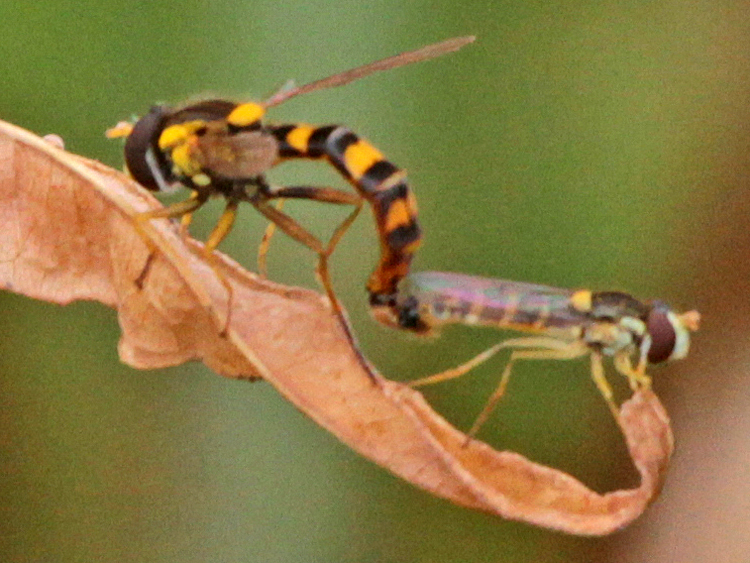
These two hoverflies looked so different from one another I'd have imagined they were different species were it not for the fact that they were copulating.  Turns out they were (both) Sphaerophoria scripta.


Sphaerophoria scripta, Burnham Overy Dunes, 25th August


Andrew Bloomfield kindly showed me some more spiders.  These included Tegenaria agrestis, Alopecosa barbipes and a Theridion sp.  I think he said he needed to check the ID of the latter and I've not followed up to find out which species it was.  The very limited research I've done (googling) suggests it may be Theridion pictum though if I remember rightly T varians was mentioned.

Alopecosa barbipes, Burnham Overy Dunes, 25th August


Theridion sp. (looks like images of Theridion pictum), Burnham Overy Dunes, 25th August


Andy also pointed out some interesting grasshoppers.  First were a couple of Lesser Marsh Grasshoppers one of which was an unusual pink form.  There was also Mottled Grasshopper and Andy found a Long-winged Conehead, apparently not a common sighting here.

Lesser Marsh Grasshopper, Burnham Overy Dunes, 25th August


Long-winged Conehead, Burnham Overy Dunes, 25th August


Also thanks to Andy for pointing out Tiny Earthstars - a rare fungus that is not found at many other sites.


Tiny Earthstars, Burnham Overy Dunes, 25th August