Description


A diary of my mothing activity covering highlights and photos from my moth trapping activities. Mainly Norfolk (UK), occasionally beyond. I may mention other wildlife sightings here, especially insects, but for birds see my birding diary.
Showing posts with label Feathered Ranunculus. Show all posts

Thursday, 8 April 2021

Review of 2019 and 2020 - Moths: Noctuids (Noctuidae) part 9: Satellite to Dark Brocade

NOCTUIDS (NOCTUIDAE) (continued)


Satellite Eupsilia transversa - In 2019 one caught in the garden on 9th February and then singles on 5th and 26th October.  In 2020 singles on 17th March and 1st April and 3 between 20th October and 25th November.  I average about 6 a year here and have never had less than 3.  At the meadows singles on 4th October 2019, 29th September 2020 (my earliest ever autumn record) and 8th November.

Satellite, North Elmham Cathedral Meadows, 4th October 2019


Satellite, North Elmham, 17th March 2020
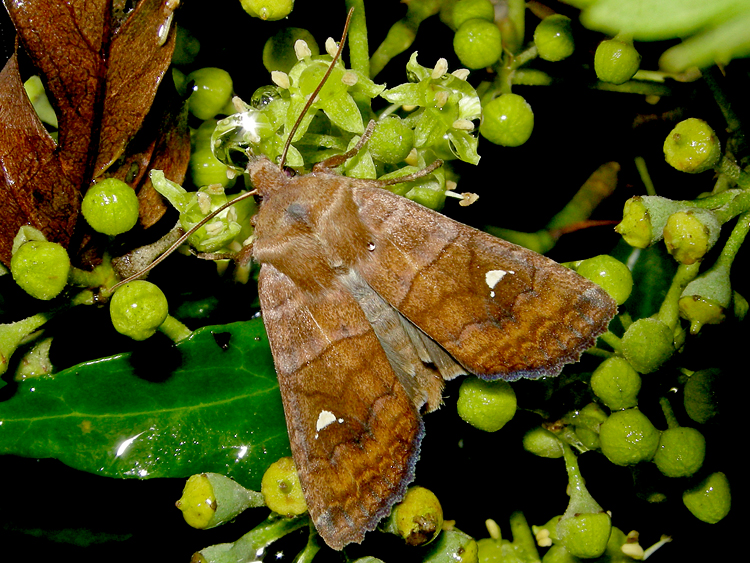

Satellite, North Elmham Cathedral Meadows, 29th September 2020


Satellite, North Elmham Cathedral Meadows, 8th November 2020


Olive Ipimorpha subtusa - None.  Apparently some people catch these regularly but I've only ever caught one, here in 2018.


Lesser-spotted Pinion Cosmia affinis
- Singles in the garden on 4th August 2019 and 1st August 2020, my first ever records of this species anywhere.


Lesser-spotted Pinion, North Elmham, 4th August 2019


Lesser-spotted Pinion, North Elmham, 1st August 2020


Dun-bar Cosmia trapezina - At least 10 between 12th and 31st July 2019 (not counted on one night but unlikely to have been much more than one) and 20 between 10th July and 10th August 2020.  2019 was my worst year here for this species - on average I catch around 28 a year.  Elsewhere singles at the meadows on 3 dates and one at Bintree Wood.

Dun-bar, North Elmham Cathedral Meadows, 26th July 2019


Dun-bar, North Elmham Cathedral Meadows, 7th August 2020


Lunar-spotted Pinion Cosmia pyralina - Singles trapped in the garden on 16th and 24th July 2019.  I've caught exactly 2 here in 4 out of the 6 years I've lived here (but none in 2017 or 2020).


Centre-barred Sallow Atethmia centrago - 2019 was my worst year for this species with just 2 singles caught on consecutive nights 2nd and 3rd September; 7 in 2020 between 5th and 15th September.  The average annual tally is 9-10.  Elsewhere 10 at Whitwell Street on 3rd September 2020 and one at the meadows.

Centre-barred Sallow, North Elmham Cathedral Meadows, 8th September 2020


Minor Shoulder-knot Brachylomia viminalis - None.  I had never recorded this species anywhere until 2018 and still haven't found it locally, which is surprising given the large numbers that occur in Foxley Wood, for example (which had a direct line of sight to my light when I lived in Bawdeswell).  Surely it will turn up here sometime...


Suspected Parastichtis suspecta - None.  I caught this species twice when I lived in Bawdeswell but so far haven't found it here in North Elmham.


Dingy Shears Apterogenum ypsillon - One in the garden on 10th July 2019, the 5th I've caught here in 5 years but none here in 2020.  Elsewhere one at Weybourne on 5th July 2019 and one at the meadows on 18th July 2020.

Dingy Shears, Weybourne, 5th July 2019


Dingy Shears, North Elmham, 10th July 2019


Dingy Shears, North Elmham Cathedral Meadows, 18th July 2020


Merveille du Jour Griposia aprilina - 5 trapped in the garden between 16th October and 2nd November 2019 and 14 between 11th and 22nd October 2020 including a record count of 4 on the last date.  I average 9-10 a year

Merveille du Jour, North Elmham, 16th October 2019


Merveille du Jour, North Elmham, 23rd October 2019


Merveille du Jour, North Elmham, 11th October 2020


Merveille du Jour, North Elmham, 16th October 2020


Merveille du Jour, North Elmham, 19th October 2020


Brindled Green Dryobotodes eremita - None in 2019 but 3 here on consecutive nights from 18th to 20th October 2020 (they appeared to all be different individuals, certainly the first two were).  This species is surprisingly scarce here - before 2020 I'd only caught 4 in 6 years.  I used to get more when I lived in Bawdeswell.  Elsewhere one at the meadows on 8th September 2020.

Brindled Green, North Elmham Cathedral Meadows, 8th September 2020


Brindled Green, North Elmham, 18th October 2020


Deep-brown Dart Aporophyla lutulenta - None.  I've never seen this species and records in mid Norfolk are few and far between.  Not out of the question that I could find one round here though.


Black Rustic Aporophyla nigra - Totals of 17 in the garden between 25th September and 1st November 2019, my worst year since 2014, and 28 between 15th September and 22nd October 2020 (during which period I was away for a week).  I've averaged 32-33 a year here.  Elsewhere one at the meadows on 4th October 2019 and 32 in Cornwall.

Black Rustic, North Elmham, 25th September 2019


Feathered Ranunculus Polymixis lichenea - None in 2019; 42 at Tresidder in Cornwall between 3rd and 9th October 2020.  I've never seen this species in Norfolk and as it's almost only found at the coast and in the Norwich area I don't particularly expect to find one locally.  But there have been a couple of records not all that far away (e.g. Stibbard) so maybe there are a few knocking around this part of Norfolk too...

Feathered Ranunculus, Tresidder (Cornwall), 3rd October 2020


Feathered Ranunculus, Tresidder (Cornwall), 6th October 2020


Large Ranunculus Polymixis flavicincta - None.  Some people catch these regularly but I've only ever caught one here in North Elmham, in 2016, and just a small number elsewhere.


Dark Brocade Mniotype adusta - This must be one of the most widespread moths in Norfolk to have avoided me - there's even been a record in my road.  But until 2019 I'd never seen one, and I've still not found one in Norfolk.  It's perhaps a bit commoner on Mull where I caught 3 at Ceann Chnocain on 13th June 2019.


Dark Brocades, Ceann Chnocain (Mull), 13th June 2019


Next page: more Noctuidae

Saturday, 13 April 2019

Cornwall part 1 - mothing at Tresidder

The usual cottage we stay in at Porthgwarra wasn't available for our holiday in Cormwall at the beginning of October, and nor were any of the alternatives that we fancied along this bit of coast.  So we opted for somewhere different, a cottage a bit further inland but in the same area.  Situated in the hamlet of Tresidder at the top of the Penberth valley and looking out across the valley I hoped the moth traps might pull in a few interesting migrant moths.  But of course you need to weather to be right for migrants, and it wasn't ideal.

It was a good six nights though - a decent selection of interesting moths that I don't see at home, whether they were migrants or not.  We stayed six nights, 1st to 6th October, and I ran a Robinson trap every night plus an old Skinner trap whenever there was no real threat of rain (it has no protective cover), which was most nights.

Now, at home I trap every night, release the moths at first light and it seems that hardly any get retrapped the following night.  Here it seemed to be different, and although I let them go at first light some of the moths were hanging around and getting re-caught on subsequent nights.  So the total summed counts for the week below include moths counted on consecutive nights and are higher than the true number of individuals trapped.

Anyway, here are some of the highlights, roughly in order of interest (to me):
  • Olive-tree Pearl Palpita vitrealis - 1 on 3rd, a migrant and a new moth for me (I don't count one that Dave N brought round to show me once).  Presumably a pregnant female as I found some eggs where it had been sitting, and I'm pretty sure they weren't there before.


Olive-tree Pearl Palpita vitrealis, Tresidder, 4th October

  • Clancy's Rustic - 1 on 3rd, clearly a migrant (and a pretty tatty worn specimen).  I saw one in a pot on Scillies once but this was the first time I've ever caught one myself.  It turned out to be a good year for this species with Norfolk getting its first ever record later in the month - in fact its first 4 records!
Clancy's Rustic, Tresidder, 3rd October

  • Four-spotted Footman - one on 4th.  A migrant, a stunner, and only the second I've ever seen.

Four-spotted Footman, Tresidder, 3rd October

  • Vestal -  1 on 3rd and 2 on 5th, presumably all migrants.  I've seen these in Cornwall before, and once at home, but such amazing moths they will always be high up on any list of highlights.
Vestal, Tresidder, 3rd October


Vestals, Tresidder, 5th October

  • White-speck - different singles on 3rd, 4th and 5th.  Also migrants I presume and a species I'd only seen twice before.
White-speck, Tresidder, 3rd October


White-speck, Tresidder, 4th October

  • Delicate - recorded every night with a total of 106 and a maximum of 33 on 5th.  Although a migrant species I think these must now be breeding locally.  The numbers would have been exceptional if they'd all been migrants, especially during a period when there wasn't an especially strong immigration evidenced by other species.  Anyway, I'd only seen one before so it was great to see so many every night.

Delicates, Tresidder, 1st October

  • L-album Wainscot - recorded every night with a total of 19 and a maximum of 6 on 2nd.  Although a migrant species I think these are now breeding locally too.  I'd only ever seen two before.

L-album Wainscots, Tresidder, 1st October


  • Scarce Bordered Straw - 1 on 4th.  A migrant species I've only seen on 3 occasions before.
Scarce Bordered Straw, Tresidder, 4th October

  • Brindled Ochre - singles on 2nd and 6th.  I've done better for these on past trips when I've stayed at Porthgwarra, but they're always great to see and I've never seen one anywhere else.
Brinlded Ochre, Tresidder, 2nd October

  • Flounced Chestnut -  1 on 3rd - only the second I've ever seen though I don't know if they're any commoner down here than they are at home?
Flounced Chestnut, Tresidder, 3rd October

  • Feathered Ranunculus - recorded every night with a total of 24 and a maximum of 10 on 6th.  Although this species does occur in Norfolk, mainly along the north coast and in the Norwich area, it's so far eluded me here.  I've seen quite a few in Cornwall on previous trips though, but it's a fabulous moth so always a highlight.
Feathered Ranunculus, Tresidder, 1st October

  • Large Ranunculus - 1 on 6th, the only new moth of the trip on the final night - a nice moth and only my fourth although some people in Norfolk get them regularly.

Large Ranunculus (with a Feathered Ranunculus in forst image), Tresidder, 6th October

  • Autumnal Rustic - 1 on 2nd then 9 on 5th and 3 on 6th.  Another species that does occur in Norfolk but much less commonly than in the south west.  I'm yet to see one in Norfolk but have seen quite a few in Cornwall before.
Autumnal Rustic, Tresidder, 2nd October

  • Plum Fruit Moth Grapholita funebrana - 1 on 4th.  Although I've seen a few of these at home (all but one in 2016) I don't think it's a particularly common species and not one I was expecting to see here.  It was a very worn individual though.
  • Little Slender Calybites phasianipennella - 1 on 2nd.  A species I don't see very often - only 5 before.
Little Slender Calybites phasianipennella, Tresidder, 2nd October

  • Angle Shades - recorded every night except the first with a total of 42 and a maximum of 15 on 4th.  Although a common resident breeder in the UK this species is also a migrant and with these peaking at the same time as other migrants I suspect a lot of these were migrants.  Although common at home I usually only get the occasional single at home so these numbers are good for me.
Angle Shades, Tresidder, 2nd October

  • Rusty-dot Pearl Udea ferrugalis - recorded every night with a total of 66 and a maximum of 29 on 4th.  A common migrant species that sometimes reaches home, but it also breeds locally in SW Cornwall and I'm not sure how many of these were migrants vs. locals.
  • Dark Spectacle - singles on 2nd and 3rd.
Dark Spectacle, Tresidder, 2nd October

  • Pinion-streaked Snout - recorded every night except the last with a total of 28 and a maximum of 14.  A species I encounter fairly often at home, but never in anything like such numbers.
Other migrants were Diamond-back Plutella xylostella (with singles on 1st and 6th), Rush Veneer Nomophila noctuella (1 on 6th), Dark Sword-grass (1 on 6th) and Silver Y (3 on each of the first two nights).  I guess the Turnip Moths (6 over 3 nights) may have been migrants too.

Dark Sword-grass, Tresidder, 6th October


The other micro moths recorded were Common Flat-body Agonopterix heracliana (1 on 6th), Dingy Dowd Blastobasis adustella (1 on 2nd), London Dowd Blastobasis lacticolella (1 on 6th), Large Fruit-tree Tortrix Archips podana (1 on 4th), Privet Tortrix Clepsis consimilana (1 on 4th), Light Brown Apple Moth Epiphyas postvittana (9 over 4 nights, max 3), Ashy Button Acleris sparsana (singles on 3rd and 5th), Rhomboid Tortrix Acleris rhombana (singles on 3rd and 5th), Marsh Grey Eudonia pallida ({1 on 6th), Narrow-winged Grey Eudonia angustea (79 over 5 nights, max 73), Mother of Pearl Patania ruralis (singles on 2nd and 3rd) and Common Plume Emmelina monodactyla (1 on 2nd, 2 on 4th).

The other macros were Blood-vein (singles 2nd & 3rd), Small Fan-footed Wave (1 on 3rd), Brimstone Moth (17 over 4 nights, max 7), Garden Carpet (1 on 3rd), Common Marbled Carpet (53 over 6 nights, max 13), Grey Pine Carpet (singles on 4th and 5th), Green Carpet (1 on 4th), Double-striped Pug (10 over 5 nights), Willow Beauty (1 on 3rd), Light Emerald (1 on 4th), Yellow-tail (1 on 3rd), Large Yellow Underwing (259 over 6 nights, max 90), Lesser Yellow Underwing (10 over 5 nights, max 5), Setaceous Hebrew Character (258 over 6 nights, max 81), Square-spot Rustic (267 over 6 nights, max 92), Nutmeg (1 on 3rd), Smoky Wainscot (singles on 3 consecutive nights), Common Wainscot (14 over 5 nights, max 5), Black Rustic (65 over 6 nights, max 22), Green-brindled Crescent (5 over 4 nights), Chestnut (2 on 5th), Beaded Chestnut (203 over 6 nights, max 54), Lunar Underwing (360 over 6 nights, max 136), Pink-barred Sallow (2on 4th and 1 on 5th), Lesser Common Rustic (2 singles plus a Common Rustic agg.), Copper Underwing (2 on 3rd), Rosy Rustic (23 over 6 nights, max 6), Burnished Brass (6 over 3 nights), Spectacle (1 on 2nd), Straw Dot (singles on 3 consecutive nights) and Snout (29 over 5 nights, max 14.

Common Marbled Carpet, Tresidder, 1st October


Grey Pine Carpet, Tresidder, 4th October


Double-striped Pug, Tresidder, 4th October


Willow Beauty, Tresidder, 3rd October


Nutmeg, Tresidder, 3rd October


There was also this Knot Grass caterpillar crawling up the wall of the cottage on 2nd.

Knot Grass caterpillar, Tresidder, 2nd October


As you would expect, there was a variety of other insects in the moth traps too, and I'll write about these in a separate post...