
Description


A diary of my mothing activity covering highlights and photos from my moth trapping activities. Mainly Norfolk (UK), occasionally beyond. I may mention other wildlife sightings here, especially insects, but for birds see my birding diary.
Showing posts with label Merveille du Jour. Show all posts

Thursday, 8 April 2021

Review of 2019 and 2020 - Moths: Noctuids (Noctuidae) part 9: Satellite to Dark Brocade

NOCTUIDS (NOCTUIDAE) (continued)


Satellite Eupsilia transversa - In 2019 one caught in the garden on 9th February and then singles on 5th and 26th October.  In 2020 singles on 17th March and 1st April and 3 between 20th October and 25th November.  I average about 6 a year here and have never had less than 3.  At the meadows singles on 4th October 2019, 29th September 2020 (my earliest ever autumn record) and 8th November.

Satellite, North Elmham Cathedral Meadows, 4th October 2019


Satellite, North Elmham, 17th March 2020

Satellite, North Elmham Cathedral Meadows, 29th September 2020


Satellite, North Elmham Cathedral Meadows, 8th November 2020


Olive Ipimorpha subtusa - None.  Apparently some people catch these regularly but I've only ever caught one, here in 2018.


Lesser-spotted Pinion Cosmia affinis
- Singles in the garden on 4th August 2019 and 1st August 2020, my first ever records of this species anywhere.


Lesser-spotted Pinion, North Elmham, 4th August 2019


Lesser-spotted Pinion, North Elmham, 1st August 2020


Dun-bar Cosmia trapezina - At least 10 between 12th and 31st July 2019 (not counted on one night but unlikely to have been much more than one) and 20 between 10th July and 10th August 2020.  2019 was my worst year here for this species - on average I catch around 28 a year.  Elsewhere singles at the meadows on 3 dates and one at Bintree Wood.

Dun-bar, North Elmham Cathedral Meadows, 26th July 2019


Dun-bar, North Elmham Cathedral Meadows, 7th August 2020


Lunar-spotted Pinion Cosmia pyralina - Singles trapped in the garden on 16th and 24th July 2019.  I've caught exactly 2 here in 4 out of the 6 years I've lived here (but none in 2017 or 2020).


Centre-barred Sallow Atethmia centrago - 2019 was my worst year for this species with just 2 singles caught on consecutive nights 2nd and 3rd September; 7 in 2020 between 5th and 15th September.  The average annual tally is 9-10.  Elsewhere 10 at Whitwell Street on 3rd September 2020 and one at the meadows.

Centre-barred Sallow, North Elmham Cathedral Meadows, 8th September 2020


Minor Shoulder-knot Brachylomia viminalis - None.  I had never recorded this species anywhere until 2018 and still haven't found it locally, which is surprising given the large numbers that occur in Foxley Wood, for example (which had a direct line of sight to my light when I lived in Bawdeswell).  Surely it will turn up here sometime...


Suspected Parastichtis suspecta - None.  I caught this species twice when I lived in Bawdeswell but so far haven't found it here in North Elmham.


Dingy Shears Apterogenum ypsillon - One in the garden on 10th July 2019, the 5th I've caught here in 5 years but none here in 2020.  Elsewhere one at Weybourne on 5th July 2019 and one at the meadows on 18th July 2020.

Dingy Shears, Weybourne, 5th July 2019


Dingy Shears, North Elmham, 10th July 2019


Dingy Shears, North Elmham Cathedral Meadows, 18th July 2020


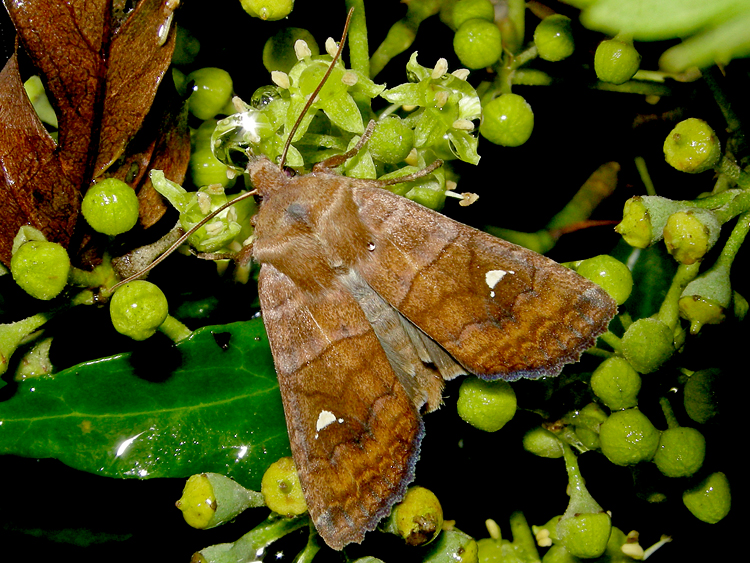
Merveille du Jour Griposia aprilina - 5 trapped in the garden between 16th October and 2nd November 2019 and 14 between 11th and 22nd October 2020 including a record count of 4 on the last date.  I average 9-10 a year

Merveille du Jour, North Elmham, 16th October 2019


Merveille du Jour, North Elmham, 23rd October 2019


Merveille du Jour, North Elmham, 11th October 2020


Merveille du Jour, North Elmham, 16th October 2020


Merveille du Jour, North Elmham, 19th October 2020


Brindled Green Dryobotodes eremita - None in 2019 but 3 here on consecutive nights from 18th to 20th October 2020 (they appeared to all be different individuals, certainly the first two were).  This species is surprisingly scarce here - before 2020 I'd only caught 4 in 6 years.  I used to get more when I lived in Bawdeswell.  Elsewhere one at the meadows on 8th September 2020.

Brindled Green, North Elmham Cathedral Meadows, 8th September 2020


Brindled Green, North Elmham, 18th October 2020


Deep-brown Dart Aporophyla lutulenta - None.  I've never seen this species and records in mid Norfolk are few and far between.  Not out of the question that I could find one round here though.


Black Rustic Aporophyla nigra - Totals of 17 in the garden between 25th September and 1st November 2019, my worst year since 2014, and 28 between 15th September and 22nd October 2020 (during which period I was away for a week).  I've averaged 32-33 a year here.  Elsewhere one at the meadows on 4th October 2019 and 32 in Cornwall.

Black Rustic, North Elmham, 25th September 2019


Feathered Ranunculus Polymixis lichenea - None in 2019; 42 at Tresidder in Cornwall between 3rd and 9th October 2020.  I've never seen this species in Norfolk and as it's almost only found at the coast and in the Norwich area I don't particularly expect to find one locally.  But there have been a couple of records not all that far away (e.g. Stibbard) so maybe there are a few knocking around this part of Norfolk too...

Feathered Ranunculus, Tresidder (Cornwall), 3rd October 2020


Feathered Ranunculus, Tresidder (Cornwall), 6th October 2020


Large Ranunculus Polymixis flavicincta - None.  Some people catch these regularly but I've only ever caught one here in North Elmham, in 2016, and just a small number elsewhere.


Dark Brocade Mniotype adusta - This must be one of the most widespread moths in Norfolk to have avoided me - there's even been a record in my road.  But until 2019 I'd never seen one, and I've still not found one in Norfolk.  It's perhaps a bit commoner on Mull where I caught 3 at Ceann Chnocain on 13th June 2019.


Dark Brocades, Ceann Chnocain (Mull), 13th June 2019


Next page: more Noctuidae

Monday, 15 April 2019

Mervs, a Hummer and some Ivy Bees

When I got back from Cornwall on 8th October pretty much the first thing I did was get the moth trap on. I didn't catch many moths that night, but 2 Merveille du Jour were new for the year.  Other moths in the trap were Long-horned Flat-body Carcina quercana, Garden Rose Tortrix Acleris variegana, 2 Narrow-winged Greys Eudonia angustea, Common Marbled Carpet, 11 Large Yellow Underwings, 4 Black Rustics, 2 Green-brindled Crescents, Red-line Quaker, Yellow-line Quaker, 2 Beaded Chestnuts, 5 Lunar Underwings, Sallow and 2 Snouts.


Merveille du Jours, North Elmham, 8th October


Also new for the year was the caddisfly Anabolia nervosa, aka Brown Sedge.  Other caddis were Limnephilus affinis and 2 Limnephilus lunatus.

Brown Sedge Anabolia nervosa, North Elmham, 8th October


Next day I was keen to get back to the meadows after a week away.  Butterflies included 6 Small Coppers, 2 Red Admirals and a Speckled Wood.

Small Copper, North Elmham Cathedral Meadows, 9th October


Also found a Forest Bug, a Broom Psyllid Arytaina genistae and a yellow leafhopper that turned out to be Fagocyba carri, a nice result as I don't think that's an especially common species.


Fagocyba carri (male, gen det), North Elmham Cathedral Meadows, 9th October


There were also 2 7-spot Ladybirds, 3 Willow Flea Beetles, a Hornet and the green lacewing Chrysoperla carnea agg.  I think this spider is Phylloneta sisyphia.  The epigynal features weren't totally clear but this seemed to be the best match.

Phylloneta sisyphia, North Elmham Cathedral Meadows, 9th October


Wildflowers included a late showing of Musk Mallow (also one plant that seemed to have leaves that were intermediate between this species and Common Mallow - a hybrid perhaps?) and Lady's Bedstraw.

Lady's Bedstraw, North Elmham Cathedral Meadows, 9th October


That evening there was a Many-plume Moth Alucita hexadactyla indoors, and in the trap, 2 Narrow-winged Greys Eudonia angustea, Shuttle-shaped Dart, Large Yellow Underwing, 5 Black Rustics, 4 Green-brindled Crescents, Merveille du Jour, Red-line Quaker, 2 Beaded Chestnuts, Lunar Underwing and the caddisfly Limnephilus lunatus.

The following night the trap was a little busier with Fulvous Clothes Moth Tinea semifulvella, Long-horned Flat-body Carcina quercana, Light Brown Apple-moth Epiphyas postvittana, Garden Rose Tortrix Acleris variegana, 17 Narrow-winged Greys Eudonia angustea, Treble Brown Spot, Garden Carpet, Common Marbled Carpet, Shuttle-shaped Dart, 4 Black Rustics, 3 Beaded Chestnuts, 2 Lunar Underwings, Pink-barred Sallow, Sallow, Rosy Rustic and Snout.

There was also the green lacewing Chrysoperla carnea, the beetle Lagria hirta and the following caddisflies: Mottled Sedge Glyphotaelius pellucidus, 5 Limnephilus auricula, Limnephilus flavicornis, 11 Limnephilus lunatus and Halesus radiatus.

I did some birding at Brancaster on 11th.  The non-avian highlight was a Hummingbird Hawk-moth in the dunes between the golf-course and the beach.

Hummingbird Hawk-moth, Brancaster, 11th October


There were also a couple of caddisflies Anabolia nervosa along the seawall and an Ivy Bee at Broad Lane.

Anabolia nervosa, Brancaster, 11th October


Ivy Bee, Brancaster, 11th October


I also popped along to the chalk pit at Titchwell where there were lots more Ivy Bees.


Ivy Bees, Titchwell Chalkpit, 11th October


That night a Large Wainscot was new for the year at home.

Large Wainscot, North Elmham, 11th October


The other moths were 5 Privet Tortrixes Clepsis consimilana, 2 Light Brown Apple-moths Epiphyas postvittana, Garden Rose Tortrix Acleris variegana, 18 Narrow-winged Greys Eudonia angustea, Single-dotted Wave, Mallow, Common Marbled Carpet, 6 Shuttle-shaped Darts, White-point, 3 Black Rustics, 7 Green-brindled Crescents, Red-line Quaker, Yellow-line Quaker, 7 Beaded Chestnuts, Lunar Underwing, 3 Barred Sallows, Sallow, Rosy Rustic, Straw Dot and Snout.

There were 5 green lacewings, at least one of which was Chrysoperla carnea (the other 4 were female aggs., presumably the same species).  There were several caddisflies: Brown Sedge Anabolia nervosa, Mottled Sedge Glyphotaelius pellucidus, Limnephilus affinis, 4 Limnephilus auricula, 11 Limnephilus lunatus, Limnephilus vittatus and Halesus radiatus.

Bugs consisted of Tarnished Plant Bug Lygus rugulipennis and 2 Pinalitus cervinus.  Also 7 Kybos leafhoppers (all female so not identifiable) and another Fagocyba carri, this time a new species for the garden.

Fagocyba carri (male, gen det), North Elmham, 11th October


Beetles consisted of Black Sexton Beetle, Lagria hirta and a new genus of rove beetle for me, Philonthus.  Unfortunately I don't have references that enable me to make a positive species-level ID, though I suspect it is carbonarius.


Philonthus sp., possibly Philonthus carbonarius, North Elmham, 11th October

Friday, 5 January 2018

Bacton Wood

The last field meeting of the year for the Norfolk Moth Survey was at Bacton Wood on Saturday 14th October.  We arrived a little late and when setting up I realised I'd forgotten my sheets.  The technique of suspending a light over a tripod on a white sheet is a little less effective when the white sheet is missing.  We did ok though - I had another trap and others brought theirs too.

Stuart found this occupied pupal case of a Common Bagworm Psyche casta on a tree trunk, a common species that's meant to be easy to find as a pupa, but the adult I'm still to find.

occupied pupal case of Common Bagworm Psyche casta, Bacton Wood, 14th October


Other moths were Small Red Slender Caloptilia rufipennella, Garden Midget Phyllonorycter messaniella, 2 White-shouldered Smudges Ypsolopha parenthesella, Long-horned Flat-body Carcina quercana, Winter Groundling Scrobipalpa costella, 4 London Dowds Blastobasis lacticolella, White-faced Tortrix Pandemis cinnamomeana, Light Brown Apple Moth Epiphyas postvittana, 8 Dark-triangle Buttons Acleris laterana, 2 Ashy Buttons Acleris sparsana, 4 Garden Rose Tortrixes Acleris variegana, Notch-wing Button Acleris emargana, Bud Moth Spilonota ocellana, Many-plumed Moth Alucita hexadactyla, 2 Double-striped Tabbies Hypsopygia glaucinalis, Mallow, 3 Red-green Carpets, 3 Common Marbled Carpets, 4 Pine Carpets, 15 Grey Pine Carpets, 50 Spruce Carpets, 2 Pale November Moths, Brimstone Moth, Feathered Thorn, Buff Footman, 2 Green-brindled Crescents, 3 Chestnuts, Brick, 2 Barred Sallows and 3 Snouts.


Winter Groundling Scrobipalpa costella, Bacton Wood, 14th October


The only lacewing I retained was Chrysoperla carnea but a caddisfly was more interesting - my first Limnephilus decipiens (there were also 3 Limnephilus lunatus).

Limnephilus decipiens, Bacton Wood, 14th October


A Water Boatman proved to be Callicorixa praeusta, the first time I'd identified this species.

Callicorixa praeusta, Bacton Wood, 14th October


This psyllid was another lifer, Cacopsylla melanoneura.

Cacopsylla melanoneura, Bacton Wood, 14th October


Two leafhoppers were challenging.  I narrowed them down to one of the two Acericerus species but couldn't decide between Acericerus vittifrons and Acericerus ribauti.  The latter doesn't feature in the RES Handbook as its a recent arrival in the UK but the British Bugs website gives a couple of tips to identify the males (one of the two was a male).  Mine quite unambiguously had a long dark midline on the face rather like vittifrons (and quite unlike ribauti) and equally unambiguously had the short antennal palettes of ribauti (and clearly wrong for vittifrons).  These were the only similar species showing in the British Bugs gallery and the RES Handbook seeemed to confirm I was in the right area but didn't offer any further options.  So unable to proceed any further I retained the specimens for later study.  And that would be the end of the story so far but that I had another idea when typing this up... the British Bugs website has a checklist of all the leafhoppers and sure enough there is a third species of Acericerus listed on there which doesn't yet feature in the gallery.  A quick google found lots of good images of this species from Europe and well, they're basically identical to the two I'd taken.  I will keep them in case they prove to be significant (it's another new arrival to the UK amd I'm not sure if there are any Norfolk records yet or not (probably - several in Suffolk)) but I'm reasonably happy now that they are this third species, Acericerus heydenii.


Acericerus heydenii (male), Bacton Wood, 14th October


Acericerus heydenii (female), Bacton Wood, 14th October


Other less interesting bugs were Birch Shieldbug and 3 Empoasca vitis.  We saw one Hornet, an Orange Ladybird and lots of large Dor Beetles on the ground near my light which had particularly strong bluish-purple shine on the underside.  I retained one to identify and it proved to be another new species for me, Woodland Dor Beetle Anoplotrupes stercorosus.

Woodland Dor Beetle Anoplotrupes stercorosus, Bacton Wood, 14th October


So even if the moths were a bit so-so the other insects made the event very worthwhile from my perspective.

There were hardly any moths at home that night although Merveille du Jour was new for the year.

Merveille du Jour, North Elmham, 14th October


The few others were 3 Narrow-winged Greys Eudonia angustea, 2 November Moths, Beaded Chestnut and Lunar Underwing.   One of the November Moths was very interesting as the genitalia hadn't formed properly.  The 8th sternite was effected too making identification difficult but there were two smudges which I suspect would have been the projections had they formed properly, in which case their distance from one another eliminated Pale November Moth.  The valvae had not developed properly, joined together to form a broadly-spherical but bi-lobed sac.  The edges of the lobes had darkened ridges with teeth like the valvae edges of November and Pale November Moths (thus eliminating Autumnal Moth).  I am not entirely sure if this was simply a male that had developed aberrantly or if it was an intersex.  The structure of the 8th sternite was rather female-like but although the genitalia themselves were very unusual I couldn't really identify anything female-like (but most male parts were there, if not formed how they should have been).  For that reason I suspect it wasn't intersex but had simply been malformed.  The moth seemed healthy enough until I opened its abdomen, but I'm quite sure it would never have been able to breed with its genitalia in that state!

presumed November Moth with abnormally developed genitalia, North Elmham, 14th October


In case anyone's interested I've done a PDF with photos and a fuller description of the genitalia.

2 Limnephilus lunatus were the only caddisflies but there was also a beetle, a small weevil.  There are good keys to a lot of the beetle families freely available online but although Mark Gurney has some excellent guides to weevils I can't yet find an online source that allows a complete identification of some groups of weevils.  Mark Gurney's guides got me into the right ballpark (I think) for this weevil and by comparing various images from a number of online sources I eventually reached an ID that I am fairly sure is correct.  Perhaps I should leave it as tentative at this stage but I think it's Notaris acridulus.


probable Notarus acridulus, North Elmham, 14th October