Description


A diary of my mothing activity covering highlights and photos from my moth trapping activities. Mainly Norfolk (UK), occasionally beyond. I may mention other wildlife sightings here, especially insects, but for birds see my birding diary.
Showing posts with label Silvery Leafcutter Bee. Show all posts

Friday, 4 August 2017

Fritillaries, Six-belts and a Norfolk Owlet

On Monday 26th June, after finding Peacock, Comma and Meadow Brown in the garden (Comma was new for the year here) early on, I headed up to Burnham Overy.  I was hoping to see, among other things, Dark Green Fritillaries.  I wasn't disappointed - I must have seen at least 20 Dark Green Fritillaries, quite possibly a lot more.  And I didn't have to wait until I reached the dunes - these were feeding along the seawall.


Dark Green Fritillaries, Burnham Overy, 26th June


A good selection of other butterflies included 2 Small Whites, 5 Brown Arguses, Common Blue, 9 Small Tortoiseshells, at least 140 Meadow Browns, 5 Ringlets, 5 Small Heaths, 4 Essex Skippers and 4 Small Skippers.

I had another go at attracting Six-belted Clearwings to lure and this time I was successful - I saw my first two.  I also saw a Five-spot/Narrow-bordered Five-spot Burnet agg. in the same area.


Six-belted Clearwing, Burnham Overy, 26th June


There were about 15 Welsh Chafers in the same area - the same place I saw them a while back.  I'd started to doubt my ID given that they're not shown as occurring here on the NBN Atlas so I retained one for re-checking.  I keyed it out very carefully and apart from being a little on the small side it keyed out perfectly for Welsh Chafer Hoplia philanthus.

Welsh Chafer Hoplia philanthus, Burnham Overy, 26th June


I was pleased to bump into this Forester, a species I've rarely seen before.

Forester, Burnham Overy, 26th June


I often see Spindle Ermines Yponomeuta cagnagella around the spindle trees in the dunes, either the adults or the larvae in their coccoons.  Sometimes the caterpillars strip the trees completely.  It was interesting to see huge numbers of adults today that had clearly just emerged - and also to see even more huge numbers of pupae at the bases of the trees.  I must have seen at least 500 adults and I should think that there must have been thousands of pupae, many still clealy occupied.


Spindle Ermine Yponomeuta cagnagella pupae, Burnham Overy, 26th June


At the east end of the dunes I met a chap looking at bugs who was on holiday with his family.  Turns out that he's a county recorder for bugs and he had a couple of interesting ones with him which he showed me.  I can't remember the names of either, but one he said was easily identified by its disctinctive diamond-shaped markings and even in my really awful photo I think these are clear enough to identify it as Graptopeltus lynceus.

Graptopeltus lynceus, Burnham Overy, 26th June


He had been looking for one of two rare species that live under Storksbill (if I remember rightly) and I thought he had said he had found one, and that that was the other bug he showed me.  According to my recollection he wasn't yet sure which of the two it was.  Having looked it up I'm guessing he was referring to the Arenocoris spp. but although the bug he showed me looks a bit like one of those, I'm not sure it is.  Maybe he never said it was and I just remembered wrong, or maybe I got confused and photographed the wrong insect, or maybe I'm now wrong and it really is one of the Arenocoris spp. as I thought he'd said, but I can't help thinking that it is in fact Coranus woodroffei.  Please let me know if you know better though.

Coranus woodroffei I think?, Burnham Overy, 26th June


Anyway, he was a lovely guy and I enjoyed meeting him and chatting about bugs and things.  I went on to find a couple more bugs - Rhopalus parumpunctatus, a new one for me, and Common Green Caspid Lygocoris pabulinus.

Rhopalus parumpunctatus, Burnham Overy, 26th June


Common Green Caspid Lygocoris pabulinus, Burnham Overy, 26th June


I also found a lovely Sulphur Beetle Cteniopus sulphureus, another new species for me.

Sulphur Beetle Cteniopus sulphureus, Burnham Overy, 26th June


My main moth target for today was a Rosebay Willowherb specialist that is only found here.  It was found to be common here in 1980 when it was added to the British list, though a couple of earlier records from the west of the county came to light subsequently.  I believe it has been recorded in Suffolk and in Lincolnshire too, but so far as I know Holkham NNR (which includes Burnham Overy Dunes) is the only place it is regularly recorded in the UK - and even here there was only one record between 1980 and 2014.  Anyway, I found my first - a Norfolk Owlet Scythris inspersella.

Norfolk Owlet Scythris inspersella, Burnham Overy, 26th June


Other moths included Downland Conch Aethes tesserana, 2 Barred Grass-veneers Agriphila inquinatella, 2 Pearl Grass-veneers Catoptria pinella, Common Carpet, Lime-speck Pug, Common Footman and 2 Cinnabars.

I keyed the following bee out to Black-headed Leafcutter Bee Megachile circumcincta - hope I got that right!

[2026 update: I surely didn't get that right... I think it must have been Silvery Leafcutter Bee Megachile leachella.]


Silvery (not Black-headed) Leafcutter Bee Megachile leachella, Burnham Overy, 26th June


Other insects of note included Dune Villa Villa modesta, Swollen-thighed Beetle Oedemera nobilis and my first identified Red-legged Spider Wasp Episyron rufipes (pretty sure I've seen them before without knowing what they were).

Dune Villa Villa modesta, Burnham Overy, 26th June


Swollen-thighed Beetle Oedemera nobilis, Burnham Overy, 26th June


Red-legged Spider Wasp Episyron rufipes, Burnham Overy, 26th June

Sunday, 30 October 2016

Copper Ermel, Dowdy Plume, Dune Villas and a leaf cut by a bee

For the third night in the row, 24th August was a good night.  The highlight was my first ever adult Copper Ermel Roeslerstammia erxlebella.

Copper Ermel Roeslerstammia erxlebella, North Elmham, 24th August


New for the year were Small Birch Bell Epinotia ramella, Centre-barred Sallow and Old Lady.

Centre-barred Sallow, North Elmham, 24th August


I was more surprised to see a Rosy Footman, a pristine fresh individual so I suspect a second generation which isn't normal for this species.  Narrow-winged Grey Eudonia angustea was also my first of its second generation this year, although for that species it's the first spring generation that's a relatively new phenonemon.

Four species of migrant moth was good for here:  3 Diamond-back Moths Plutella xylostella, Rusty-dot Pearl Udea ferrugalis, 2 Rush Veneers Nomophila noctuella and Silver Y.

Other micros were Oak Bent-wing Bucculatrix ulmella, Golden Argent Argyresthia goedartella, Wainscot Smudge Ypsolopha scabrella, Small Clover Case-bearer Coleophora alcyonipennella, 2 Brown House Moths Hofmannophila pseudospretella, Long-horned Flat-body Carcina quercana, 2 Dingy Dowds Blastobasis adustella, 2 Chequered Fruit-tree Tortrixes Pandemis corylana, Dark-triangle Button Acleris laterana, 2 Garden Rose Tortrixes Acleris variegana, 7 Common Marbles Celypha lacunana, 2 Pearl Veneers Agriphila straminella, 5 Common Grass-veneers Agriphila tristella, 7 Elbow-stripe Grass-veneers Agriphila geniculea, Chequered Grass-veneer Catoptria falsella, 3 Water Veneers Acentria ephemerella, 3 Ringed China-marks Parapoynx stratiotata, Beautiful China-mark Nymphula nitidulata, 6 Garden Pebbles Evergestis forficalis, 2 Pale Straw Pearls Udea lutealis, 7 Mother of Pearls Pleuroptya ruralis, Ash-bark Knot-horn Euzophera pinguis and Beautiful Plume Amblyptilia acanthadactyla.

The remainder of the macros were 3 Single-dotted Waves, 3 Riband Waves, Flame Carpet, 2 Red Twin-spot Carpets, Dark-barred Twin-spot Carpet, 6 Common Carpets, 10 Green Carpets, 2 Wormwood/Currant Pugs, Tawny Speckled Pug, 2 Double-striped Pugs, 3 Treble-bars, 3 Yellow-barred Brindles, 25 Brimstone Moths, 2 Canary-shouldered Thorns, Dusky Thorn, 3 Willow Beauties, 2 Poplar Hawkmoths, 2 Iron Prominents, Lesser Swallow Prominent, Swallow Prominent, 19 Flame Shoulders, 24 Large Yellow Underwings, 4 Lesser Yellow Underwings, 10 Lesser Broad-bordered Yellow Underwings, Small Square-spot, 6 Setaceous Hebrew Characters, 5 Square-spot Rustics, 2 Common Wainscots, Copper Underwing, 2 Straw Underwings, Dark Arches, Cloaked Minor, Common Rustic, 9 Flounced Rustics, 2 Burnished Brasses, 2 Spectacles, 30 Straw Dots and 3 Snouts.

Treble-bar (female), North Elmham, 24th August


Green Lacewings consisted of 2 Cunctochrysa albolineata and Dichochrysa flavifrons.  Caddisflies included a Athripsodes albifrons and bugs included a Forest Bug.

Next day I headed up to Burnham Overy for some birding.  Saw some birds but the non-birds were more varied and interesting.  I saw 4 Toads, 2 Natterjacks and 2 Common Toads.  Later on with Andrew B and his colleague we found a Common Lizard.

Common Lizard, Burnham Overy Dunes, 25th August


Natterjack, Burnham Overy Dunes, 25th August


There were a lot of plume moths in the dunes.  Some looked like, and one was subsequently confirmed as being, Breckland Plume Crombrugghia distans - at least 10 of these seen.  Others looked rather like Common Plume Emmelina monodactyla, but they didn't seem big enough.  I couldn't immediately see what else they could be though, so suspecting that's what they were I retained one just in case.  Good job I did... they were, or at least that one was, Dowdy Plume Stenoptilia zophodactylus, a new moth for me.  At least 6 of these, assuming they were all the same.

 Breckland Plume Crombrugghia distans (male, gen det), Burnham Overy Dunes, 25th August


Dowdy Plume Stenoptilia zophodactylus (male, gen det), Burnham Overy Dunes, 25th August


Other moths were 6 Spindle Ermines Yponomeuta cagnagella, 2+ Beautiful Groundlings Caryocolum marmorea, 6 Yellow-spot Tortrixes Pseudargyrotoza conwagana, Common Marble Celypha lacunana, 10+ Elbow-stripe Grass-veneers Agriphila geniculea, Hook-tipped Grass-veneer Platytes alpinella, Straw-barred Pearl Pyrausta despicata, 3 Common Carpets and 3 Yellow Belles.

Spindle Ermine Yponomeuta cagnagella, Burnham Overy Dunes, 25th August


Butterflies included getting on for 200 Small/Green-veined Whites along the sea wall.  Both species were involved - I identified and counted 55 Small Whites and 23 Green-veined Whites.  Also Small Copper, 3 Brown Arguses, Common Blues, Small Tortroiseshells, Wall Browns, Meadow Browns, Gatekeeper, Small Heaths (most of the non-Whites were in the dunes).  Dragonflies included Migrant Hawker and at least 2 Ruddy Darters.

I was mystified by a green thing flying with a strange up and down motion through the dunes.  It had quite a big very green body and was flying most bizarrely - or at least that was what I first thought.  When it landed I realised that it was in fact a bee carrying a leaf!  Although I was vaguely aware that there was such a thing as a leafcutter bee I'd never seen one carrying a leaf it had cut before.  Turns out, I think, that it was Silvery Leafcutter Bee Megachile leachella, my first leafcutter in the UK.

Silvery Leafcutter Bee Megachile leachella, Burnham Overy Dunes, 25th August


Other interesting insects included 2 Dune Villas, a distinctive Bee Fly I was familiar with only through a couple of photos I'd seen on Twitter recently.


Dune Villas Villa modesta, Burnham Overy Dunes, 25th August


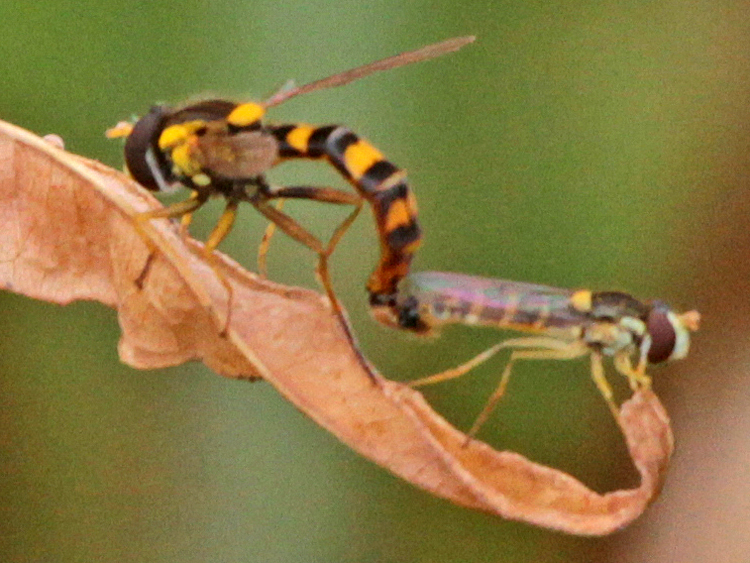
These two hoverflies looked so different from one another I'd have imagined they were different species were it not for the fact that they were copulating.  Turns out they were (both) Sphaerophoria scripta.


Sphaerophoria scripta, Burnham Overy Dunes, 25th August


Andrew Bloomfield kindly showed me some more spiders.  These included Tegenaria agrestis, Alopecosa barbipes and a Theridion sp.  I think he said he needed to check the ID of the latter and I've not followed up to find out which species it was.  The very limited research I've done (googling) suggests it may be Theridion pictum though if I remember rightly T varians was mentioned.

Alopecosa barbipes, Burnham Overy Dunes, 25th August


Theridion sp. (looks like images of Theridion pictum), Burnham Overy Dunes, 25th August


Andy also pointed out some interesting grasshoppers.  First were a couple of Lesser Marsh Grasshoppers one of which was an unusual pink form.  There was also Mottled Grasshopper and Andy found a Long-winged Conehead, apparently not a common sighting here.

Lesser Marsh Grasshopper, Burnham Overy Dunes, 25th August


Long-winged Conehead, Burnham Overy Dunes, 25th August


Also thanks to Andy for pointing out Tiny Earthstars - a rare fungus that is not found at many other sites.


Tiny Earthstars, Burnham Overy Dunes, 25th August