Description


A diary of my mothing activity covering highlights and photos from my moth trapping activities. Mainly Norfolk (UK), occasionally beyond. I may mention other wildlife sightings here, especially insects, but for birds see my birding diary.
Showing posts with label Dark Bush-cricket. Show all posts

Sunday, 28 April 2019

Sprawling Sprawlers and the last of the Turnips

The best moth of the night of 25th October was a Grey Shoulder-knot, my first autumn example since 2014.  The Shoulder-knot I expect to see in October is Blair's Shoulder-knot but in 2018 I didn't catch a single one.

Grey Shoulder-knot, North Elmham, 25th October


Other things were 6 Narrow-winged Greys Eudonia angustea, Common Plume Emmelina monodactyla, 2 November Moths, 3 Pale November Moths, Feathered Thorn, 2 Sprawlers, 2 Green-brindled Crescents, Yellow-line Quaker and the caddisfly Mottled Sedge Glyphotaelius pellucidus.

There were only 3 moths the following night: 2 Narrow-winged Greys Eudonia angustea and Yellow-line Quaker.  The following day was very windy and that night there were just 2 Pale November Moths, and then on 28th Narrow-winged Grey Eudonia angustea and Pale November Moth.

On 29th there was a Merveille du Jour and 2 Yellow-line Quakers and the low numbers continued with Narrow-winged Grey Eudonia angustea, Feathered Thorn and the caddisfly Brown Sedge Anabolia nervosa on 30th.

There was a bit more on 31st including an unprecedented count of 10 Pale November Moths.  Others were 2 November Moths, a female November Moth agg., Feathered Thorn, Mottled Umber, White-point, 2 Sprawlers, Satellite, Yellow-line Quaker, the caddisflies Limnephilus lunatus and Limnephilus vittatus and the mirid bug Pinalitus cervinus.

The following night there were November Moth, 3 Pale November Moths, Feathered Thorn, Sprawler, 2 Green-brindled Crescents, Brick, the green lacewing Chrysoperla carnea and the mirid bug Pinalitus cervinus.

A wander round the Cathedral Meadows on 2nd November turned up a few bits and pieces.  The White Willow still held at least one Willow Flea Beetle Crepidodera aurata and also had the leafhopper Lindbergina aurovittata.

Lindbergiana aurovittata, North Elmham Cathedral Meadows, 2nd November


A quick sweep of the Broom produced 3 Broom Psyllids Arytaina genistae, the barklouse Ectopsocus petersi and a new weevil for me, Pirapion immune. Apparently the latter is more commonly recorded on Gorse - well, there is a little bit of gorse amongst the Broom, and a fair bit more only a little distance away.

Pirapion immune, North Elmham Cathedral Meadows, 2nd November


Ectopsocus petersi, North Elmham Cathedral Meadows, 2nd November


Found a few occupied leafmines in fallen Oak leaves along the railway including 3 Five-spot Pigmies Ectoedemia quinquella (in one leaf) and White-banded Pigmy Ectoedemia albifasciella.


occupied leadfmines of Five-spot Pigmies Ectoedemia quinquella, North Elmham Cathedral Meadows, 2nd November


occupied leadfmine of White-banded Pigmy Ectoedemia albifasciella, North Elmham Cathedral Meadows, 2nd November


I found these galls on Goat/Grey Willow leaves but can't quite make up my mind if they are made by the fly Iteomyia capreaea or the mite Aculus laevis.  I didn't have the gall book at the time and I didn't retain the leaf for checking more detail.  Hopefully I'll find them again this year.


unidentified galls, apparently either Iteomyia capreae or Aculus laevis, North Elmham Cathedral Meadows, 2nd November


That night there were 2 Sprawlers and a Yellow-line Quaker in the garden moth trap.

I think this harvestman that I photographed in the house must be Leiobunum blackwalli, the first I've identified.


Leiobunum blackwalli, North Elmham, 3rd November


A few more moths in the trap that night, but not much variety: 3 Feathered Thorns, 7 Sprawlers and a Chestnut.

The following night the moth trap produced my first new moths for the year for over 2 weeks, 2 December Moths.

December Moths, North Elmham, 4th November


It wasn't a bad catch by November standards with 4 Narrow-winged Greys Eudonia angustea, Mallow, 2 November Moths, 3 Pale November Moths, 9 Feathered Thorns, Mottled Umber, Turnip Moth, 15 Sprawlers, 2 Green-brindled Crescents, Chestnut, Brick and Yellow-line Quaker.

Sprawler, North Elmham, 4th November


An early morning walk round the meadows didn't produce much on 5th - a 7-spot Ladybird being the only non-avian thing I noted.  But I went back after dark with the headtorch and found a few bits and pieces. I could hear what I suspected was a Dark Bush-cricket as I walked down the track and whereas previous attempts to find calling bush-crickets had not fared well this one did eventually give itself up.  It was indeed a Dark Bush-cricket.


Dark Bush-cricket, North Elmham Cathedral Meadows, 5th November


It was a little too cold for most insects but I did find a couple of Feathered Thorns and the ground beetle Harpalus affinis.  I also noted Walnut Orb Weaver Nuctenea umbratica, Common Shiny Woodlouse Oniscus asellus and White-legged Snake Millipede Tachypodoiulus niger.

Feathered Thorn, North Elmham Cathedral Meadows, 5th November


Harpalus affinis, North Elmham Cathedral Meadows, 5th November


That night the garden moth trap produced 15 Sprawlers again...

15 Sprawlers, North Elmham, 5th November


It was a good year for Turnip Moths.  I never do very well for this species compared to many other moth trappers.  My previous best year here was a total of 13 individuals in 2015, with just 4 in 2016 and only one or two in 2017.  On 5th November I recorded my last of 2018 - my 51st individual, so about 4 times more than my previous best.

Turnip Moth, North Elmham, 5th November


Other things that night included Garden Midget Phyllonorycter messaniella, London Dowd Blastobasis lacticolella, 5 Narrow-winged Greys Eudonia angustea, Common Plume Emmelina monodactyla, 3 Pale November Moths, 4 other November Moth aggs. (3 unidentifiable females and a male that seemed intermediate but I felt was most likely an extreme Pale), 6 Feathered Thorns, 2 Shuttle-shaped Darts, White-point, Green-brindled Crescent, Yellow-line Quaker, 2 of the green lacewing Chrysoperla carnea and 2 of the caddisfly Limnephilus lunatus.

There were 15 Sprawlers for the third consecutive night on 6th - I don't think they were the same moths both nights, at least there was certainly a fair bit of change-over with the other insects.  Other moths were Narrow-winged Grey Eudonia angustea, December Moth, November Moth, 4 Pale November Moths, 7 Feathered Thorns, Mottled Umber, Shuttle-shaped Dart, 2 White-points, Green-brindled Crescent, Chestnut and Yellow-line Quaker. Non-moths included 2-3 of the green lacewings Chrysoperla carnea, the caddisflies Limnephilus affinis and 3 Limnephilus lunatus, the bugs Lygus pratensis and Pinalitus cervinus, an Edwardsiana leafhopper sp. and the barkfly Ectopsocus briggsi.

A Dark Chestnut the following night was my first of the year, belatedly perhaps.

Dark Chestnut, North Elmham, 7th November


Apart from the Orchard Ermine Yponomeuta padella complex, which cannot be identified on external features or genitalia, and apart from female Epirrita spp., it's pretty unusual nowadays for me to catch a moth that I cannot identify one way or another.  But here's one I'm not entirely sure about.  Once I would have seen the strongly pale-edged median band and the dark lines delineating some of the cells within the median band and called it a Spruce Carpet, but it's not as easy as that.  Apparently Grey Pine Carpet can be as grey and contrasty as this, and as it doesn't have much of a postmedian line I think that has to remain in the frame.  I kept hold of it, hoping it would be a male so I could check its antennae (males of the two species have different-shaped segments of the antennae) but alas it's a female.  I suspect some people would call this one way or the other, and if you know what you're talking about and are convinced it is identifiable then please let me know, but for now I shall leave it unidentified.

Spruce or Grey Pine Carpet (female), North Elmham, 7th November


Other moths were Diamond-back Plutella xylostella, 3 Narrow-winged Greys Eudonia angustea, Pale November Moth, 6 Sprawlers, 2 Bricks and 2 Yellow-line Quakers. There was also a green Llacewing Chrysoperla carnea agg., 5 of the caddisfly Limnephilus lunatus and the barkfly Graphopsocus cruciatus in the trap and a Common Heart-shield beetle Nebria brevicollis on the ground.

Graphopsocus cruciatus, North Elmham, 7th November


Common Heart-shield Nebria brevicollis, North Elmham, 7th November

Monday, 18 February 2019

A new ant, a new fly and a new barklouse

On 19th August I did some moth-trapping at the meadows.  There was a nice selection of moths, though nothing earth-shattering.  The highlight was probably Hook-tipped Grass-veneer Platytes alpinella, a species I had at home twice in 2015 but not since.

Hook-tipped Grass-veneer Platytes alpinella, North Elmham Cathedral Meadows, 19th August


The other moths were Carrion Moth Monopis weaverella, Blackthorn Slender Parornix torquillella, Brown Rowan Argent Argyresthia semifusca, Dark Ash-bud Moth Prays ruficeps, 2 Wainscot Smudges Ypsolopha scabrella, White-shouldered Smudge Ypsolopha parenthesella, 6 Clover Case-bearers Coleophora alcyonipennella, Brown House Moth Hofmannophila pseudospretella, Mouse-ear Groundling Caryocolum fraternella, Knapweed Conch Agapeta zoegana, Chequered Fruit-tree Tortrix Pandemis corylana, Common Marble Celypha lacunana, Rush Marble Bactra lancealana, 2 Marbled Piercers Cydia splendana, 20 Common Grass-veneers Agriphila tristella, Chequered Grass-veneer Catoptria falsella, Marsh Grey Eudonia pallida, Ringed China-mark Parapoynx stratiotata, Dark-barred Twin-spot Carpet, 2 Common Carpets, Green Carpet, Tawny Speckled Pug, 2 Brimstone Moths, Turnip Moth, 2 Flame Shoulders, Large Yellow Underwing, Broad-bordered Yellow Underwing, 15 Lesser Broad-bordered Yellow Underwings, 6 Setaceous Hebrew Characters, Six-striped Rustic, Square-spot Rustic, Nutmeg, 2 Common Wainscots, Centre-barred Sallow, Dun-bar, 3 Vine's Rustics, 2 Silver Ys and Straw Dot.

White-shouldered Smudge Ypsolopha parenthesella, North Elmham Cathedral Meadows, 19th August


Chequered Grass-veneer Catoptria falsella, North Elmham Cathedral Meadows, 19th August


This Dark Bush-cricket spent the evening on the sheet that the trap was sitting on.


Dark Bush-cricket, North Elmham Cathedral Meadows, 19th August


2 Dichochrysa prasina were the only lacewings I noted and there was a Common Earwig.  I didn't check all the caddisflies, but of the ones I did there was a nice selection: Ithytrichia lamellaris, 2 Hydropsyche pellucidula, 2 Small Silver Sedges Lepidostoma hirtum, Limnephilus lunatus, Limnephilus sparsus, Molanna angustata, Athripsodes albifrons and Grouse Wing Mystacides longicornis.

Bugs included Common Green Capsid Lygocorus pabulinus, Tarnished Plant Bug Lygus rugulipennis (I confirmed one but there were lots of similar bugs), Macrosteles sexnotatus and 4 water boatmen.  I retained one of the latter for checking, making sure, or so I thought, that I had retained a male.  At home I discovered it was in fact a female, so not identifiable.

Beetles included 2 Violet Ground Beetles Carabus violaceus, 4 Strawberry Seed Beetles Harpalus rufipes, Bradycellus verbasci, Hydrobius fuscipes, Orange Ladybird, 2 Harlequin Ladybirds and Acorn Weevil.

Violet Ground Beetle Carabus violaceus, North Elmham Cathedral Meadows, 19th August


Hydrobius fuscipes, North Elmham Cathedral Meadows, 19th August


The only lifers I had this night were a flying ant which I keyed out to Lasius umbratus and a fly which I would normally ignore but it was such a beauty I had to see if I could identify it.  Turns out it was a Green Gem Microchrysa flavocornis - the vernacular name is very appropriate.  My photos don't do it justice.

Lasius umbratus, North Elmham Cathedral Meadows, 19th August


Green Gem Microchrysa flavocornis, North Elmham Cathedral Meadows, 19th August


I had previously reported that last time I moth trapped down here I got stung by a German Wasp.  Well I'm sorry, I got mixed up.  It was actually this night that I got stung, not back then, and although I never discovered the true identity of the actual wasp that stung me, the only wasp I did identify this night was a Common Wasp.

Spiders included at least one Nuctenea umbratica.

At home that night a migrant species, Rush Veneer Nomophila noctuella was the only new moth for the year.

Rush Veneer Nomophila noctuella, North Elmham, 20th August


Other moths were New Oak Slender Caloptilia robustella, 2 Blackthorn Slenders Parornix torquillella, Phyllonorycter sp. (escaped before identification), Large Lance-wing Epermenia falciformis, House Neb Bryotropha domestica, Barred Fruit-tree Tortrix Pandemis cerasana, Light Brown Apple-moth Epiphyas postvittana, Dark-triangle Button Acleris laterana, 3 Garden Rose Tortrixes Acleris variegana, 3 Barred Marbles Celypha striana, 6 Common Marbles Celypha lacunana, 2 Blotched Marbles Endothenia quadrimaculana, Nut-bud Moth Epinotia tenerana, 23 Common Grass-veneers Agriphila tristella, 6 Elbow-stripe Grass-veneers Agriphila geniculea, 4 Garden Pebbles Evergestis forficalis, Pale Straw Pearl Udea lutealis, Mother of Pearl Pleuroptya ruralis, Beautiful Plume Amblyptilia acanthadactyla, 2 Common Plumes Emmelina monodactyla, 3 Orange Swifts, Blood-vein, Small Blood-vein, Garden Carpet, Tawny Speckled Pug, 4 Double-striped Pugs, 5 Brimstone Moths, 2 Dusky Thorns, Rosy Footman, Turnip Moth, 4 Flame Shoulders, Large Yellow Underwing, 2 Lesser Broad-bordered Yellow Underwings, 3 Setaceous Hebrew Characters, Square-spotted Clay, Antler Moth, Common Wainscot, 7 Flounced Rustics, 2 Vine's Rustics, Spectacle and 3 Straw Dots.

Mayflies, lacewings and caddisflies consisted of 2 Pond Olives Cloeon dipterum, Blue-winged Olive Serratella ignita, 2 Chrysopa commata, Chrysoperla carnea, 3 Hemerobius lutescens, Micromus variegatus, Polycentropus irroratus, Hydropsyche pellucidula and Mottled Sedge Glyphotaelius pellucidus.

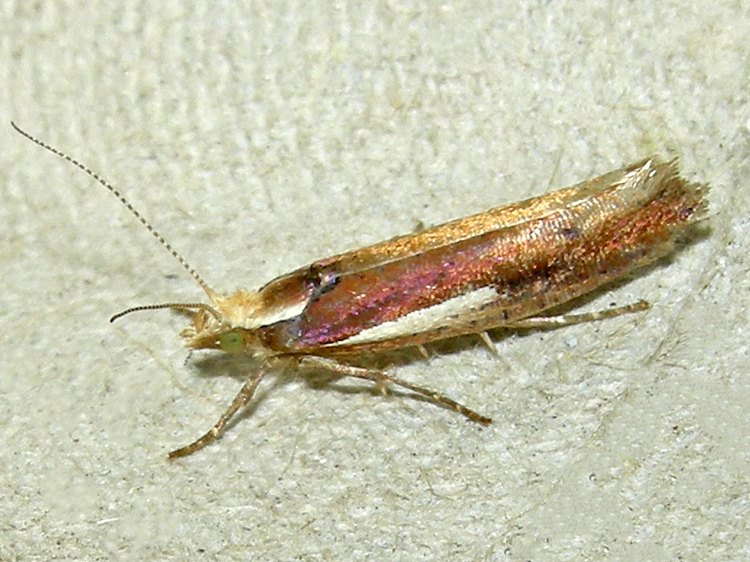
The barkfly (or barklouse) Ectopsocus petersi was a new species for me, or at least the first time I had identified one.

Ectopsocus petersi, North Elmham, 19th August


Most of my Kybos leafhoppers are unidentifiable females so it was nice to get a male Kybos betulicola, the first I've had this year.  Arguably the Alebra albostriella was a better looking insect.

Kybos betulicola (male, gen det), North Elmham, 19th August


Alebra albostriella, North Elmham, 19th August


Other bugs were Birch Shieldbug, 2 Forest Bugs and Tarnished Plant Bug Lygus rugulipennis.  Beetles were Amara apricaria, 7 Bradycellus verbasci and Aphodius rufipes.

Saturday, 23 September 2017

More Frits and a Dark Fleabane Neb

Flounced Rustic was new for the year on Sunday 13th August, the first of many of this common and not terribly exciting species.

Flounced Rustic, North Elmham, 13th August


It was a fairly quiet night - the other moths were Little Dwarf Elachista canapennella, Brown House Moth Hofmannophila pseudospretella, Dingy Dowd Blastobasis adustella, Garden Rose Tortrix Acleris variegana, Rush Marble Bactra lancealana, 9 Common Grass-veneers Agriphila tristella, Clouded Border, Willow Beauty, 3 Flame Shoulders, 2 Large Yellow Underwings, 3 Lesser Broad-bordered Yellow Underwings, Small Square-spot, 5 Setaceous Hebrew Characters, Square-spotted Clay, Burnished Brass, Spectacle and Straw Dot. A Limnephilus lunatus was the only caddis.

Next day I took my parents round Foxley Wood where Silver-washed Fritillaries were abounding.  I put down 6+ in my notes but I've got 6 different individuals among my photos and I'm pretty sure I didn't photograph anywhere near all of them.


Silver-washed Fritillaries, Foxley Wood, 14th August


Another dozen species of butterfly included Large, Small and Green-veined Whites, Brimstone, Brown Argus, Common Blue, Peacock (at least 30), Painted Lady, Comma, Meadow Brown, Gatekeeper and Speckled Wood.

Brimstone, Foxley Wood, 14th August


Peacock, Foxley Wood, 14th August


Painted Lady, Foxley Wood, 14th August


Comma, Foxley Wood, 14th August


There were some good moths too.  There was masses of Fleabane flowering here and I looked hard to find a gelechiid that flies in the day and can often be found on Fleabane flowers, but which I'd never seen.  This was successful - I ended up finding 2 Dark Fleabane Nebs Apodia bifractella.  Perhaps surprisingly since this is a fairly well-covered site there don't appear to be any previous records for the 10k square.

Dark Fleabane Neb Apodia bifractella, Foxley Wood, 14th August


A patch of Goldenrod had a Bordered Beauty feeding on it, a moth I don't see very often.  Other moths recorded were Pale-streak Grass-veneer Agriphila selasella, Pearl Veneer Agriphila straminella, 2 Common Grass-veneers Agriphila tristella, Shaded Broad-bar, 2 Common Carpets, Small Phoenix and 2 Straw Dots.

A Viburnum Beetle Pyrrhalta viburni was another insect feeding on the Fleabane and a new species for me.


Viburnum Beetle Pyrrhalta viburni, Foxley Wood, 14th August


My second ever Damsel Bug was a new species for me too, Marsh Damsel Bug Nabis limbatus.  The only Damsel Bug I had seen previosuly was one I trapped in  Cornwall in 2014 - and it proved to be a first for Britain (Nabis capsiformis) so it's high time I found one of the common species in this family! A green mirid bug proved to be Neolygus contaminatus.


Marsh Damsel Bug Nabis limbatus, Foxley Wood, 14th August


Dragonflies included several Migrant Hawkers, a Southern Hawker and a few Common Darters.  These Dark Bush-crickets were nice to see - not one I find very often.


Dark Bush-crickets, Foxley Wood, 14th August


As usual I had little success identifying fungi.  I think these are Orange Oak Boletes though Orange Birch Bolete seems to be very similar (and perhaps other species too?).  I didn't notice what species of tree they were under but there were certainly plenty of oaks in the area (and there are oak leaves visible around the mushrooms in some of the photos).  (PS: thanks to James for confirming they are likely Orange Oak Boletes).


probable Orange Oak Boletes, Foxley Wood, 14th August


I think this one may possibly be an older specimen of the same species.

possible Orange Oak Boletes, Foxley Wood, 14th August


I wondered if this one may have been a younger specimen of the same species but James thinks it's probably a Cep Boletus edulis.

probable Cep, Foxley Wood, 14th August


This one looks quite distinctive but I'm not sure.  I was leaning towards Blusher but there are one or two similar species that I wasn't entirely sure about. I'm pleased to say James agrees with me!

Blusher, Foxley Wood, 14th August


Pretty sure I've seen these before.  I wondered if they were Sulphur Tuft but I've a feeling there was another species that I have mistaken for Sulphur Tuft before and maybe I've done the same again?  Nope, James has confirmed - they are indeed Sulphur Tuft!  Thanks again James!

Sulphur Tufts, Foxley Wood, 14th August


I'm not sure what these are, though possibly one of the milkcaps?  Yes, again thanks to James for confirming definitely one of the milkcaps and possibly Oak Milkcap Lactarius quietus.

possible Oak Milkcap, Foxley Wood, 14th August


I couldn't identify the next ones but James has suggested Saffron Bolete Leccinum crocipodium for this one.

Saffron Bolete Leccinum crocipodium, Foxley Wood, 14th August


He has suggested Deer Shield Pluteus cervinus for this one...


Deer Shield Pluteus cervinus, Foxley Wood, 14th August


And this one is a mould, Fuligo septa - thanks again James!

Fuligo septa, Foxley Wood, 14th August