
Description


A diary of my mothing activity covering highlights and photos from my moth trapping activities. Mainly Norfolk (UK), occasionally beyond. I may mention other wildlife sightings here, especially insects, but for birds see my birding diary.
Showing posts with label Molanna angustata. Show all posts

Sunday, 31 January 2021

Review of 2019 and 2020 - Caddisflies: Sericostomatidae, Beraeidae, Molannidae and part 1 of Leptoceridae

Family SERICOSTOMATIDAE


Welshman's Button Sericostoma personatum - A female netted along the footpath west from Carsaig on Mull on 10th June 2019 was my first ever, but swiftly followed by another female closer to home at the meadows on 22nd August.  Then in 2020 I caught not one but 3 in my garden moth trap between 1st August and 3rd September.  These included 2 males with their distinctive enlarged palps.

female Welshman's Button Sericostoma personatum, between Carsaig and Rubha Dubh (Mull), 10th June 2019


female Welshman's Button Sericostoma personatum, North Elmham Cathedral Meadows, 22nd August 2019


male Welshman's Button Sericostoma personatum, North Elmham, 1st August 2020


male Welshman's Button Sericostoma personatum, North Elmham, 14th August 2020


Notidobia ciliaris - None - there are quite a few widespread records in Norfolk so maybe some chance of finding one here sooner or later.


-----------------------------------


Family BERAEIDAE


Beraea maurus - None.  Another caddisfly that is widespread in Norfolk but which I haven't found yet.


Beraea pullata - I finally found my first representative of this family on 24th April 2020 when I swept one from Broom (adjacent to a dyke) at the meadows.  That's not the way I usually find caddisflies and it was right next to where I often do mothing with lights so maybe this family is reluctant to come to light?

 female Beraea maurus, North Elmham, Cathedral Meadows, 24th April 2020


Beraeodes minutus - None.  Judging from the number of dots on the NBN Atlas this looks like it's the commonest member of the family in Norfolk, but it's escaped my detection so far.


-----------------------------------


Family MOLANNIDAE


Molanna angustata - 3 in the garden moth trap between 7th and 26th August 2019 and 9 in the 6 nights between 9th and 14th August 2020.  Elsewhere 2 more August records from the meadows (one each year), one at Hills and Holes on 21st May 2020 and one at Bintree Woods on 24th July 2020.

male Molanna angustata, North Elmham, 7th August 2019


male Molanna angustata, North Elmham, 10th August 2019


Molanna angustata, North Elmham Cathedral Meadows, 22nd August 2019


Molanna angustata, North Elmham Cathedral Meadows, 7th August 2020


-----------------------------------


Family LEPTOCERIDAE


Adicella reducta - None.  Apparently another common and widespread caddis that I haven't encountered yet.


Triaenodes bicolor - One in my garden moth trap on 22nd July 2019 was my first record of this species.  It was on its last legs but that did mean it posed with its wings spread providing a good look at the difference in the colour between its fore and hindwings.


Triaenodes bicolor, North Elmham, 22nd July 2019


Ylodes conspersus - None but I've had one here before in August 2017 which I gather was the first for the Wensum Valley.  A pretty scarce species in Norfolk with just 2-3 records from the Nar Valley and one from the Norwich area I believe.


Athripsodes albifrons - Singles in the garden trap on 28th August 2019 and 9th and 14th August 2020.

female Athripsodes albifrons, North Elmham, 28th August 2019


Athripsodes albifrons, North Elmham, 14th August 2020


Athripsodes bilineatus - One at the meadows on 22nd August 2019 was my first record of this species.

female Athripsodes bilineatus, North Elmham Cathedral Meadows, 22nd August 2019


Athripsodes cinereus - 2 at the meadows on 7th July and 22nd August 2019, my first records of this species, and then I added it to the garden list with one on 23rd August.  There were 2 more at the meadows in 2020, on 7th August and 8th September.  All but one of these were female.

female Athripsodes cinereus, North Elmham Cathedral Meadows, 7th July 2019


male Athripsodes cinereus, North Elmham Cathedral Meadows, 22nd August 2019
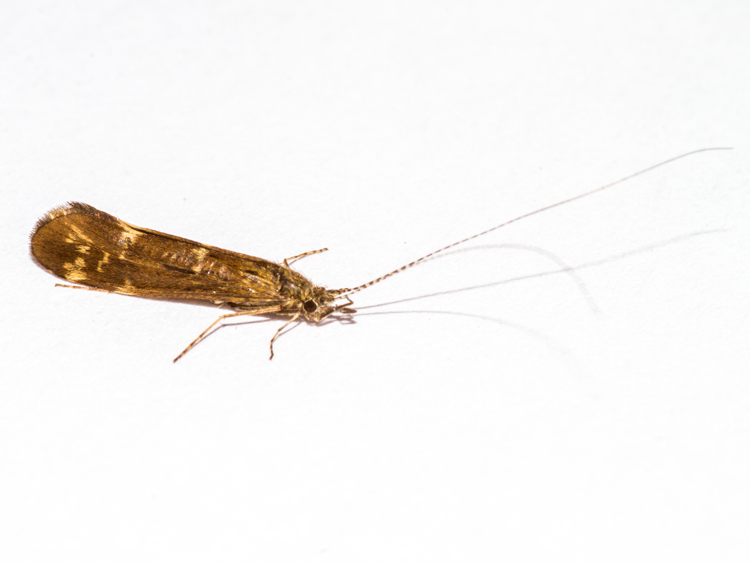

female Athripsodes cinereus, North Elmham Cathedral Meadows, 7th August 2020


female Athripsodes cinereus, North Elmham Cathedral Meadows, 8th September 2020


Another eventual candidate for this species was at home on 22nd June 2020.  Females are quite challenging for me, and up until 2020 the task was made easier by being able to compare genitalia with the images on the trichoptera.insects-online.de website.  With this site now down I'm pretty much relying entirely on the Barnard and Ross Handbook and this particular individual was tricky.  In many respects the genitalia looked very similar to Athripsodes aterrimus (one of which I was examining at the same time).  The indentation on the edge was perhaps closer to cinereus but the subgenital plate looked identical to the aterrimus, right down to the triangular wedge between where the two halves diverge at the tip.  But I don't think it can be aterrimus because that species always seems to have a slightly arched sub-rectangular sclerite beyond the tip of the subgenital plate (not sure what this bit is called but you can see it on the photo of aterrimus at the bottom of this page), whereas on this caddisfly there was no sign of this - instead a more square-shaped but with an obvious indentation on the top.  Unless someone more experienced gets back to me in the meantime I shall wait until I can catch more cinereus to compare with this before I record this one.


possible female Athripsodes cinereus, North Elmham, 22nd June 2020


Athripsodes aterrimus - The 2019 season started with singles at the meadows on 25th May and 15th June but then I caught 4 in the garden between 24th June and 3rd August.  In 2020 just 3 here, one on 26th June and 2 on 12th August.  I'd recorded far more than this here in each of the previous 3 year (with 23 in 2016).  Again all but one were female.

female Athripsodes aterrimus, North Elmham Cathedral Meadows, 25th May 2019


female Athripsodes aterrimus, North Elmham Cathedral Meadows, 24th June 2019


female Athripsodes aterrimus, North Elmham, 8th July 2019


female Athripsodes aterrimus, North Elmham, 16th July 2019


female Athripsodes aterrimus, North Elmham, 3rd August 2019


male (above) and female Athripsodes aterrimus, North Elmham, 12th August 2020


Next page: more Leptoceridae

Or return to Caddisfly index

Wednesday, 12 December 2018

White Birch Case-bearer (Coleophora betulella)

After a good night on 5th July, and a Currant Clearwing to pheromone lure during the day, there was another good night on 6th July with 464 moths of 114 species.  Prize among these was my first ever White Birch Case-bearer Coleophora betulella.  Maybe not everyone's cup of tea I'll admit - it was a pretty worn specimen and there wasn't a hope of identifying it based on its external features.

Currant Clearwing, North Elmham, 6th July


White Birch Case-bearer Coleophora betulella (male, gen det), North Elmham, 6th July


Quite a lot of other new moths for the year too (for the garden - had seen some of these elsewhere): Cherry-fruit Moth Argyresthia pruniella, Lesser Tawny Tubic Batia lunaris, 2 Dover Shades Cnephasia genitalana, Maple Button Acleris forsskaleana, Nut-bud Moth Epinotia tenerana, 12 Water Veneers Acentria ephemerella, Beautiful China-mark Nymphula nitidulata, Chequered Pearl Evergestis pallidata, Dusky Pearl Udea prunalis, Grey Knot-horn Acrobasis advenella, Brown Scallop, Scalloped Oak and Small Rufous.

Cherry-fruit Moth Argyresthia pruniella, North Elmham, 6th July


Lesser Tawny Tubic Batia lunaris, North Elmham, 6th July


Dover Shade Cnephasia genitalana (male, gen det), North Elmham, 6th July


Maple Button Acleris forsskaleana, North Elmham, 6th July


Nut-bud Moth Epinotia tenerana, North Elmham, 6th July


Dusky Pearl Udea prunalis, North Elmham, 6th July


Brown Scallop, North Elmham, 6th July


Small Rufous, North Elmham, 6th July


The rest of the moths were 10 Bird-cherry Ermines Yponomeuta evonymella, 3 Ermine sp. Yponomeuta padella/malinellus/cagnagella, 2 Hawthorn Ermines Paraswammerdamia nebulella, 2 Diamond-backs Plutella xylostella, 2 Small Dingy Tubics Borkhausenia fuscescens, 3 Brown House Moths Hofmannophila pseudospretella, Common Groundling Teleiodes vulgella, London Dowd Blastobasis lacticolella, 7 Common Yellow Conches Agapeta hamana, Barred Fruit-tree Tortrix Pandemis cerasana, Dark Fruit-tree Tortrix Pandemis heparana, 3 Large Fruit-tree Tortrixes Archips podana, Variegated Golden Tortrix Archips xylosteana, 5 Privet Tortrixes Clepsis consimilana, Large Ivy Tortrix Lozotaenia forsterana, Brown-barred Tortrix Epagoge grotiana, 3 Red-barred Tortrixes Ditula angustiorana, 2 Grey Tortrixes Cnephasia stephensiana, 2 Flax Tortrixes Cnephasia asseclana, 2 Yellow Oak Buttons Aleimma loeflingiana, 8 Barred Marbles Celypha striana, 5 Common Marbles Celypha lacunana, 2 Plum Tortrixes Hedya pruniana, Marbled Orchard Tortrix Hedya nubiferana, Holly Tortrix Rhopobota naevana, 2 Common Cloaked Shoots Gypsonoma dealbana, 2 Hoary Bells Eucosma cana, 2 Many-plume Moths Alucita hexadactyla, 80 Garden Grass-veneers Chrysoteuchia culmella, Inlaid Grass-veneer Crambus pascuella, 2 Satin Grass-veneers Crambus perlella, 3 Straw Grass-veneers Agriphila straminella, 2 Meadow Greys Scoparia pyralella, 3 Common Greys Scoparia ambigualis, 4 Little Greys Eudonia lacustrata, Small Grey Eudonia mercurella, 4 Small Magpies Anania hortulata, Elder Pearl Anania coronata, 19 Mother of Pearls Pleuroptya ruralis, 5 Rosy Tabbies Endotricha flammealis, 2 Bee Moths Aphomia sociella, False Cacao Moth Ephestia woodiella, White Plume Pterophorus pentadactyla, 3 Common Plumes Emmelina monodactyla, Chinese Character, Buff Arches, Common Emerald, Blood-vein, 3 Small Blood-veins, 9 Small Fan-footed Waves, Dwarf Cream Wave, Small Dusty Wave, 11 Single-dotted Waves, 17 Riband Waves, 4 Large Twin-spot Carpets, Shaded Broad-bar, Common Carpet, Barred Straw, July Highflyer, Scallop Shell, Small Rivulet, Sandy Carpet, 4 V-Pugs, 4 Double-striped Pugs, Small Yellow Wave, 2 Clouded Borders, 3 Early Thorns, Willow Beauties, Mottled Beauty, Engrailed, Common White Wave, Common Wave, 4 Clouded Silvers, 3 Elephant Hawk-moths, Yellow-tail, 12 Rosy Footmen, 3 Dingy Footmen, Buff Footman, 30 Common Footmen, 2 Buff Ermines, Heart and Dart, Flame, Large Yellow Underwing, 4 Double Square-spots, 2 Dot Moths, Clay, 4 Smoky Wainscots, Marbled Beauty, Brown Rustic, 3 Dark Arches, Middle-barred Minor, Common Rustic, 34 Uncertains, 4 Rustics, 5 Mottled Rustics, 4 Beautiful Hook-tips, Straw Dot, 9 Snouts, 14 Fan-foots and Small Fan-foot.

Common Groundling Teleiodes vulgella, North Elmham, 6th July


The mayfly Lake Olive Cloeon simile was new for the year. 

Lake Olive Cloeon similie, North Elmham, 6th July


One of 2 Blue-winged Olives Serratella ignita moulted from sub-imago to imago the following day:


Blue-winged Olive Serratella ignita, North Elmham, 6th July


Lacewings consisted of Chrysoperla carnea agg., Cunctochrysa albolineata and Dichochrysa flavifrons.  Among the caddisflies Molanna angustata was new for the house and Crunoecia irrorata new for the year.  The others were Hydropsyche pellucidula, Medium Sedge Goera pilosa and Mottled Sedge Glyphotaelius pellucidus.

Molanna angustata, North Elmham, 6th July


Crunoecia irrorata, North Elmham, 6th July


There were 5 Iassus lanio (leafhoppers), 2 Common Red Soldier Beetles Rhagonycha fulva and 4 Lagria hirta (another beetle).

Sunday, 8 October 2017

Frost's Common Take 2

A Mouse Moth was the only new moth for the year on Monday 21st August but there was a reasonable variety of moths: possible Skin Moth Monopis laevigella (lost before confirmed), Blackthorn Slender Parornix torquillella, 2 Garden Midgets Phyllonorycter messaniella, Nut Leaf Blister Moth Phyllonorycter coryli, probable Red Hazel midget Phyllonorycter nicellii (lost before confirmed), 2 Bird-cherry Ermines Yponomeuta evonymella, Woundwort Case-bearer Coleophora lineolea, an exceptionally small Golden-brown Tubic Crassa unitella, 2 Brown House Moths Hofmannophila pseudospretella, 2 Long-horned Flat-bodies Carcina quercana, Dingy Dowd Blastobasis adustella, Light Brown Apple Moth Epiphyas postvittana, 5 Dark-triangle Buttons Acleris laterana, 2 Garden Rose Tortrixes Acleris variegana, Barred Marble Celypha striana, 3 Common Marbles Celypha lacunana, Marbled Piercer Cydia splendana, Pearl Veneer Agriphila straminella, 18 Common Grass-veneers Agriphila tristella, 4 Elbow-stripe Grass-veneers Agriphila geniculea, Marsh Grey Eudonia pallida, Narrow-winged Grey Eudonia angustea, 2 Mother of Pearls Pleuroptya ruralis, Grey Knot-horn Acrobasis advenella, 2 Common Plumes Emmelina monodactyla, Pebble Hook-tip, Blood-vein, Single-dotted Wave, 2 Riband Waves, Garden Carpet, Common Carpet, Common Marbled Carpet, 3 Green Carpets, Sharp-angled Carpet, 3 Currant Pugs, 3 Double-striped Pugs, 11 Brimstone Moths, Dusky Thorn, Common Wave, 4 Light Emeralds, Shuttle-shaped Dart, 4 Flame Shoulders, 3 Large Yellow Underwings, 2 Lesser Broad-bordered Yellow Underwings, 3 Setaceous Hebrew Characters, 3 Six-striped Rustics, Square-spot Rustic, 8 Common Wainscots, Common Rustic, 5 Flounced Rustics, 2 Vine's Rustics, 2 Straw Dots and 3 Snouts.

Mouse Moth, North Elmham, 21st August


Blackthorn Slender Parornix torquillella (male, gen det), North Elmham, 21st August


My second ever Small Silver Sedge Lepidostoma hirtum followed one night after my first.  Other caddisflies were Oxyethira flavicornis, 2 Hydropsyche siltalai, 2 Hydropsyche pellucidula and Medium Sedge Goera pilosa.

Beetles included 2 Trechus quadristriatus, a new species for me.


Trechus quadristriatus, North Elmham, 21st August


Other beetles were 5 Bradycellus verbasci and 2 Aphodius rufipes.  Other insects included the mayfly Pond Olive Cloeon dipterum, the green lacewing Nineta vittata, a female Conwentzia sp. Waxfly, the brown lacewing Micromus variegatus and 9 Forest Bugs (aka Red-legged Shieldbugs).

Nest day a quick look round Wells Wood produced a few insects including my first Plagiognathus arbustorum (a mirid bug) feeeding on Fleabane.

Plagiognathus arbustorum, Wells, 22nd August


Moths included Common Grass-veneer Agriphila tristella and Small Fan-footed Wave.

That night Dave and I headed back to Frost's Common, a site we'd been planning to trap at for a long while.  The Norfolk Moth Survey event there was a wash-out so we thought we'd try again on a better night.  Conditions weren't ideal but we managed 47 species including a few mildly interesting ones: Oak Carl Tischeria ekebladella, 3 Brown Birch Slenders Parornix betulae, 2 Golden Argents Argyresthia goedartella, Bird-cherry Ermine Yponomeuta evonymella, Birch Ermel Swammerdamia caesiella, Chamomile Conch Cochylidia implicitana, Chequered Fruit-tree Tortrix Pandemis corylana, 2 Common Marbles Celypha lacunana, 3 Birch Marbles Apotomis betuletana, Rush Marble Bactra lancealana, Small Birch Bell Epinotia ramella, 2 Pearl Veneers Agriphila straminella, Barred Grass-veneer Agriphila inquinatella, 6 Ground-moss Greys Eudonia truncicolella, 3 Brown China-marks Elophila nymphaeata, 7 Ringed China-marks Parapoynx stratiotata, 3 Small China-marks Cataclysta lemnata, 3 Mother of Pearls Pleuroptya ruralis, Meal Moth Pyralis farinalis (only my second ever), Double-striped Knot-horn Cryptoblabes bistriga, Dotted Oak Knot-horn Phycita roborella, 2 Maiden's Blushes, 3 Common Carpets, Yellow Shell, 2 Purple Bars, 5 Green Carpets, 5 Double-striped Pugs, Yellow-barred Brindle, 5 Brimstone Moths, 2 Common Waves, 3 Light Emeralds, Poplar Hawk-moth, Dingy Footman, 2 Buff Footmen, 3 Common Footmen, Shuttle-shaped Dart, 4 Flame Shoulders, Large Yellow Underwing, Lesser Yellow Underwing, Lesser Broad-bordered Yellow Underwing, Setaceous Hebrew Character, 2 Common Wainscots, Svensson's Copper Underwing, Burnished Brass, Spectacle, 10 Straw Dots and 2 Snouts.

Chamomile Conch Cochylidia implicitana, Frost's Common, 22nd August


Meal Moth Pyralis farinalis, Frost's Common, 22nd August


Double-striped Knot-horn Cryptoblabes bistriga, Frost's Common, 22nd August


The leafhopper Eupteryx urticae was a new species for me.  Other bugs included Birch Shieldbug, 8 Forest Bugs, Lygus pratensis and the leafhopper Allygus mixtus.

Eupteryx urticae, Frost's Common, 22nd August


Allygus mixtus, Frost's Common, 22nd August


Caddisflies included a Molanna angustata and there were 2 Orange Ladybirds.  Other wildlife included 3 Red Deer.

Molanna angustata (male), Frost's Common, 22nd August


We found a newt at each of the lights which I am having some trouble identifying.  They are most likely Smooth Newts - I don't think there are all that many confirmed records of Palmate Newt in Norfolk from what I can glean.  The references I've got and those I've found on the internet seem to focus on adults for identification, some mentioning that immatures require more caution but not elaborating any further. Several references refer to the unspotted throat as a key feature for Palmate Newt but even some of those include photos of Smooth Newts with unspotted throats, so clearly this is not diagnostic!  The upperpart markings appear to be very variable and overlapping between the tweo species as are the spots below and the pattern of orange underneath.  I get the impression, but if someone can confirm that would be great, that the presence or absence of pale tubercles on the bottom of the feet (present on Palmate) is the most reliable feature.  Having had this problem before I recalled that spots on the soles of the feet were relevant and so took photos as I couldn't remember the detail of what to look for.  Sadly my photos aren't perfectly clear (it's quite hard to get a newt to stay still upside down without manhandling it) and there are some pale spots in some images that aren't in others, suggesting that they may be grit or dirt.  At least one of them does seem to have one or two pale spots on the sole in the same place in every photo suggesting it may be a real feature and suggesting that they might be Palmate Newts.  However, I'm not convinced and suspect they are in fact female and/or immature Smooth Newts.  If you are any clearer on these things please do get in touch!


Newts (top two are the same individual, lower two are the other individual), Frost's Common, 22nd August