Description


A diary of my mothing activity covering highlights and photos from my moth trapping activities. Mainly Norfolk (UK), occasionally beyond. I may mention other wildlife sightings here, especially insects, but for birds see my birding diary.
Showing posts with label Azure Damselfly. Show all posts

Wednesday, 3 February 2021

Review of 2019 and 2020 - Dragonflies: Demoiselles and Damselflies

DEMOISELLES (family CALOPTERYGIDAE)


Banded Demoiselle Calopteryx splendens - Recorded at the meadows on just 5 dates between 24th June and 3rd August 2019 and 10 dates between 25th May and 20th July 2020 with at least 10 there on 29th June 2019.  Elsewhere singles in my garden on 16th and 24th June 2020 and one at Hindolveston on 6th July.

Banded Demoiselle, North Elmham Cathedral Meadows, 29th June 2019


Banded Demoiselle, North Elmham Cathedral Meadows, 27th May 2020


Banded Demoiselle, North Elmham Cathedral Meadows, 1st June 2020


-----------------------------------


EMERALD DAMSELFLIES (family LESTIDAE)


Emerald Damselfly Lestes sponsa - At least 40 at Winterton on 19th August 2019.  These included a strange reddish individual which didn't seem to just be an artefact of the light as it remained red-looking from different angles and in both sun and shade.  At the time several people commented that they hadn't seen one like this before, but I have since seen other photos showing similar individuals (and a Scarce Emerald Damselfly showing a similar appearance).  A male at Whitwell Street near Reepham on 12th August was my only record in 2020 although after reviewing photos of some Lestes taken at Thompson Common on 7th August I think one or more of those may have been this species too.  The angles aren't ideal for seeing the really critical features but some characters seem suggestive of this species.


Emerald Dameslflies, Winterton, 19th August 2019


probable Emerald Dameslfly, Thompson Common, 7th August 2020


Emerald Dameslfly, Whitwell Street, 12th August 2020


Scarce Emerald Damselfly Lestes dryas - At least one at Thompson Common on 7th August 2020.  This was the only Emerald Damselfly species I identified in the field and I imagined that all 8 or so seen were probably the same, although I relied on the photos being good enough to confirm at home.  In fact most of the photos didn't show the critical features clearly enough but at least some seemed to favour Emerald Damselfly and much more surprisingly one showed a pair of Willow Emerald Damselflies.  This red female isn't at the perfect angle but I think I can see enough on here to confirm it as Scarce - it seems very robust and the ovipositor appears quite large.


female Scarce Emerald Dameslfly, Thompson Common, 7th August 2020


Southern Emerald Damselfly Lestes barbarus - One at Winterton on 19th August 2019.  This was my main target for this trip.  Remarkably the individual we saw wasn't the one that had been seen on previous days.  Sadly it never settled for long and quickly disappeared, so although I got adequate views to be happy with the ID I was unable to get any photos.  Having not been for these in the past this was my first UK record although I've seen them in southern Europe before.


Willow Emerald Damselfly Lestes viridis - None identified in the field but to my surprise I later discovered that I had photographed a pair at Thompson Common on 7th August 2020.  Although I've never made the effort to twitch this species in the UK I have seen them in southern Europe and I thought I knew them well enough to not overlook them in the field.  I even looked at the photos on my computer after returning home and didn't spot them straight away!  In my defence, they original photo was badly lit and quite dark which meant (a) the spurs on the side of the thorax weren't discernible at all and (b) the male looked as though it had fairly strong blue pruinose.  I think it was the latter than put me off the scent but when I checked them again just prior to preparing this blog post I noticed the pale pterostigmas.  After editing the photos and lightening up the dark areas I could see that the pruinose wasn't as extensive as it had looked and the elongated spurs on the side of the thorax were present.

Willow Emerald Dameslflies, Thompson Common, 7th August 2020


-----------------------------------


BLUE and RED DAMSELFLIES (family COENAGRIONIDAE)


Blue-tailed Damselfly Ischnura elegans - 6 at Winterton on 19th August 2019.  Surprisingly I have found this species to be very scarce at the meadows - I only saw one in 2018, one in 2020 and didn't manage to find any in 2019.  One at Hindolveston in 2020 was my only other record.  Are these getting scarce or is it just that I haven't done enough dragonflying in suitable habitat recently - I used to see these all over the place and often in good numbers.

Blue-tailed Damselfly, North Elmham Cathedral Meadows, 20th July 2020


Common Blue Damselfly Enallagma cyathigerum - Regularly encountered at the meadows between 22nd May and 15th August 2019 and between 27th May and 20th July 2020, though never in high numbers (single figure counts only).

Common Blue Damselfly, North Elmham Cathedral Meadows, 15th August 2019


Common Blue Damselfly, North Elmham Cathedral Meadows, 27th May 2020


Common Blue Damselfly, North Elmham Cathedral Meadows, 20th June 2020


Azure Damselfly Coenagrion puella - 2019 seemed to be a poor year with just two records at the meadows involving 4 individuals, on 25th May and 4th June.  It may be partly due to the limited range of places I visited in 2019 but this was a stark showing of a species that I usually see on many occasions during the course of a year and often in very large numbers.  2020 was only a little better with up to 10 at the meadows on 7 dates between 25th May and 6th July.  Also one in the garden on 19th June 2020.

Azure Damselfly, North Elmham Cathedral Meadows, 15th May 2020


Azure Damselfly, North Elmham Cathedral Meadows, 27th May 2020


Small Red-eyed Damselfly Erythromma viridulum - At least 30 at Winterton on 19th August 2019.

Small Red-eyed Damselfly, Winterton, 19th August 2019


Large Red Damselfly Pyrrhosoma nymphula - A total of 18 recorded at the meadows on 6 dates between 30th April and 25th May 2019 and 21 between 24th April and 3rd June 2020.  Also recorded on Mull in June 2019.

Large Red Damselfly, North Elmham Cathedral Meadows, 2nd May 2019


Next page: Hawkers, Goldenrings and Darters

Or return to Dragonfly index

Friday, 10 June 2016

Tens of thousands of moths

On Saturday morning I was up at Titchwell birding and swimming in Diamond-back Moths Plutella xylostella.  OK, perhaps that's an exaggeration, but there really were a lot of them.  They were everywhere, but some places were thick with them - you could see maybe 50-100 in some small patches of vegetation with more appearing if the vegetation was disturbed.  I put down 1000 in my records but that really was a very conservative estimate - just of the moths I'd seen.  I couldn't possibly guess how many were actually there.  Tens of thousands obviously, hundreds of thousands probably, millions mabye?  I wouldn't be surprised.

Not much else of lepidopteran note - a Common Nettle-tap Anthophila fabriciana and 2 Common Marbles Celypha lacunana were the only other moths I saw in the misty murk.  A Scorpion Fly proved to be Panorpa germanica (gen det).

Next I headed to Dersingham Bog.  I thought there might be fewer moths here with it being further inland, or at least further from a north/east facing coast.  But there were loads of Diamond-back Moths Plutella xylostella here too.  The heath itself was quite windswept and there weren't many here (although still kicking up a few every few steps) but in the shelter of the woodland above the heath there were hundreds.  I didn't spend long here and didn't cover that much ground, but even so I must have easily seen 500.

I managed a few other moths too: 2 Green Long-horns Adela reaumurella, Brassy Tortrix Eulia ministrana, Common Grey Scoparia ambigualis and 3 Common Heaths.


Common Heaths, Dersingham Bog, 4th June


A leafhopper turned out to be Chamaepsylla hartigii, a first for me.  A wildflower tick for me here too, which I might not have noticed if it wasn't for the display board telling me about it.  Cranberry.  The flowers aren't exactly tiny and they're bright pink, yet they were strangely hard to see even when looking down on them.  I must have walked past them before, here at least if not elsewhere.

I wish I'd spent longer trying to get a decent photo of an amazing insect that I found on a log pile close to where I parked.  Turned out none of my photos of it were in focus, which is a bit disappointing.  It was obviously an Ichneumon wasp, but what an Ichneumon!  It was a monster!  An absolute beast!  Off the top of my head I can't think of another insect I have ever seen anywhere in the world as long as this.  The body was probably well over an inch long, the antennae about as long on top and then the ovipositor!  Wow!  I believe it's something called Ephialtes manifestator.

Ephialtes manifestator, Dersingham Bog, 4th June


But good as this was, top trump goes to a hoverfly.  A large and very distinctive hoverfly that I was pretty sure I hadn't ever seen before.  Turns out it was Sericomyia lappona, a species with a relatively restricted range in Norfolk.  Looks like it occurs only in west and north-west Norfolk, and given its preference of boggy habitat I would hazard a guess that Dersingham Bog might be the best place to see it in this county.


Sericomyia lappona, Dersingham Bog, 4th June


To the untrained eye this Hoverfly looks even more distinctive, but alas there are 2-3 similar species and the quality of my photos is not high enough for me to be 100% certain of its ID.  Probably Helophilus pendulus.  Not a greatly significant record even if the ID was clinched (either way).

Helophilus sp., probably Helophilus pendulus, Dersingham Bog, 4th June


My next stop was a little further inland, a footpath close to the Babingley River just south of West Newton.  I've been meaning to explore this path for ages.  The path starts running down the edge of a crop field on one side and on the other, a strip of low vegetation, a dyke and then a hedgerow.  It goes on like this for maybe a third of a mile before crossing a sheepfield and then running alongside the river itself.  I only got as far as the sheepfield.  Being a bit further inland I didn't expect especially huge number of Diamond-backs, although with the numbers I'd seen elsewhere I knew it would hold a good few.  Well, it was spectacular.  I have never seen anything like it.  As soon as I opened my car door a cloud of Diamond-back Moths got up beside me.  But this was only the start - they continued all the way down the path.  Counting them was impossible but I was keen to document how many there were so set about to estiamte numbers as accurately (but conservatively) as possible.  To give you an idea, a single stinging-nettle held about 20 - and that was just the ones I could see without disturbing it.  There were a lot of stinging nettles, and a lot of other plants with moths on.  In just one small section in front of me I could see hundreds, and that went on for pretty much the whole footpath.  A very conservative estimate for just this small stretch of footpath was 10-15,000 Diamond-back Moths.

With so many moths present it was hard to pick out any that were different, but I did manage a few.  Best was a new moth for me, and a very attractive one too - White-barred Gold Micropterix aruncella.  They're not hugely rare (indeed my second followed a couple of days later) but a first is always exciting, especially when they're so stunning.

White-barred Gold Micropterix aruncella, Babingley River near West Newton, 4th June


I also found 5 Cocksfoot Moths Glyphipterix simpliciella, a Common Marble Celypha lacunana and a Drinker caterpillar, but an interesting-looking small Plume moth sadly evaded my net.  Bugs included a number of Hairy Shieldbugs and the striking Cercopis vulnerata.

Hairy Shieldbugs, Babingley River near West Newton, 4th June


Cercopis vulnerata, Babingley River near West Newton, 4th June


Dragonflies included at least 20 Azure Damselflies and about 3 Blue-tailed Damselflies.

Azure Damselfly, Babingley River near West Newton, 4th June


Next stop was Roydon Common where I was to join the Norfolk Moth Survey for an evening's trapping.  I got there early - a lot early - with Dave so as to give ourselves plenty of time to look for day-flying moths before the trapping started.  A good time was had, with thousands more Diamond-back Moths, but I'll save the details for my next post...

Wednesday, 1 June 2016

Mayfly magic - out with the old skin and in with the new

On Saturday afternoon I joined Dave and Matthew Casey on one of Matthew's patches that was a site for Large Red-belted Clearwings.  It's a bit early but Dave has a pheremone lure and we thought it worth a shot.  We didn't succeed with the Clearwings but saw a nice variety of inverts, and it was good to meet Matthew again - and also really nice to meet James Lowen for the first time, who lives nearby and turned up later with his daughter.

Dave and Matthew had already found a Marsh Pug and some Little Long-horns Cauchas fibulella before I arrived, and other Long-horns included a couple of Meadow Long-horns Cauchas rufimitrella.

Little Long-horn Cauchas fibulella, New Costessey, 28th May


Other moths included Common Nettle-tap Anthophila fabriciana, Thistle Bell Epiblema scutulana, Grey Gorse Piercer Cydia ulicetana, Red Twin-spot Carpet and Common Carpet.  Butterflies included Holly Blue and Speckled Wood, and Damseflies included Azure and Blue-tailed.

Azure Damselfly, New Costessey, 28th May


There were lots of Mayflies along the stream.  They looked distinctive but to be sure of getting an ID I took one home in a pot to examine with the key to hand.  It proved to be a Green Drake Ephemera danica but the more interesting thing was that it shed its skin while in my pot.  I'd already photographed it when I looked back at the pot and at first thought there was a second, dead, Mayfly in the pot.  How could that be, I pondered, before realising that it was in fact an empty skin.  The new iteration of Mayfly didn't look vastly different from the first, but the body was brighter and paler, the wings seemed paler and more strongly marked and the tail was longer.  I don't know much about Mayflies yet, but learned something new here.  Firstly I hadn't realised that the change from sub-imago to imago (adult) involved shedding its skin and secondly, when I read up on that the text seemed to imply that the sub-imago just rests before moulting into an imago, yet mine was definitely captured in flight.


Green Drake Ephemera danica, New Costessey, 28th May - the sub-imago, its shed skin and the resulting imago


This Alder Fly turned out to be Sialis lutaria.  There are 3 species of Alder Fly in the UK and you have to examine their genitalia to sort them out.  They don't need a full dissection but I must admit I found it a bit tricky matching my specimen to the diagrams in the key.  Got there in the end though, I think.

Alder Fly Sialis lutaria (male, gen det), New Costessey, 28th May


Other inverts of note were Dock Bug, Red-headed Cardinal (beetle) and Green Nettle Weevil Phyllobius pomaceus. Snails included a Strawberry Snail Trochulus striolatus and Dave pointed out what turned out to be my first identified Amber Snail Succinea putris.

Dock Bug, New Costessey, 28th May


 Green Nettle Weevil Phyllobius pomaceus, New Costessey, 28th May


Amber Snail Succinea putris, New Costessey, 28th May

Monday, 8 June 2015

A day at Burnham Overy

I spent much of Friday birding Burnham Overy but as always kept an eye out for moths and other insects, especially when more of them become active towards dusk.

There has been a noticeable immigration of Painted Ladies - hard to know how many but I reckon I saw at least 25-30.  Other butterflies included Wall Brown, Holly Blue and my first Red Admiral of the year.

Painted Lady, Burnham Overy, 5th June


Holly Blue, Burnham Overy, 5th June


I suspect this Azure Damselfly in the dunes had been blown there from inland rather than being an immigrant.

Azure Damselfly, Burnham Overy, 5th June


The dusking for moths wasn't as successful as I'd hoped, largely due to the wind.  A couple of things got away and I recorded Bordered Carl Coptotriche marginea, 2 Hook-streaked Grass-Veneers Crambus lathoniellus and Yellow Shell. This next moth really had me stumped though.  A small greyish-brown Tortrix with big pale spots... what on earth was it?


At an impasse I started to question whether it reall was a Tortrix, after all it was quite small.  I checked various options from other families and wondered for a while if it might be a very worn example of a larger Incurvaria species, or even Lampronia.  Some of them shared some of the pale spots, most prominent on the dorsum and along the costa, though most lacked the pale spot in the middle of the wing.  Eventually I found a picture of Lampronia splendidella that seemed to show a similar pattern - but that's not a British species (though not from very far east of Britain, so perhaps not completely inconceivable).  Under the microscope it didn't seem to have much of a tongue which I think is good for these families but I wasn't convinced by the antennae which were simple, lacking any hint of pectinations.  Then after it had expired it stuck its tongue out - it did have a long proboscis after all, so I was back with the Tortricidae.  Only then did I notice through the microscope that it had just a very few yellow and orangey coloured scales on its wings.  Not many, but enough to make me think that when fresh this would perhaps have been a yellow and orange species.  And then at last the penny dropped - it was just another Downland Conch Aethes tesserana.  Compare this picture from Lepiforum with mine below:

Downland Conch Aethes tesserana, Burnham Overy, 5th June


Beetle action included a few Catharis rustica...

Catharis rustica, Burnham Overy, 5th June


This fly is quite distinctive and quite attractive as flies go - Coastal Silver-stiletto apparently, although the abdomen wasn't quite as stiletto-shaped as it is in most pics...

Coastal Silver-stiletto, Burnham Overy, 5th June


There were loads of these Turnip Sawflies on the Alexanders - don't recall seeing this species before.


Turnip Sawfly, Burnham Overy, 5th June


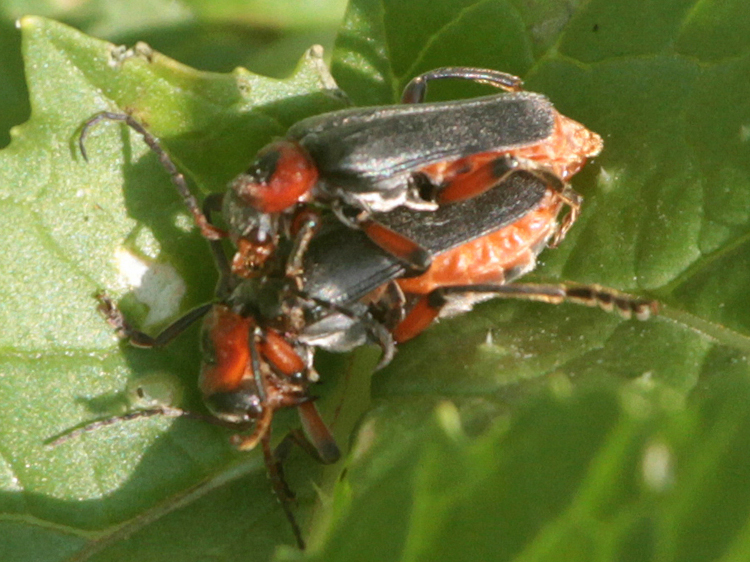
Here's another beetle I can't identify - let me know if you recognise it.

unidentified Beetle, Burnham Overy, 5th June


Some nice plants here too, like these.

Houndstongue, Burnham Overy, 5th June


Yellow Horned-poppy, Burnham Overy, 5th June


Not all the plants were doing so well... these Spindle trees were covered in green leaves last visit with just a few small tents of Spindle Ermine Yponomeuta cagnagella larvae visible.  Now they are completely stripped.


Spindle trees stripped by Spindle Ermine Yponomeuta cagnagella caterpillars, Burnham Overy, 5th June