Description


A diary of my mothing activity covering highlights and photos from my moth trapping activities. Mainly Norfolk (UK), occasionally beyond. I may mention other wildlife sightings here, especially insects, but for birds see my birding diary.
Showing posts with label Ribautiana tenerrima. Show all posts

Tuesday, 25 May 2021

Review of 2019 and 2020 - Leafhoppers part 6: subfamily Typhlocybinae II

LEAFHOPPERS (CICADELLIDAE) continued


SUBFAMILY TYPHLOCYBINAE (continued)


Eupteryx atropunctata - One in my garden moth trap on 4th August 2020 was a new species for me.

Eupteryx atropunctata, North Elmham, 4th August 2020


Eupteryx decemnotata - None.  I caught one here in 2017.


Eupteryx florida - One in my garden moth trap on 31st July 2019 was my second here.  None here in 2020 but 4 at the meadows between 8th and 24th April, mostly on White Dead Nettle.

Eupteryx florida, North Elmham, 31st July 2019


Eupteryx florida, North Elmham, 24th April 2020


Eupteryx melissae - One in my garden moth trap on 9th July 2019 was my second record here.

Eupteryx melissae, North Elmham, 9th July 2019


Eupteryx urticae - Found on nettles at the meadows on 19th August and 5th September 2020.  None in the garden but I have recorded this species here before (in 2017).

Eupteryx urticae, North Elmham Cathedral Meadows, 19th August 2020


Eupteryx urticae, North Elmham Cathedral Meadows, 5th September 2020


Ribautiana cruciata - 2 to light in Cornwall on 7th October 2020.  I've seen this species in Norfolk before but not locally.


female (top) and male Ribautiana cruciata, Tresidder (Cornwall), 7th October 2020 - showing different orientations of the male's aedeagus


Ribautiana debilis - A new leafhopper for me, netted off cherry at the meadows on 3rd June 2020.


male Ribautiana debilis, North Elmham Cathedral Meadows, 3rd June 2020 - showing different orientations of its rather fancy aedeagus


Ribautiana scalaris - A new leafhopper for me, to light at Swanton Great Wood on 27th August 2019.

Ribautiana scalaris, Swanton Great Wood, 27th August 2019


Ribautiana tenerrima - Found at the Cathedral Meadows on at least 4 dates between 5th September and 2nd October 2020, mostly on Bramble and largely thanks to a tip from David (@AmblingMan) on Twitter about gently turning over Bramble leaves that show pale speckling (feeding signs).  1-2 others were not recorded as they got away before I could confirm them, but were probably also this species.  Also 2 to light in Cornwall on 6th October 2020.

Ribautiana tenerrima, North Elmham Cathedral Meadows, 5th September 2020


Ribautiana tenerrima, North Elmham Cathedral Meadows, 2nd October 2020


Ribautiana tenerrima, Tresidder (Cornwall), 6th October 2020


Eupterycyba jucunda - None.  I found this species indoors here in 2018.


Lindbergina aurovittata - Caught in my garden moth trap on 23rd June and 16th August 2019 and 14th November 2020.  Also beaten from Oak at the meadows on 8th September 2019 (probably - this one escaped before I could confirm it) and 19th August 2020; also to light at Swanton Great Wood on 27th August 2019.

Lindbergina aurovittata, North Elmham, 23rd June 2019


Lindbergina aurovittata, North Elmham Cathedral Meadows, 19th August 2020


Lindbergina aurovittata, North Elmham, 14th November 2020


Next page: more Leafhoppers

Saturday, 13 April 2019

Cornwall part 2 - other insects at Tresidder

I've just posted a separate page about the moths I caught while staying at Tresidder last autumn between 1st and 6th October.  Here's a post about the other insects I found there.

There were a few caddisflies, the best of which was Hydropsyche instabilis on 4th, a species I've only seen once before.  The other caddis were Limnephilus auricula (41 over the first 4 nights, max 23 on 2nd), Limnephilus lunatus (10 over the first 4 nights, max 5 on 2nd), Limnephilus sparsus (4 on 3 of the first 4 nights), Limnephilus vittatus (singles on each of the first 3 nights) and Halesus raidatus (4 on 3rd followed by up to 4 on each of the final 3 nights).

Hydropsyche instabilis, Tresidder, 4th October


Halesus radiatus, Tresidder, 3rd October


The only true bug to appear in the moth trap was this Pantilus tunicatus on 4th.

Pantilus tunicatus, Tresidder, 4th October


The best leafhopper I caught was a Ribautiana tenerrima (on 4th), a new species for me.

Ribautiana tenerrima, Tresidder, 4th October


Other leafhoppers were Empoasca vitis (1 on 3rd), Empoasca decipiens (2 on 4th), Fagocyba cruenta (different single males on 2nd and 4th) and Edwardsiana rosae (different single males on 2nd, 3rd and 4th; also a female Edwardsiana sp. on 3rd).

This striking barkfly (or booklouse) turned out to be Atlantopsocus adustus, a lifer for me.

Atlantopsocus adustus, Tresidder, 4th October


The only beetle I identified while I was in Cornwall was this one, a new species for me, Chrysolina banksii.

Chrysolina banksii, Tresidder, 4th October


This bee turned out to be a Common Furrow Bee Lasioglossum calceatum, a species I'd not identified before.

Common Furrow Bee, Tresidder, 3rd October


This Wall Brown butterfly was roosting in the garden near the trap on 2nd.


Wall Brown, Tresidder, 2nd October


There was a lot of grasshopper chirping going on in the garden but they always fell silent when I started pointing a torch in their direction so it was very hard to find them, and the sound didn't seem to quite match the sounds on the iRecord Grasshoppers app.  Eventually I identified them as Meadow Grasshoppers, but I also found a single Field Grasshopper.

Meadow Grasshopper, Tresidder, 4th October


Field Grasshopper, Tresidder, 4th October


While trying to catch the grasshoppers I swept a couple of bugs, Stenodema laevigata and my first ever Ant Damsel Bug Himacerus mirmicoides, both on 2nd. Also 2 Common Shiny Woodlice on 2nd.

Stenodema laevigata, Tresidder, 2nd October


Ant Damsel Bug Himacerus mirmicoides, Tresidder, 2nd October


Well that's just what I found at the place we were staying.  There were a few things to note from elsewhere too, though mainly my focus was on birds for the rest of the trip.

On 3rd October we walked down the Penberth Valley from our cottage and along the cliffs to Porthgwarra.  Here there were lots of Ivy Bees, a new species for me although it has now colonised Norfolk.  Butterflies at Porthgwarra included 2 Red Admirals, Speckled Wood and Wall Brown, and there were also 5 Common Nettle-taps Anthophila fabriciana and a Common Plume Emmelina monodactyla.

Common Plume Emmelina monodactyla, Rosketal, Porthgwarra, 3rd October


This thick caterpillar was on those huge-leaved plants (Gunnera I think?).  I can't figure out what species it is - let me know if you can please!

unidentified caterpillar, Rosketal, Porthgwarra, 3rd October


As we walked back across the fields at Polgigga I found another caterpillar I can't identify.  This was on the crop growing in the field - Oil Seed Rape or something similar.

unidentified caterpillar, Polgigga, 3rd October


I think I can identify two caterpillars I found on the moor at Porthgwarra the next morning - Fox Moths.

Fox Moth caterpillar, Porthgwarra Moor, 4th October


I also found a couple of Ivy Bees at Tresidder that day too.

Next day at Porthgwarra I found a few butterflies: Small Copper, 5 Red Admirals and 2 Speckled Woods.  There were also a few moths including a Grey Pine Carpet and 5 Common Nettle-taps Anthophila fabriciana.  I spent some time looking for migrant birds at Trevean Pool and didn't find any, but I did find 3 migrant moths on the adjacent bit of moor: Diamond-back Plutella xylostella, Rush Veneer Nomophila noctuella and Silver Y.

Rush Veneer Nomophila noctuella, Trevean Pool/Porthgwarra Moor, 5th October


The only other migrant I found there was a Migrant Hawker.  Also Common Darter.

Migrant Hawker, Trevean Pool, 5th October


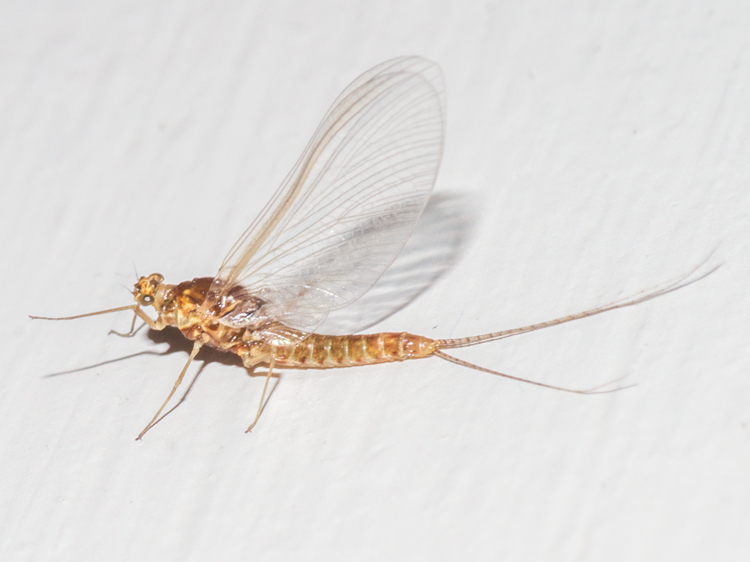
I have seen mayflies doing what I took to be a display flight where they fly up and down in the air like a yo-yo, and imagined they would be males displaying.  But I saw a mayfly doing this at Kenidjack and caught it in order to identify it.  It turned out to be a female ready to lay eggs, a Blue-winged Olive Serratella ignita.

Blue-winged Olive Serratella ignita, Kenidjack Valley, 5th October


I didn't have much else to add after this, except for a few butterflies at Porthgwarra on the final morning (7th): Small Copper, 4 Red Admirals and Wall Brown.