
Description


A diary of my mothing activity covering highlights and photos from my moth trapping activities. Mainly Norfolk (UK), occasionally beyond. I may mention other wildlife sightings here, especially insects, but for birds see my birding diary.
Showing posts with label Lozotaeniodes formosana. Show all posts

Sunday, 14 January 2018

Flounced Chestnut

A good night on 19th October with 51 moths of 22 species.  I didn't immediately recognise the best one but when Dave suggested the ID it was obvious (well, fairly).  Indeed I'd been keeping an eye out for one as I'd never seen one before but they're usually a bit more strongly marked and I'd not appreciated how plain they could be.  It was a Flounced Chestnut, a very welcome macro lifer for so late in the season.  They're a little on the scarce side so it's not entirely surprising that I'd not seen one before but there are a few records in Norfolk every year.

Flounced Chestnut, North Elmham, 19th October


The other moths were Long-horned Flat-body Carcina quercana, 6 Light Brown Apple Moths Epiphyas postvittana, 2 Ashy Buttons Acleris sparsana, 2 Narrow-winged Greys Eudonia angustea, Pale November Moth, Feathered Thorn, 2 Shuttle-shaped Darts, Large Yellow Underwing, Broad-bordered Yellow Underwing, 2 Setaceous Hebrew Characters, 7 Black Rustics, 4 Green-brindled Crescents, Merveille du Jour, Brick, Red-line Quaker, 10 Yellow-line Quakers, 2 Beaded Chestnuts, Angle Shades, Large Wainscot, Burnished Brass and 2 Straw Dots.

Other insects included 5 Chrysoperla carnea (green lacewing), Limnephilus auricula, Limnephilus flavicornis, 15 Limnephilus lunatus, Limnephilus marmoratus, Halesus radiatus (caddisflies), Pinalitus cervinus (bug) and a leafhopper that was probably Empoasca decipiens (would be new for the house but I wasn't entirely convinced by the externals and couldn't make the genitalia quite fit either, though I couldn't find anything else that fitted better).

I think this ugly little beast in my study the next day was Amaurobius similis.  I still dislike spiders but I'll try to identify them so long as I don't have to touch them or get too close.  Maybe one day I'll grow to like them, but for now, ugh.


Amaurobius similis, North Elmham, 20th October


Slightly fewer moths that night: 2 Garden Midgets Phyllonorycter messaniella, 2 Light Brown Apple Moths Epiphyas postvittana, Ashy Button Acleris sparsana, Narrow-winged Grey Eudonia angustea, Double-striped Tabby Hypsopygia glaucinalis, 2 Common Marbled Carpets, 2 November Moths, Pale November Moth, 2 Feathered Thorns, 3 Shuttle-shaped Darts, 2 Black Rustics, 3 Green-brindled Crescents, 2 Merveille du Jours, 2 Bricks, 5 Yellow-line Quakers, Beaded Chestnut, Straw Dot and Snout.

Ashy Button Acleris sparsana, North Elmham, 20th October


The only lacewings and caddisflies were Chrysoperla carnea, Limnephilus affinis and 7 Limnephilus lunatus but hot on the heals of my first identified ones a few days earlier there were 5 Fagocyba cruenta (yellow leafhoppers).

There was a big drop in moth numbers the following night: Light Brown Apple Moth Epiphyas postvittana, November Moth, Pale November Moth, Black Rustic, Yellow-line Quaker and Beaded Chestnut.  But it was worth putting the trap on for the leafhoppers - two more yellow leafhoppers, one another Fagocyba cruenta but the other a new one for me, Alnetoidea alneti.  The joy of being fairly new to identifyting a group like this is that you can still pick up new species from among the common ones - and this one is supposed to be "extremely common".

Alnetoidea aneti, North Elmham, 21st October
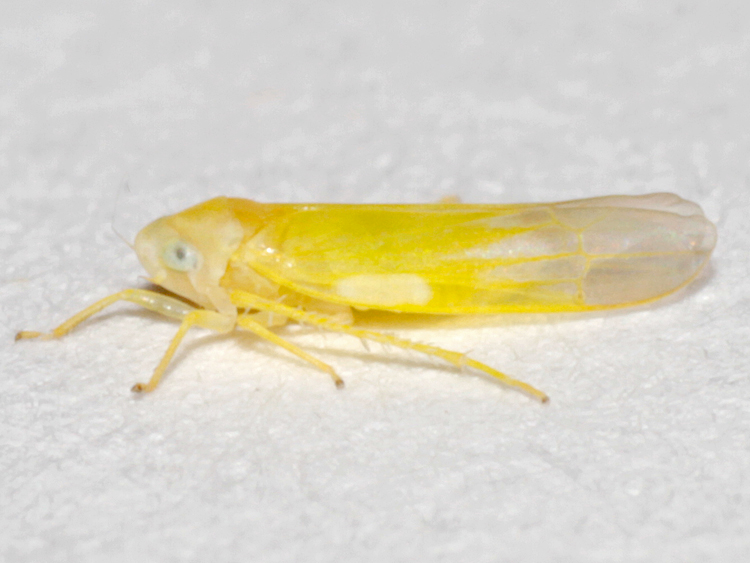

Fagocyba cruenta, North Elmham, 21st October


A Froghopper hopped away before I could ID it and the only other insects I noted were caddisflies: 3 Limnephilus lunatus and Halesus radiatus.

Things quietened down the following night with just Pale November Moth, Feathered Thorn, Green-brindled Crescent, Merveille du Jour, 5 Yellow-line Quakers and 2 Beaded Chestnuts making up the moths and Chrysoperla carnea agg., Limnephilus flavicornis and Limnephilus lunatus the lacewings and caddisflies.

If 22nd was quiet 23rd made up for it.  The highlights among 58 moths of 28 species were my first Sprawler of the year and my first Mottled Umber of the autumn but a much bigger surprise was an Orange Pine Tortrix Lozotaeniodes formosana.  Not because it's rare (though it is unusual here - I've only seen one here before, this July) or because it's stunning (though it certainly is) but because of the late date.  They normally finish flying in August and I think this might be the latest ever in Norfolk.

Orange Pine Tortrix Lozotaeniodes formosana, North Elmham, 23rd October


Blair's Shoulder-knot (left) and Sprawler (right), North Elmham, 23rd October


Mottled Umber, North Elmham, 23rd October


Other moths were 2 Garden Midgets Phyllonorycter messaniella, Long-horned Flat-body Carcina quercana, 4 Light Brown Apple Moths Epiphyas postvittana, Ashy Button Acleris sparsana, Red-green Carpet, 2 Pine Carpets, 9 November Moths, Feathered Thorn, 2 Large Yellow Underwings, 4 Setaceous Hebrew Characters, White-point, 2 Common Wainscots, 2 Black Rustics, Blair's Shoulder-knot, 2 Green-brindled Crescents, Merveille du Jour, Satellite, Red-line Quaker, 2 Yellow-line Quakers, 5 Beaded Chestnuts, Rosy Rustic, 2 Large Wainscots, 2 Burnished Brasses, 3 Straw Dots and Snout.

November Moth (male), North Elmham, 23rd October - not every pale November Moth is a Pale November Moth...


It wasn't just moths in the trap - there were lots of leafhoppers.  Having had several in recent days I imagined all the bright yellow leafhoppers would be Fagocyba cruenta so didn't retain them all for checking.  Of those I did keep 2 were indeed cruenta but one turned out to be Edwardsiana flavescens, a new one for here.  Other leafhoppers included Alebra albostriella, 5 Empoasca vitis and probably 2 Kybos betulicola (the male confirmed, the female either this or smaragdula).

Edwardsiana flavescens, North Elmham, 23rd October


Alebra albostriella, North Elmham, 23rd October


There were also 2 mirid bugs (Birch Catkin Bug Kleidocerys resedae and Pinalitus cervinus), 2 barkflies Valenzuela flavidus, the green lacewing Chrysoperla carnea and the caddisflies Limnephilus affinis, Limnephilus auricula, Limnephilus flavicornis and 9 Limnephilus lunatus.

Someone once pointed out a spider to me which they identified as Nuctenea umbratica on the basis of two white marks on the underside of its abdomen.  This spider in my shed had similar markings, but whether that's diagnostic or not I'm not sure.  I didn't get a good look at the top side of it.

Spider (possibly Nuctenea umbratica?), North Elmham, 24th October

Wednesday, 6 September 2017

Garden Garden Tiger

There were two additions to the garden list on Tuesday 18th July, both very distinctive species.  The first was the beautifully-marked Orange Pine Tortrix Lozotaeniodes formosana, a species I've encoutered at a few sites but never at home until now.


Orange Pine Tortrix Lozotaeniodes formosana, North Elmham, 18th July


The second was another easily recognised species, once common in gardens but sadly now quite rare across much of the county.  It remains common in the Broads and along the north coast but is now much less frequently encountered elsewhere, so I was very pleased to get one at home - a Garden Tiger.


Garden Tiger, North Elmham, 18th July


Wainscot Smudge Ypsolopha scabrella, Grey Poplar Bell Epinotia nisella and White-spotted Pug were new for the year here.

Wainscot Smudge Ypsolopha scabrella, North Elmham, 18th July


Grey Poplar Bell Epinotia nisella, North Elmham, 18th July


White-spotted Pug, North Elmham, 18th July


Other highlights included Grey-streaked Smudge Plutella porrectella, Body-marked Case-bearer Coleophora clypeiferella and no less than 5 Elephant Hawk-moths.

Other moths were 2 Bird’s-nest Moths Tinea trinotella, 2 Horse Chestnut Leaf-miners Cameraria ohridella, Hawthorn Argent Argyresthia bonnetella, 3 Bird-cherry Ermines Yponomeuta evonymella, Little Ermel Swammerdamia pyrella, 2 Brown House Moths Hofmannophila pseudospretella, Long-horned Flat-body Carcina quercana, 3 Common Flat-bodies Agonopterix heracliana, Dark Groundling Bryotropha affinis, 3 Cinereous Groundlings Bryotropha terrella, Dingy Dowd Blastobasis adustella, Common Cosmet Mompha epilobiella, Plain Conch Phtheochroa inopiana, Hook-marked Straw Moth Agapeta hamana, Dark Fruit-tree Tortrix Pandemis heparana, Light Brown Apple Moth Epiphyas postvittana, 2 Dover Shades Cnephasia genitalana, White-triangle Button Acleris holmiana, 3 Garden Rose Tortrixes Acleris variegana, Barred Marble Celypha striana, Common Cloaked Shoot Gypsonoma dealbana, Bud Moth Spilonota ocellana, 6 Marbled Piercers Cydia splendana, Codling Moth Cydia pomonella, 4 Garden Grass-veneers Chrysoteuchia culmella, Grass-veneer Crambus pascuella, Yellow Satin Veneer Crambus perlella, 17 Pearl Veneers Agriphila straminella, Common Grass-veneer Agriphila tristella, 4 Pearl Grass-veneers Catoptria pinella, Base-lined Grey Scoparia basistrigalis, 3 Little Greys Eudonia lacustrata, 5 Small Greys Eudonia mercurella, Chequered Straw Evergestis pallidata, Pale Straw Pearl Udea lutealis, 28 Mother of Pearls Pleuroptya ruralis, Double-striped Tabby Hypsopygia glaucinalis, 4 Rosy Tabbies Endotricha flammealis, White Plume Pterophorus pentadactyla, 3 Chinese Characters, Blood-vein, Lesser Cream Wave, Least Carpet, 5 Small Fan-footed Waves, 5 Single-dotted Waves, 2 Riband Waves, 2 Red Twin-spot Carpets, Large Twin-spot Carpet, Small Rivulet, Currant Pug, 2 Double-striped Pugs, Brimstone Moth, 4 Early Thorns, Scalloped Oak, Peppered Moth, 2 Yellow-tails, Black Arches, 2 Rosy Footmen, 12 Dingy Footmen, 5 Scarce Footmen, Buff Footman, 11 Common Footmen, Buff Ermine, 2 Ruby Tigers, Heart and Dart, Shuttle-shaped Dart, 2 Flame Shoulders, 4 Large Yellow Underwings, 4 Double Square-spots, 4 Nutmegs, Smoky Wainscot, Grey Dagger, 2 Dun-bars, 4 Dark Arches, Cloaked Minor, 2 Common Rustics, 5 Dusky Sallows, 3 Uncertains, 3 Rustics, 4 Nut-tree Tussocks, Beautiful Hook-tip, 2 Snouts and 2 Fan-foots.

The micro caddisfly Ithytrichia lamellaris was a first for me.

Ithytrichia lamellaris (female), North Elmham, 18th July


A good selection of other caddisflies included Oxyethira falcata, Ecnomus tenellus, 2 Hydropsyche siltalai, 2 Hydropsyche pellucidula, 2 Limnephilus lunatus, Limnephilus sparsus and  Ceraclea dissimilis.

There were a few lacewings too: 2 Cunctochrysa albolineata, 9 Dichochrysa flavifrons, 2 Micromus variegatus.  Mayflies included 2 Pond Olives Cloeon dipterum and a Blue-winged Olive Serratella ignita.  The only beetle was an Orange Ladybird.

Wednesday, 10 August 2016

Hills and Holes (Hockham)

Saturday 9th July was the Norfolk Moth Survey event at Hills and Holes near Hockham.  A superb site that I've never been to before - in fact it was completely off my radar and I never even knew it existed.  Dave and I set our lights in one area and it was so good that we never left it to go and see what the others had in their traps.  We totalled 114 species including multiple individuals of 2 species I'd never seen before: 3 Bugloss Case-bearers Coleophora pennella and 5 White-strap Sobers Syncopacma larseniella.


White-strap Sobers Syncopacma larseniella, Hills and Holes, 9th July


Bugloss Case-bearers Coleophora pennella (male above & female below, gen det), Hills and Holes, 9th July


My first ever NMS event at Weston Park in 2011 produced a white Coleophora which I put down as kuhlweiniella based on the fact that a diffierent individual that I didn't see was collected and confirmed as that species.  In hindsight that was flawed logic - no reason at all to assume they were both the same species and the one I saw wasn't checked.  So although it was already on my list, the gen detted White Oak Case-bearer Coleophora kuehnella from Hills and Holes probably should have been my third lifer of the night. Grotty worn specimen though!

White Oak Case-bearer Coleophora kuehnella (male, gen det), Hills and Holes, 9th July


Other good micros included 3 Dotted Ermels Ethmia dodecea, White-shouldered Sober Sophronia semicostella and Ash-coloured Sober Acompsia cinerella.

White-shouldered Sober Sophronia semicostella, Hills and Holes, 9th July


The rest of the micros were 3 Bird-cherry Ermines Yponomeuta evonymella, Tipped Oak Case-bearer Coleophora flavipennella, 5 Grey Rush Case-bearers Coleophora glaucicolella, Common Rush Case-bearer Coleophora alticolella, Meadow Neb Metzneria metzneriella, 3 Water-mint Conches Phalonidia manniana, 2 Hook-marked Straw Moths Agapeta hamana, Burdock Conch Aethes rubigana, Large Fruit-tree Tortrix Archips podana, Variegated Golden Tortrix Archips xylosteana, 3 Orange Pine Tortrixes Lozotaeniodes formosana, 2 Red-barred Tortrixes Ditula angustiorana, 3 Flax Tortrixes Cnephasia asseclana, 2 Yellow Oak Buttons Aleimma loeflingiana, 2 Green Oak Tortrixes Tortrix viridana, Barred Marble Celypha striana, 2 Common Marbles Celypha lacunana, 2 Pine Marbles Piniphila bifasciana, White-backed Marble Hedya salicella, Triangle-marked Roller Ancylis achatana, 2 Hoary Bells Eucosma cana, Two-coloured Bell Eucosma obumbratana, 7 Orange-spotted Shoots Rhyacionia pinicolana, Marbled Piercer Cydia splendana, 80 Garden Grass-veneers Chrysoteuchia culmella, 2 Hook-streaked Grass-Veneers Crambus lathoniellus, Yellow Satin Veneer Crambus perlella, 2 Pearl Grass-veneers Catoptria pinella, Water Veneer Acentria ephemerella, Meadow Grey Scoparia pyralella, Common Grey Scoparia ambigualis, Brown China-mark Elophila nymphaeata, Ringed China-mark Parapoynx stratiotata, Chequered Straw Evergestis pallidata, Fenland Pearl Anania perlucidalis, Bee Moth Aphomia sociella, Dotted Oak Knot-horn Phycita roborella, 2 Twin-barred Knot-horns Homoeosoma sinuella, 5 Brown Plumes Stenoptilia pterodactyla and White Plume Pterophorus pentadactyla.

Orange Pine Tortrix Lozotaeniodes formosana, Hills and Holes, 9th July


White-backed Marble Hedya salicella, Hills and Holes, 9th July


Orange-spotted Shoots Rhyacionia pinicolana, Hills and Holes, 9th July

Water-mint Conch Phalonidia manniana (female, gen det), Hills and Holes, 9th July


The best macro was one of the last moths found, a fantastic Festoon.  I've only seen a couple before and both of those were seen in pots having been found by other people on events like this, so my first opportunity to get a reasonable photo.

Festoon, Hills and Holes, 9th July


One Cream Wave sp. looked for all the world like a Cream Wave, including its size, wing shape and wing markings, but it would be a very late date for that.  I gen detted it and it proved to be one of 8 Lesser Cream Waves, but it did make me wonder whether these two species can be wholly reliably identified without dissection, especially if they are not at the extremes of size.

Other macros were 2 Ghost Moths, Buff Arches, Figure of Eighty, Small Fan-footed Wave, Dwarf Cream Wave, Large Twin-spot Carpet, 2 Shaded Broad-bars, Common Carpet, Barred Straw, Blue-bordered Carpet, Brown Scallop, Toadflax Pug, Green Pug, Clouded Magpie, 3 Brown Silver-lines, Brimstone Moth, Swallow-tailed Moth, 2 Peppered Moths, Willow Beauty, Mottled Beauty, 2 Engraileds, 3 Clouded Silvers, Barred Red, 2 Pine Hawkmoths, Elephant Hawkmoth, Swallow Prominent, 2 Buff-tips, Yellow-tail, White Satin, Rosy Footman, Red-necked Footman, Four-dotted Footman, 2 Dingy Footmen, Scarce Footman, Buff Footman, Short-cloaked Moth, Heart and Club, Flame, Flame Shoulder, 2 Large Yellow Underwings, Dot Moth, Brown-line Bright-eye, Clay, 2 Smoky Wainscots, Shoulder-striped Wainscot, 2 Poplar Greys, Sycamore, Miller, Grey Dagger, 3 Coronets, Small Angle Shades, 2 Dark Arches, Light Arches, Clouded Brindle, Slender Brindle, Ear Moth, 3 Marbled White Spots, Green Silver-lines, Burnished Brass, Silver Y, Beautiful Golden Y, Spectacle, 2 Blacknecks, Beautiful Hook-tip, Straw Dot, Snout and Small Fan-foot.

Blackneck, Hills and Holes, 9th July


Brown Scallop, Hills and Holes, 9th July


Coronets, Hills and Holes, 9th July


Miller, Hills and Holes, 9th July


Red-necked Footman, Hills and Holes, 9th July


Ear Moth (male, gen det), Hills and Holes, 9th July


Pine Hawkmoth, Hills and Holes, 9th July


Clouded Brindle, Hills and Holes, 9th July


Toadflax Pug, Hills and Holes, 9th July


Best of the other things were a pair of Scarce Emerald Damselflies that spent the evening on my sheet.  It's 17 years since I last saw these!


Scarce Emerald Damselflies, Hills and Holes, 9th July


Also the green lacewing Chrysopa perla and 2 Honey Bees.  I didn't pay too much attention to the caddisflies as I haven't got time to sort them all out in the peak moth season (not this year anyway), but I did retain one - and it turned out to be a new one for me, Ceraclea fulva.