Description


A diary of my mothing activity covering highlights and photos from my moth trapping activities. Mainly Norfolk (UK), occasionally beyond. I may mention other wildlife sightings here, especially insects, but for birds see my birding diary.
Showing posts with label Sitona lineatus. Show all posts

Wednesday, 2 May 2018

A new survey site: the Cathedral Meadows

I have recently been asked by members of our parish council to help surveying the Cathedral Meadows, some parish council land running between the North Elmham Chapel ruins and the railway (the chapel was formerly known as a cathedral).  They are particularly interested in my records of moths and butterflies, though of course I will be recording everything I can.  There is a small wildflower meadow on the site which they are especially interested in, but I plan to record wildlife from the whole site, and use it as an opportunity to brush up on some of the taxa I've not paid as much attention to as I would like (though for the foreseeable future there will still be some big gaps - I can't see me having time to master ichneumons any time soon for example, or most of the flies, and I'm not sure I can reaslistically hope to make much progress with mosses and lichens at the moment either).

My first proper look round was on 20th April.  I found my first dragonflies of the year, 2 teneral Large Red Damselflies.

Large Red Damselfly, North Elmham Cathedral Meadows, 20th April


A number of bees were active, including Orange-tailed Mining Bee, Red-tailed Bumblebee, Common Carder Bee and Buff-tailed Bumblebee.

Orange-tailed Mining Bee Andrena haemorrhoa, North Elmham Cathedral Meadows, 20th April


Common Carder Bee, North Elmham Cathedral Meadows, 20th April


Having recently acquired the Naturalists' Handbook guide to Ants I made use of it to identify a red ant as the Common Red Ant Myrmica rubra, possibly the first time I've ever made a confident species-level identification of an ant!

Common Red Ant Myrmica rubra, North Elmham Cathedral Meadows, 20th April


There were Dark-edged Bee-flies along the track and I identified 3 species of beetle: 7-spot Ladybrd, Pea-leaf Weevil Sitona lineatus, and a new click beetle for me, Limonius poneli (according to Mike Hackston's excellent keys this is the same species that is often recorded as Kibunea minuta).

Pea-leaf Weevil Sitona lineatus, North Elmham Cathedral Meadows, 20th April


Limonius poneli, North Elmham Cathedral Meadows, 20th April


Bugs included 2 Stenodema laevigata and a new species for me, Scolopostethus affinis.

Stenodema laevigata, North Elmham Cathedral Meadows, 20th April


Scolopostethus affinis, North Elmham Cathedral Meadows, 20th April


My first positively-identified Stenocranus minutus were among the hoppers.


Stenocranus minutus, North Elmham Cathedral Meadows, 20th April


Another new species for me was Euscelis incisus.

Euscelis incisus, North Elmham Cathedral Meadows, 20th April


I'm not 100% certain about this one - I suspect it's a nymph of Javesella dubia - please let me know if you can confirm (or otherwise).


possible Javesella dubia?, North Elmham Cathedral Meadows, 20th April


Despite being in posession of the lovely new book on spiders I had been unable to put a name to this one, and wasn't even be sure of what family it belonged to.  Keith Kerr and Richard Wilson kindly confirmed that it's in the Lyniphiidae family and Richard suggested a couple of possible genera.  Keith gave me some more pointers which with the help of a close-up view of its palp lead me to conclude that it was Bathyphantes nigrinus.

Bathyphantes nigrinus (male), North Elmham Cathedral Meadows, 20th April


The flora didn't present many surprises but of 3 species of fern growing on the chapel ruins this Maidenhair Spleenwort was technically a lifer.  I'm sure I've seen it before (probably including here) but have never looked it up and identified it before.

Maidenhair Spleenwort, North Elmham Chapel, 20th April


No moths and not many butterflies, but a productive start to surveying this site.

Sunday, 27 March 2016

Breckland inverts

On Friday I spent the day in the Brecks and Fens.  My attention was mainly on birds, but always keeping an eye out for other wildlife of course.  And some of it was quite interesting, to me at least, although probably pretty unremarkable to an ardent pan-lister.

Rarely is it this late before I see a butterfly, but this year it wasn't until Friday that I saw my first identified butterflies (a couple of brief glimpses previously) - Small Tortoiseshells in 3 locations and 2 Brimstones at Hockwold Fen.  Hockwold Fen was also the site of my only beetle of the day, a new species for me, albeit apparently a very common one - Pea-leaf Weevil Sitona lineatus.


Pea-leaf Weevil Sitona lineatus, Hockwold Fen, 25th March


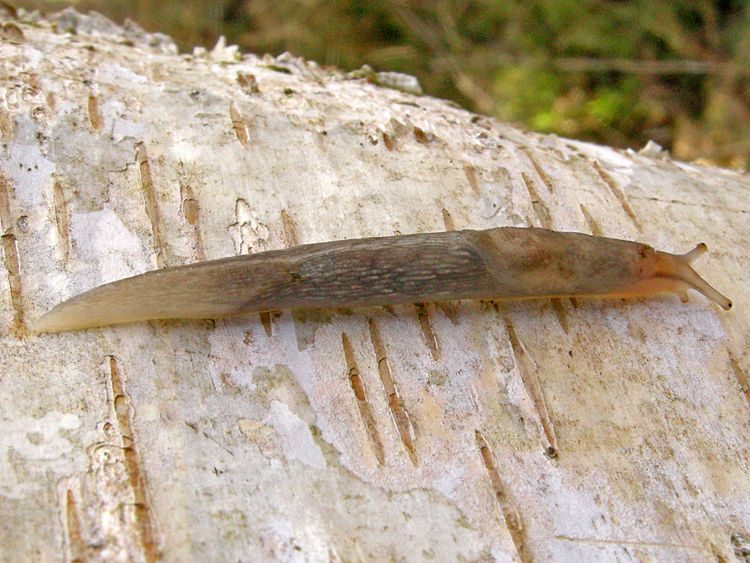
Earlier in the day at Lynford I found several slugs descending tree trunks.  I'm in the process of putting together a pan-list but haven't got to slugs yet, and so not made much attempt to identify many of them so far.  But these looked a bit different to the slugs I'm used to seeing so I decided to look them up.  Not 100% sure but I think they're Chestnut Slugs Deroceras invadens (please correct me if I'm wrong).


Chestnut Slugs Deroceras invadens (I think), Hockwold Fen, 25th March


When it comes to pan-listing plants I'm not sure how you can tell garden escapes from naturalised plants - I gather the latter are considered 'countable' while the former aren't.  I suspect if I ever want to take my pan-list seriously (which is unlikely) I will have to delete quite a few escapes from it.  Pretty sure half the flowers along the seawall at Burnham Overy are dodgy!  Spanish Bluebells and Grape Hyacinths for example.  Even assuming I've identified it correctly I doubt if I would be allowed to count this Glory of the Snow at a fly-tipping site...

Glory of the Snow (I think), near Cranwich Heath, 25th March


The next one was so abundant it must either be wild or naturalised, but for the life of me I couldn't find it in my books.  I was sure I've seen it before, and thought I'd even known what it was called once upon a time.  But I couldn't remember and asked here for help.  Big thanks to James again for coming to the rescue - it's the naturalised Oregon Grape (and I don't think I had ever known it before as it turns out).

Oregon Grape, Cranwich Heath, 25th March - thanks James for the ID


I'd hoped to find some moths or other interesting inverts at Cranwich Heath but drew a complete blank.  Walked all over and failed to find a single moth, beetle or bug.  I thought the semi-warm sunny afternoon might be good, but either it wasn't warm enough or it waas just too early in the season.  Or I wasn't looking hard enough.  At least this Fox was big and easy enough for me to see and identify it...

Red Fox, Cranwich Heath, 25th March


Cranwich Camp was hard work too.  I did find an intriguing woodlouse - on a rotting stump and spending most of its time down holes in the wood.  There are reasonably good references freely available online for woodlouse ID so I imagined I'd be able to put a name to it, but didn't succeed.  Once again James came to the rescue, keying it out as Common Rough Woodlouse Porcellio scaber.


Common Rough Woodlouse Porcelio scaber, Cranwich Camp, 25th March - thanks to James for the ID


One blossoming Sallow was attended by a number of bees, two of which I photographed.  I have vague recollections of identifiying Buff-tailed Bumble Bee in my youth but when I was going through my bee photos recently I couldn't find any of this species, so didn't add it to my pan-list.  I can now though, as I think this is a Buff-tailed Bumble Bee...

Buff-tailed Bumble Bee, Cranwich Camp, 25th March


I've never been very confident in separating Honey Bees from various Andrena and Colletes species, so consequently haven't paid much attention to them, and I didn't have any photos of bees that were good enough to be able to assign as Honey Bee even when I got Steven Falk and Richard Lewington's new Bees book.  So although I had clearly seen Honey Bee - and probably been stung by one - before, I didn't have any single individual that I could definitely say was one, and so hadn't added it to my pan-list.  Unless I'm much mistaken (which is always possible) this individual sets that straight.

Honey Bee, Cranwich Camp, 25th March


Back at home the moth trap yielded 2 Common Flat-bodies Agonopterix heracliana, March Moth, Common Quaker, 9 Hebrew Characters and 3 Early Greys on Friday night.  Last night produced just Dotted Border, March Moth and 4 Hebrew Characters.