Description


A diary of my mothing activity covering highlights and photos from my moth trapping activities. Mainly Norfolk (UK), occasionally beyond. I may mention other wildlife sightings here, especially insects, but for birds see my birding diary.
Showing posts with label Honey Bee. Show all posts

Friday, 11 May 2018

Chocolate in the bedroom

A Dark-edged Bee-fly in the garden on Saturday was new for the garden.

My butterfly list for the meadows was pretty poor with most of my visits so far either being early in the morning, late in the afternoon/evening, overnight or on cloudy days.  So on Saturday I decided to go mid afternoon in the hope of adding some species.  In fact it was very poor for butterflies considering the lovely warm sunshine, just the same 5 species I'd already seen there: 4 Green-veined Whites, 3 Orange-tips, Brimstone, Peacock and 2 Small Tortoiseshells.

There were several Vetch Piercers Grapholita jungiella flying in one of the fields, the first time I've ever seen this species in multiples, and at least 7 Large Red Damselflies.

Large Red Damselfly, Cathedral Meadows, 5th May


This beetle proved to be my first Bembidion lampros.

Bembidion lampros, Cathedral Meadows, 5th May


There was my first green lacewing for the site, a female Chrysoperla carnea agg. and hoverflies included this fine Leucozona lucorum.


Leucozona lucorum, Cathedral Meadows, 5th May


Dark-edged Bee-fly, Cathedral Meadows, 5th May


Among the bees were 6+ Common Carder Bees, Honey Bee and over 20 Flavous Nomad Bees Nomada flava.

Common Carder Bee, Cathedral Meadows, 5th May


Honey Bee, Cathedral Meadows, 5th May


Flavous Nomad Bee Nomada flava, Cathedral Meadows, 5th May


I found some more evidence of oak gall wasps - one isolated Oak sapling was covered in them - at least 40.

Oak galls, Cathedral Meadows, 5th May


I always think of Alexanders as being a coastal plant, so I had been surprised to find a single plant of what I think is this species near the chapel ruins.  Sounds like it does occur well inland though mainly along salted roads.

Alexanders, Cathedral Meadows, 5th May


Other botanical interest included my second species of Horsetail for the site, Marsh Horsetail.

Marsh Horsetail, Cathedral Meadows, 5th May


At home this Beech Midget Phyllonorycter maestingella was flying around the garden, my first here this year.

Beech Midget Phyllonorycter maestingella, North Elmham, 5th May


That night I trapped Common Flat-body Agonopterix heracliana, Light Brown Apple Moth Epiphyas postvittana, Brindled Pug, 2 Lesser Swallow Prominents, Swallow Prominent, 3 Muslin Moths, 3 Hebrew Characters and the hoverfly Platycheirus albimanus.

Next day I found what appears to be a Large Gorse Mining Bee Andrena bimaculata in my dining room.  Unexpected as there's no gorse in my garden or very close by, but it seems to key out to this species and everything checks out ok so far as I can tell.

Large Gorse Mining Bee Andrena bimaculata, North Elmham, 6th May


A worn micro moth was netted from the Cathedral Meadows and at first I couldn't work out what it was.  When it eventually settled I could see the tell-tale signs - it was a Garden Lance-wing Epermenia chaerophyllella. I'm sure my source of vernacular names for micro moths had this down as Golden Lance-wing before, which I always thought was quite inappropriate.  Maybe it had been a typo as it's now showing as Garden Lance-wing - much better.

Garden Lance-wing Epermenia chaerophyllella, Cathedral Meadows, 6th May


I stayed until dark at which point a few more things started to appear, including the beetle Leistus spinibarbis and a couple of moths seen in torchlight: Green Carpet and Common Pug.  But temperatures were now dropping so I didn't give it long.

Leistus spinibarbis, Cathedral Meadows, 6th May


The contents of my moth trap that night were nice, if not particularly exciting: 3 Lesser Swallow Prominents, Swallow Prominent, 2 Muslin Moths, 2 Hebrew Characters and 2 Nut-tree Tussocks.  But missing my trap and heading straight in to the bedroom was this lovely Chocolate-tip, my first of the year.


Chocolate-tip, North Elmham, 5th May

Sunday, 27 March 2016

Breckland inverts

On Friday I spent the day in the Brecks and Fens.  My attention was mainly on birds, but always keeping an eye out for other wildlife of course.  And some of it was quite interesting, to me at least, although probably pretty unremarkable to an ardent pan-lister.

Rarely is it this late before I see a butterfly, but this year it wasn't until Friday that I saw my first identified butterflies (a couple of brief glimpses previously) - Small Tortoiseshells in 3 locations and 2 Brimstones at Hockwold Fen.  Hockwold Fen was also the site of my only beetle of the day, a new species for me, albeit apparently a very common one - Pea-leaf Weevil Sitona lineatus.


Pea-leaf Weevil Sitona lineatus, Hockwold Fen, 25th March


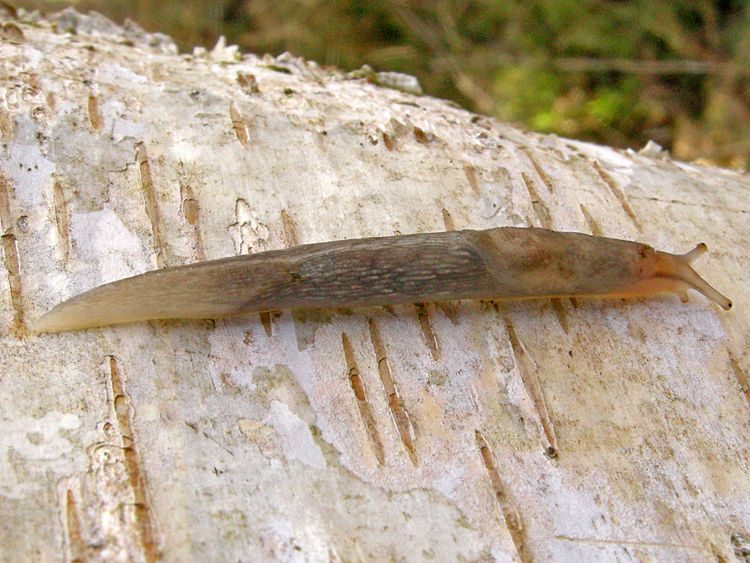
Earlier in the day at Lynford I found several slugs descending tree trunks.  I'm in the process of putting together a pan-list but haven't got to slugs yet, and so not made much attempt to identify many of them so far.  But these looked a bit different to the slugs I'm used to seeing so I decided to look them up.  Not 100% sure but I think they're Chestnut Slugs Deroceras invadens (please correct me if I'm wrong).


Chestnut Slugs Deroceras invadens (I think), Hockwold Fen, 25th March


When it comes to pan-listing plants I'm not sure how you can tell garden escapes from naturalised plants - I gather the latter are considered 'countable' while the former aren't.  I suspect if I ever want to take my pan-list seriously (which is unlikely) I will have to delete quite a few escapes from it.  Pretty sure half the flowers along the seawall at Burnham Overy are dodgy!  Spanish Bluebells and Grape Hyacinths for example.  Even assuming I've identified it correctly I doubt if I would be allowed to count this Glory of the Snow at a fly-tipping site...

Glory of the Snow (I think), near Cranwich Heath, 25th March


The next one was so abundant it must either be wild or naturalised, but for the life of me I couldn't find it in my books.  I was sure I've seen it before, and thought I'd even known what it was called once upon a time.  But I couldn't remember and asked here for help.  Big thanks to James again for coming to the rescue - it's the naturalised Oregon Grape (and I don't think I had ever known it before as it turns out).

Oregon Grape, Cranwich Heath, 25th March - thanks James for the ID


I'd hoped to find some moths or other interesting inverts at Cranwich Heath but drew a complete blank.  Walked all over and failed to find a single moth, beetle or bug.  I thought the semi-warm sunny afternoon might be good, but either it wasn't warm enough or it waas just too early in the season.  Or I wasn't looking hard enough.  At least this Fox was big and easy enough for me to see and identify it...

Red Fox, Cranwich Heath, 25th March


Cranwich Camp was hard work too.  I did find an intriguing woodlouse - on a rotting stump and spending most of its time down holes in the wood.  There are reasonably good references freely available online for woodlouse ID so I imagined I'd be able to put a name to it, but didn't succeed.  Once again James came to the rescue, keying it out as Common Rough Woodlouse Porcellio scaber.


Common Rough Woodlouse Porcelio scaber, Cranwich Camp, 25th March - thanks to James for the ID


One blossoming Sallow was attended by a number of bees, two of which I photographed.  I have vague recollections of identifiying Buff-tailed Bumble Bee in my youth but when I was going through my bee photos recently I couldn't find any of this species, so didn't add it to my pan-list.  I can now though, as I think this is a Buff-tailed Bumble Bee...

Buff-tailed Bumble Bee, Cranwich Camp, 25th March


I've never been very confident in separating Honey Bees from various Andrena and Colletes species, so consequently haven't paid much attention to them, and I didn't have any photos of bees that were good enough to be able to assign as Honey Bee even when I got Steven Falk and Richard Lewington's new Bees book.  So although I had clearly seen Honey Bee - and probably been stung by one - before, I didn't have any single individual that I could definitely say was one, and so hadn't added it to my pan-list.  Unless I'm much mistaken (which is always possible) this individual sets that straight.

Honey Bee, Cranwich Camp, 25th March


Back at home the moth trap yielded 2 Common Flat-bodies Agonopterix heracliana, March Moth, Common Quaker, 9 Hebrew Characters and 3 Early Greys on Friday night.  Last night produced just Dotted Border, March Moth and 4 Hebrew Characters.