Description


A diary of my mothing activity covering highlights and photos from my moth trapping activities. Mainly Norfolk (UK), occasionally beyond. I may mention other wildlife sightings here, especially insects, but for birds see my birding diary.
Showing posts with label Mallow. Show all posts

Friday, 19 March 2021

Review of 2019 and 2020 - Moths: Geometers (Geometridae) - part 3: Carpets II (Epirrhoe to Hydriomena)

GEOMETERS (GEOMETRIDAE) (continued)


Small Argent & Sable Epirrhoe tristata - On Mull, one west of Carsaig on 10th June 2019 and 2 along the road to Glengorm on 12th June.  This was the first time I've seen this non-Norfolk species in the UK.

Small Argent & Sable, west of Carsaig (Mull), 10th June 2019


Small Argent & Sable, Glengorm Road (Mull), 12th June 2019


Common Carpet Epirrhoe alternata - At least 40 caught in the garden between 25th May and 12th September 2019.  Not counted on 6 nights but with 1s and 2s around this time I doubt if the true figure was much higher than 40-50, so probably below average (about 60).  In 2020 67 between 21st May and 24th August, my second best total here in 6 years.  Elsewhere recorded next door, at the meadows (27 across 15 dates), and at Bintree Wood, Whitwell Street, Hills and Holes and Weybourne.

Common Carpet, North Elmham Cathedral Meadows, 22nd May 2019


Wood Carpet Epirrhoe rivata - One caught at home on 7th July 2019.  Until 2018 I was pretty skeptical about Wood Carpet records having noted a number of big pale-banded moths that I had taken to be extreme Common Carpets.  However in 2018 we found such a strong candidate for Wood Carpet at Derby Fen that I was forced to start taking them more seriously.  That individual was identified as Wood Carpet by a combination of features:
  1. It was very big – forewing length of about 15.5 mm so outside the given range for Common Carpet and towards the upper end of the range even for Wood Carpet;
  2. The white outer band on the forewing was broad, very white and with only very faint trace of a grey line dividing it through the centre (3-4 slightly more prominent grey dots near the leading edge but still faint);
  3. The white outer band on the hindwing was similarly broad and white and lacked any grey dividing line;
  4. Also the rear border of the white outer band on the forewing was very smooth (I’ve never seen this cited as a feature but it seems to be pretty consistent in most convincing photos of Wood Carpet online – Common Carpet nearly always having a more scalloped rear border to the white outer band on the forewing, at least when fresh).
That individual was a male, but although there are no known differences in male genitalia between the two species the consensus of opinion among all consulted was that this was indeed a Wood Carpet.  Two days later I caught another good candidate at home.  This was a female and although it is not clear that genitalia differences in females are consistent, there is a substantial difference between online images of female Wood Carpet genitalia and all the images I can find of female Common Carpet - and mine resembled the Wood Carpet's genitalia.  I caught one more apparent male at home a little while later and while not all of these 3 showed every character of Wood Carpet in perfection, I'm pretty much satisfied that that's what they all were.  If I'm right then I'm pretty sure that I've overlooked these in the past - the big pale-banded "Common" Carpets probably were Wood Carpets after all.  However, all this assumes that there are actually two clearly distinct different species, and I gather that isn't universally accepted.  Anyway, 2019's was another male, slightly worn and thus not as perfect as the Derby Fen individual but seems to me that it probably sits within the bounds of whatever Wood Carpets actually are.  None in 2020.

apparent Wood Carpet, North Elmham, 7th July 2019


Galium Carpet Epirrhoe rivata - None.  I'm yet to catch this species but there are a scattering of records in mid Norfolk so maybe I'll catch one some time.


Sharp-angled Carpet Euphyia unangulata - Only one trapped in the garden in 2019, on 23rd June.  I had been averaging over 5 a year and caught 3 in my previous worst year (2018).  2020 was better with 6 between 22nd June and 19th August.  Elsewhere 5 caught at the meadows, 5 at Bintree Wood and one at Hills and Holes.

Sharp-angled Carpet, North Elmham Cathedral Meadows, 23rd June 2019


Sharp-angled Carpet, North Elmham Cathedral Meadows, 7th July 2019


Sharp-angled Carpet, Bintree Wood, 13th June 2020


Sharp-angled Carpet, North Elmham, 22nd June 2020


Shoulder Stripe Earophila badiata - Totals of 5 trapped in the garden between 21st March and 24th April 2019 and 6 between 19th March and 11th April 2020.  5 is my worst annual total here - I've averaged 9 a year.  Elsewhere just 2 at the meadows on 20th March 2019.

Shoulder Stripe, North Elmham Cathedral Meadows, 20th March 2019


Shoulder Stripe, North Elmham, 24th April 2019


Shoulder Stripe, North Elmham, 9th April 2020


Streamer Anticlea derivata - Just 3 caught in the garden between 24th April and 19th May 2019 and 16 between 8th April and 9th May 2020.  These were my worst and second-best showings - apart from 23 in 2016 I've caugt 4-5 in the other years.  Elsewhere one at the meadows on 22nd April 2019.

Streamer, North Elmham Cathedral Meadows, 22nd April 2019


Streamer, North Elmham, 24th April 2019


Beautiful Carpet Mesoleuca albicillata - None.  I have only ever caught one of these, at my last place in Bawdeswell in 2010.  It was quite early in my mothing career and I don't think I realised quite how good it was at the time.  I look forward to the next one, hopefully here in North Elmham.


Dark Spinach Pelurga comitata - Singles caught in my garden on 8th August 2019 and 29th July 2020, then one at the meadows on 7th August 2020.  I'd only ever seen 3 before, all here (one in 2016 and 2 in 2018).

Dark Spinach, North Elmham, 8th August 2019


Dark Spinach, North Elmham, 29th July 2020


Dark Spinach, North Elmham Cathedral Meadows, 7th August 2020


Mallow Larentia clavaria - Totals of 6 trapped in my garden between 23rd September and 10th October 2019 and 11 between 21st September and 19th October 2020.  These were below par and 2019 was my lowest total so far.

Mallow, North Elmham, 21st September 2020


July Highflyer Hydriomena furcata - 5 caught in my garden between 6th July and 7th August 2019 was below average but 2 in 2020 (29th June and 11th July) was my worst year here so far.  I average 7 a year here but often catch a lot more at other sites - only 3 elsewhere in 2019/20 though, with singles at the meadows, Bintree Wood and Weybourne.

July Highflyer, North Elmham, 5th August 2019


July Highflyer, North Elmham, 29th June 2020


May Highflyer Hydriomena impluviata - One here on 25th May 2019 and 3 between 17th and 21st May 2020.  This species isn't quite annual here though I usually catch 2-3.  Also one at Sculthorpe Moor on 26th April 2019 and 2 at Hills and Holes on 21st May 2020.

May Highflyer, North Elmham, 25th May 2019


May Highflyer, North Elmham, 17th May 2020


Next page: more Geometridae

Saturday, 16 March 2019

A 'Notable' leafhopper: Eurhadina ribauti

There was a good selection of moths on the night of 15th September, though nothing as good as the Corn Moth Nemapogon granella that I'd found on the front door earlier on.  They were Beech Midget Phyllonorycter maestingella, Diamond-back Plutella xylostella, Vetch Sober Aproaerema anthyllidella, Large Fruit-tree Tortrix Archips podana, Light Brown Apple-moth Epiphyas postvittana, 2 Garden Rose Tortrixes Acleris variegana, 4 Common Marbles Celypha lacunana, Elbow-stripe Grass-veneer Agriphila geniculea, 4 Narrow-winged Greys Eudonia angustea, 3 Blood-veins, 3 Small Dusty Waves, Common Marbled Carpet, Green Carpet, 2 Brimstone Moths, 2 Dusky Thorns, 2 Light Emeralds, 4 Large Yellow Underwings, 3 Lesser Yellow Underwings, Broad-bordered Yellow Underwing, Square-spot Rustic, White-point, Common Wainscot, Centre-barred Sallow, 12 Lunar Underwings, Pink-barred Sallow, 3 Sallows, Mouse Moth, Flounced Rustic, Frosted Orange, Straw Dot and 3 Snouts.

Vetch Sober Aproaerema anthyllidella, North Elmham, 15th September


The caddisflies were Polycentropus flavomaculatus, Mottled Sedge Glyphotaelius pellucidus, Grammotaulius nigropunctatus, 2 Limnephilus affinis, 3 Limnephilus auricula, 3 Limnephilus flavicornis, 6 Limnephilus lunatus and 2 Limnephilus sparsus.

Bugs were represented by Black-kneed Capsid Blepharidopterus angulatus, barkflies by Ectopsocus briggsi and beetles by Aphodius rufipes.

The following day I found another Thatch Neb Bryotropha basaltinella, inside the house this time.  It was my fifth here this year and my 10th here since I moved in in 2014.  It was clearly a good year for this species as not only did I have as many as had been recorded in the county before, but two other recorders also found the species, the first county records from anywhere other than my garden (East Harling and Stoke Holy Cross, the latter involving two individuals and new for VC27).

Thatch Neb Bryotropha basaltinella (female, gen det), North Elmham, 16th September


That night was good.  The best moth was a Dark Smudge Ypsolopha horridella, my second and only about the 14th for the county.

Dark Smudge Ypsolopha horridella, North Elmham, 16th September


Other moths were a Bucculatrix sp. (think this must have escaped as I didn't photograph it and have no specimen), Garden Midget Phyllonorycter messaniella, Little Dwarf Elachista canapennella, Brown House Moth Hofmannophila pseudospretella, Brindled Flat-body Agonopterix arenella, Barred Fruit-tree Tortrix Pandemis cerasana, 6 Light Brown Apple-moths Epiphyas postvittana, 4 Garden Rose Tortrixes Acleris variegana, 2 Common Marbles Celypha lacunana, Nut-bud Moth Epinotia tenerana, 2 Narrow-winged Greys Eudonia angustea, Gold Triangle Hypsopygia costalis, White Plume Pterophorus pentadactyla, Common Plume Emmelina monodactyla, Small Dusty Wave, Green Carpet, 3 Brimstone Moths, Dusky Thorn, 4 Light Emeralds, Ruby Tiger, 4 Large Yellow Underwings, 2 Lesser Yellow Underwings, Broad-bordered Yellow Underwing, Setaceous Hebrew Character, Square-spot Rustic, Common Wainscot, 9 Lunar Underwings, Sallow, Mouse Moth, 2 Vine's Rustics and 6 Snouts.

A Pond Olive Cloeon dipterum represented the mayflies and neither green nor brown lacewing were fully identified.  The green was a female Chrysoperla carnea agg., almost certainly carnea but females can't be separated from the non-Norfolk pallida.  The brown was a Hemerobius lutescens or humulinus.  Normally these can be separated easily enough but this one, a female, wasn't clear.

Caddisflies were 3 Mottled Sedges Glyphotaelius pellucidus, 7 Limnephilus auricula, 2 Limnephilus flavicornis, 3 Limnephilus lunatus, 2 Limnephilus sparsus and Grouse Wing Mystacides longicornis.

It was the bugs that held the most interest with a very decent selection.  The highlight was a dark Phytocoris which I had to look pretty hard at to be sure it wasn't just a dark Phytocoris tiliae (one of which was also trapped).  In the end I resorted to checking the genitalia to confirm the ID - it was a new one for me, Phytocoris dimidiatus.

Phytocoris dimidiatus (male, gen det), North Elmham, 16th September


Phytocoris tiliae, North Elmham, 16th September


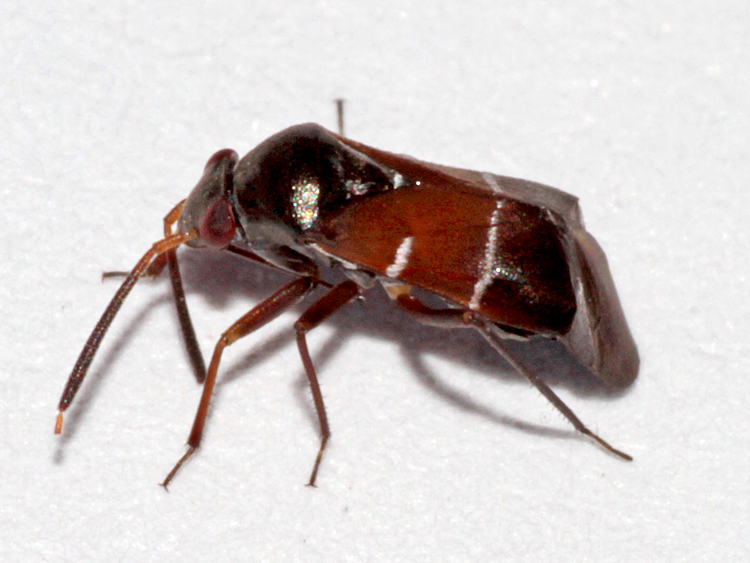
A Pantilius tunicatus was new for the year.

Pantilius tunicatus, North Elmham, 16th September


Other bugs were Birch Shieldbug Elasmostethus interstinctus, 3 Forest Bugs Pentatoma rufipes, Black-kneed Capsid Blepharidopterus angulatus, Lygus pratensis, Tarnished Plant Bug Lygus rugulipennis, Psallus varians and the leafhoppers 3 Kybos betulicola and 2 Fagocyba cruenta.  Barkflies (or barklice) consisted of a Graphopsocus cruciatus (new for the year) and 5 Ectopsocus of which at least 2 were Ectopsocus petersi.

Graphopsocus cruciatus, North Elmham, 16th September


Beetles were Amara apricaria, Nicrophorus investigator and Curculio venosus.  There was also a Hornet.

There were 3 new macro moths for the year the following night: Mallow, Green-brindled Crescent and Beaded Chestnut.  There were 35 species of moths in all, a good total for this time of year.  The others were Diamond-back Plutella xylostella, Little Dwarf Elachista canapennella, Brown House Moth Hofmannophila pseudospretella, Vetch Sober Aproaerema anthyllidella, 2 Light Brown Apple-moths Epiphyas postvittana, 3 Garden Rose Tortrixes Acleris variegana, Common Marble Celypha lacunana, Rush Marble Bactra lancealana, 3 Blood-veins, Small Blood-vein, Small Dusty Wave, Riband Wave, Garden Carpet, Common Marbled Carpet, Green Carpet, 2 Brimstone Moths, Dusky Thorn, Light Emerald, Ruby Tiger, 6 Large Yellow Underwings, 7 Lesser Yellow Underwings, Setaceous Hebrew Character, 2 Square-spot Rustics, White-point, 3 Common Wainscots, 18 Lunar Underwings, Pink-barred Sallow, Sallow, Mouse Moth, Flounced Rustic, Vine's Rustic and 4 Snouts.

Mallow, North Elmham, 17th September


Green-brindled Crescent, North Elmham, 17th September


A selection of lacewings consisted of 1-2 Chrysoperla carnea, Cunctochrysa albolineata (both green lacewings), the waxfly Conwentzia psociformis and the brown lacewing Hemerobius lutescens.  Also a Common Earwig.

There were 7 species of caddisfly: 2 Lype phaeopa, 3 Mottled Sedges Glyphotaelius pellucidus, 4 Limnephilus auricula, Limnephilus flavicornis, 9 Limnephilus lunatus and Limnephilus sparsus.

Bugs consisted of Lygus pratensis, 2 Kybos betulicola and the highlight of the nght, a decent new leafhopper.  It was easy to establish that it belonged to the genus Eurhadina, and a more careful look narrowed it down to one of two species, Eurhadina concinna or Eurhadina ribauti.  It was bound to be concinna as that's a widespread and common species on Oak rather than ribauti which is apparently much rarer, but to be sure you have to dissect them.  Well I like to be sure, and good job I do as it was in fact the rarer one, Eurhadina ribauti.  It's hard to get up to date information about the status of the various leafhopper species in Norfolk, but nationally it is listed as Notable B and there are only 12 records across the whole of the UK showing on NBN.  Apart from one in London these are all in the West Midlands or Wales, but this doesn't necessarily mean it is rare or unrecorded in Norfolk.


Eurhadina ribauti (male, aedeagus shown), North Elmham, 17th September


There were also 8 Ectopsocus barkflies.  I suspect they were all the same but I only checked one, an Ectopsocus petersi.  A Nicrophorus investigator was the only beetle and there was a Hornet.

Monday, 23 October 2017

Some interesting bugs and leafhoppers

I hadn't seen much in the way on non-avian wildlife on a visit to Burnham Overy on Saturday 16th September, but when I entered Holkham Pines I noticed something on my shoulder.  I duly potted it up and identified it as the distinctive bug Pilophorus cinnamopterus, a new one for me.  I contacted Rob Coleman the county recorder for bugs as there were no records in Norfolk showing on the NBN Atlas.  Turns out it's quite an interesting record, first recorded in Norfolk in 2013.  It's only the 5th record in Norfolk and apparently the other four were all from west Norfolk.


Pilophorus cinnamopterus, Holkham, 16th September


I also found a leafhopper at Holkham and this turned out to be Ribautiana cruciata.  Again the NBN Atlas doesn't show any records in Norfolk though it is quite widespread so I don't imagine it is really very unusual here.  Mind you, there aren't any photos on the British Bugs website which is perhaps an indicator of genuine scarcity?  Anyway, I will check with the county recorder for leafhoppers in due course.


Ribautiana cruciata, Holkham, 16th September


I was pretty much expecting that this fungus would turn out to be Shaggy Inkcap Coprinus comatus but from what I could tell looking through my books it seemed to be a better fit for the more unusual Coprinus sterquilinus.  Thanks again to James for confirming that it was indeed Shaggy Inkcap, and for identifying the yellow stuff as Fuligo septica.

Shaggy Inkcap Coprinus comatus, or possibly Coprinus sterquilinus?, Holkham, 16th September


Fuligo septica, Holkham, 16th September


That evening was the Norfolk Moth Survey event at Buckenham Carrs.  It was an exploratory visit really as some of us are hoping to do a bit more here next year.  It certainly seems like an excellent site, although the weather was not really much good on this occasion.  The only moths we found were Flame Carpet, Green Carpet, Dusky Thorn, 3 Large Yellow Underwings, Lesser Yellow Underwing, 2 Setaceous Hebrew Characters, 4 Square-spot Rustics, Brindled Green, Angle Shades and Snout.  There were about 4 each of the caddisflies Limnephilus auricula and Limnephilus flavicornis (probably more - these were just the ones I identified) and lots (25+) of Hornets.

I also found a leafhopper which on dissection proved to be Edwardsiana flavescens.  Now I know that the datasets on the NBN Atlas are very incomplete so there not being any Norfolk records of this species showing there may not be significant.  The fact that the NBN Atlas shows just two records in the whole of the UK might mean this one really is more significant though, maybe.  Or it might just be a recent arrival to the UK perhaps.  I will be in contact with the county recorder for leafhoppers to check the status of this and the Ribautiana above, but I know Tony is very busy at the moment so it might be a while before I find out.

Edwardsiana flavescens (male, gen det), Buckenham Carrs, 16th September


At home I noticed a distinctive-looking spider so took its photo and attempted to identify it using the new Britain's Spiders book.  It seems to be Araneus marmoreus.


Araneus marmoreus, North Elmham, 16th September


Very little in the moth trap that night: Light Brown Apple Moth Epiphyas postvittana, Narrow-winged Grey Eudonia angustea, Common Marbled Carpet, 2 Lesser Yellow Underwings, Lunar Underwing, 4 Flounced Rustics, 2 Snouts and Limnephilus lunatus.

The following night this Mallow was new for the year.

Mallow, North Elmham, 17th September


Other moths were Light Brown Apple Moth Epiphyas postvittana, 2 Narrow-winged Greys Eudonia angustea, Single-dotted Wave, Common Marbled Carpet, Brimstone Moth, Large Yellow Underwing, 4 Lesser Yellow Underwings, Setaceous Hebrew Character, 2 Lunar Underwings, 4 Flounced Rustics, Frosted Orange and Snout. An Aphodius rufipes was the only beetle but there was a selection of caddisflies: Mottled Sedge Glyphotaelius pellucidus, Limnephilus auricula, 5 Limnephilus lunatus, Limnephilus marmoratus and Limnephilus rhombicus.

Nothing remotely exciting in the following night's haul: Large Fruit-tree Tortrix Archips podana, 4 Narrow-winged Greys Eudonia angustea, Common Plume Emmelina monodactyla, Blood-vein, Single-dotted Wave, Common Marbled Carpet, Brimstone Moth, 2 Large Yellow Underwings, 5 Lesser Yellow Underwings, 2 Setaceous Hebrew Characters, Lunar Underwing, 7 Flounced Rustics, Frosted Orange, Snout and the caddisflies Mottled Sedge Glyphotaelius pellucidus, Limnephilus auricula, Limnephilus flavicornis and 4 Limnephilus lunatus.

Next day while birding in the Stiffkey area I found a Lesser Marsh Grasshopper and a final instar Common Green Shieldbug.

Lesser Marsh Grasshopper, Stiffkey Greens, 19th September


Common Green Shieldbug (final instar), Stiffkey Flood, 19th September


With its attractive peachy colour to its flesh I wondered if this might be Blushing Bracket but having looked it up I wasn't sure.  Thanks once again to James for confirming that it is in fact Chicken of the Woods (Sulphur Polypore).


Chicken of the Woods, Stiffkey Campsite Wood, 19th September


There were very few moths in the trap that night: Light Brown Apple Moth Epiphyas postvittana, Garden Rose Tortrix Acleris variegana, Narrow-winged Grey Eudonia angustea, Lesser Yellow Underwing, 2 Square-spot Rustics, 7 Lunar Underwings and 4 Flounced Rustics.

The following night was a little better with Brown House Moth Hofmannophila pseudospretella, White-shouldered House Moth Endrosis sarcitrella, Brindled Flat-body Agonopterix arenella, Light Brown Apple Moth Epiphyas postvittana, 2 Garden Rose Tortrixes Acleris variegana, Common Marble Celypha lacunana, 2 Narrow-winged Greys Eudonia angustea, 2 Brimstone Moths, 2 Dusky Thorns, Light Emerald, 2 Large Yellow Underwings, 4 Lesser Yellow Underwings, Setaceous Hebrew Character, Centre-barred Sallow, 8 Lunar Underwings, 2 Flounced Rustics, 2 Frosted Oranges, Vine's Rustic and 9 Snouts.

There was also a Pond Olive Cloeon dipterum (mayfly), an Aphodius rufipes (beetle) and 19 caddisflies: Hydropsyche pellucidula, 2 Limnephilus affinis, 2 Limnephilus auricula, Limnephilus flavicornis and 13 Limnephilus lunatus.  The Limnephilus affinis were new for the house, though I imagine I overlooked them last year when I had to step down my efforts with caddisflies during the second half of the summer.

Limnephilus affinis (female), North Elmham, 20th September


Next day I had another Common Frog in my moth trap but it didn't eat all of the moths!  There was Large Fruit-tree Tortrix Archips podana, Rhomboid Tortrix Acleris rhombana, Common Marble Celypha lacunana, 6 Narrow-winged Greys Eudonia angustea, Common Plume Emmelina monodactyla, Blood-vein, Brimstone Moth, Dusky Thorn, 2 Large Yellow Underwings, 3 Lesser Yellow Underwings, Setaceous Hebrew Character, Square-spot Rustic, 5 Lunar Underwings, 3 Flounced Rustics, 2 Frosted Oranges, 5 Snouts and the caddisflies Limnephilus auricula, 8 Limnephilus lunatus and Limnephilus sparsus.

The 22nd was particularly rubbish with just Feathered Thorn, Square-spot Rustic, 12 Lunar Underwings, Frosted Orange, Snout, 6 Limnephilus lunatus (caddisflies) and the beetle Aphodius rufipes.