
Description


A diary of my mothing activity covering highlights and photos from my moth trapping activities. Mainly Norfolk (UK), occasionally beyond. I may mention other wildlife sightings here, especially insects, but for birds see my birding diary.
Showing posts with label Dyseriocrania subpurpurella. Show all posts

Tuesday, 16 February 2021

Review of 2019 and 2020 - Moths: Golds (Micropterigidae), Purples (Eriocraniidae) and Swifts (Hepialidae)

GOLDS (MICROPTERIGIDAE)


Red-barred Gold Micropterix tunbergella - None.  I'm yet to find this species anywhere but I reckon there's a chance of finding it on the Hawthorn flowers at the meadows.  Probably not much chance of finding it at home.


Black-headed Gold Micropterix mansuetella - None.  Another one I'm not expecting to find at home, but perhaps half a chance of getting them at the meadows someday.


White-barred Gold Micropterix aruncella - None.  Perhaps a bit more likely that than the previous species to turn up at the meadows and who knows, maybe even at home one day.


Plain Gold Micropterix calthella - Up to 10+ at the meadows between 12th and 25th May 2019 and up to 7 between 25th April and 15th May 2020.  I've not recorded this at home, and not really expecting it either.


Plain Golds Microtperix calthella, North Elmham Cathedral Meadows, 25th April 2020


-----------------------------------


PURPLES (ERIOCRANIIDAE)


Common Oak Purple Dyseriocrania subpurpurella - One in my garden moth trap on 11th April 2020 was only my second here (following one in 2016).  Singles recorded at the meadows on 3 dates between 21st and 29th April 2019 and on 10th and 24th April 2020.

Common Oak Purple Dyseriocrania subpurpurella, North Elmham, 11th April 2020


White-spot Purple Eriocrania unimaculella - None.  I've never seen this species but there are records reasonably nearby so it may well crop up here sometime.


Mottled Purple Eriocrania sparrmannella - None.  Another one I've never seen, and a striking species that I would very much like to see.  It seems to be fairly widespread, if scarce, so must be a fair chance of coming across it sooner or later.


Small Birch Purple Eriocrania salopiella - None.  I've never caught this species though I did photograph one Dave N caught once.  It's another reasonably widespread species that might turn up here someday.


Washed Purple Eriocrania cicatricella - None.  Yet another scarce but widespread member of the family that I'm yet to encounter.


Early Purple Eriocrania semipurpurella - A male was netted in flight at the meadows fairly early in the morning on 17th April 2019, only the second time I've confirmed this species.  There were also some unidentified Eriocrania mines in the Downy Birch that was growing along the disused railway (sadly these trees were chopped dowin in the autumn).  I haven't recorded this species at home yet.

Early Purple Eriocrania semipurpurella, North Elmham Cathedral Meadows, 17th April 2019


Large Birch Purple Eeriocrania sangii - None.  I have recorded this species at home once (2018) - the only Eriocrania that I've recorded here.


-----------------------------------


SWIFTS AND GHOST MOTH (HEPIALIDAE)


Orange Swift Triodia sylvina - 2019 was a below-average year with 14 at home between 7th August and 4th September; also one to light at the meadows, a big female scattering its eggs.  2020 was more typical with 24 between 5th August and 13th September, but none anywhere else.

female Orange Swift, North Elmham Cathedral Meadows, 22nd August 2019


Common Swift Korscheltellus lupulina - A total of 56 in the garden moth trap between 17th May and 19th June 2019, just about my best year here.  Fewer in 2020 with 30 between 20th May and 21st June.  Also up to 10 at the meadows on 3 dates in 2019 and 2 in 2020.

Common  Swift, North Elmham Cathedral Meadows, 25th May 2019


Gold Swift Phymatopus hecta - None.  I've never recorded this species at home or at the meadows but it must be a strong possibility as I've seen it at Bintree Wood and Beetley Common.  Its foodplant (Bracken) doesn't grow at the meadows but does grow just a few yards further down the railway line.


Ghost Moth Hepialus humuli - Singles recorded at home on 7 nights between 24th June and 30th July 2019, my joint worst year in 5 for this species.  However 2020 was even worse with singles on just 2 nights, 8th and 9th July.  Also one at the meadows on 9th June 2020.
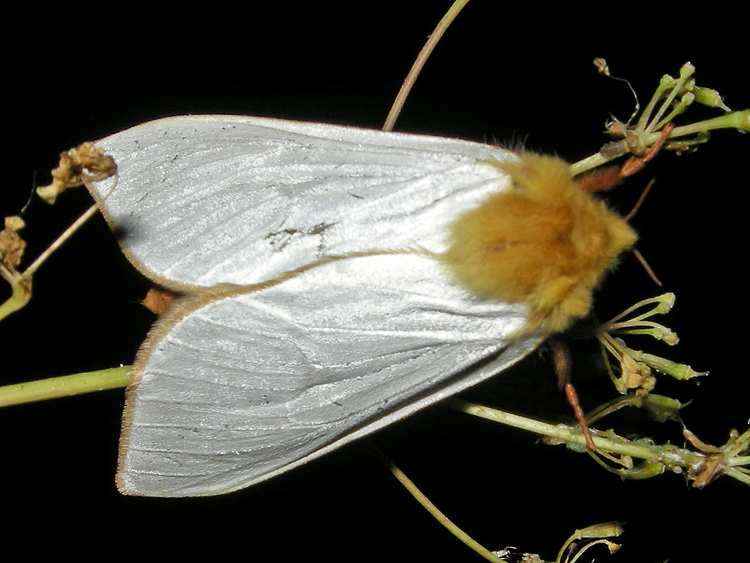
Ghost Moth, North Elmham Cathedral Meadows, 9th June 2020


Next page: Pigmies (Nepticulidae)

Saturday, 5 May 2018

Dotted Chestnut

There weren't so many moths on 23rd April but they did include a Dotted Chestnut, my second here following my first last spring.  As the species spreads northwards I shouldn't be surprised if this turns out to be annual going forward.


Dotted Chestnut, North Elmham, 23rd April


Another Lunar Marbled Brown was noteworthy - my third this year of a species I only added to my garden list last year.  Also trapped were Common Flat-body Agonopterix heracliana, 2 Common Plumes Emmelina monodactyla, Frosted Green, Brindled Pug, 2 Brindled Beauties, 2 Common Quakers, 5 Hebrew Characters, 2 Chrysoperla carnea agg. and a Common Wasp.


Common Wasp, North Elmham, 23rd April


The next night there were just 5 moths in the trap: Light Brown Apple Moth Epiphyas postvittana (new for the year), Early Thorn, Brindled Beauty and 2 Hebrew Characters.  A Brown-lipped Snail was the first I'd noticed this year.

Light Brown Apple Moth Epiphyas postvittana, North Elmham, 24th April


Next day I returned to the meadows.  It was relatively unproductive but there were 3 species of hoverfly: Melanostoma scalare, Platycheirus albimanus and Syrphus ribesii.

Melanostoma scalare, North Elmham Cathedral Meadows, 25th April


Platycheirus albimanus, North Elmham Cathedral Meadows, 25th April


Syrphus ribesii, North Elmham Cathedral Meadows, 25th April


Another ant proved to be Small Black Ant Lasius niger - that's probably the two commonest ant species knocked off now - I wonder how hard it will be to find any others?

Small Black Ant Lasius niger, North Elmham Cathedral Meadows, 25th April


I think this yellow mushroom must be a Yellow Fieldcap, but please correct me if I'm wrong.

Yellow Fieldcap, North Elmham Cathedral Meadows, 25th April


There is a good display of Cowslips in the wildflower meadow.

Cowslips, North Elmham Cathedral Meadows, 25th April


I found some Rue-leaved Saxifrage growing on the chapel ruins, along with plenty of Ivy-leaved Toadflax.

Rue-leaved Saxifrage, North Elmham Cathedral Meadows, 25th April


Ivy-leaved Toadflax, North Elmham Cathedral Meadows, 25th April


This tree growing near the chapel doesn't look like an ordinary Cypress to me - I'm erring more on the side of Nootka Cypress, but if anyone can confirm or put me right please let me know.

possible Nootka Cypress, North Elmham Cathedral Meadows, 25th April


I think these sheep thought I was going to feed them.  They were disappointed.


sheep, North Elmham Cathedral Meadows, 25th April


That night 3 Hebrew Characters were the only moths in the trap but there was also another Springtail, Orchesella cincta again I think.

Orchesella cincta, North Elmham, 25th April


A fractionally warmer night on 26th secured a small number of moths: Brindled Beauty, Muslin Moth, 2 Hebrew Characters and Nut-tree Tussock. Also a hoverfly Melanostoma scalare, my first here this year.

Early the next morning I popped up to the Cathedral Meadows where I found my first moths for the site at last.  At least 6 Beech Midgets Phyllonorycter maestingella (2 retained and confirmed) were flying around nettles beneath a beech tree, at least 2 Common Thorn Midgets Phyllonorycter oxyacanthae were flying around the track flanked by Hawthorn and a Common Oak Purple Dyseriocrania subpurpurella was flying beneath oaks on the railway.  Although I'd already counted an unconfirmed example the oxyacanthae were my first confirmed individuals of this species anywhere.

Beech Midget Phyllonorycter maestingella (male, gen det), North Elmham, 27th April


Common Thorn Midget Phyllonorycter oxyacanthae (male, gen det), North Elmham, 27th April


Common Oak Purple Dyseriocrania subpurpurella, North Elmham, 27th April


I then went to the patch at Bittering and saw my third Pyllonorycter species of the morning, a White Oak Midget Phyllonorycter harrisella.

Later that day I found my first Waxfly of the year, inside my study.  It was a Conwentzia sp., but like every other Conwentzia I've caught it was a female and so cannot be identified to species-level.

Conwentzia sp. (female), North Elmham, 27th April


That night there were no moths in the trap but 2 more hoverflies, both Melanostoma scalare.  Nothing at all the following night and just 1 Hebrew Character and another Melanostoma scalare on 29th.

Friday, 29 April 2016

Poor mothing but always something to look at

The last week hasn't been a good one for moths.  They don't like snow and Arctic conditions, apparently.

Last Friday night scraped the bottom of the barrel with Brindled Pug and Early Grey, but a smallish slug on the bottom of the moth trap aroused my curiosity.  Turns out it's a Netted Slug, but the biggest surprise is that this is supposed to be one of our commonest slugs yet it didn't look familiar to me at all.  The first time I've identified one anyway.

Netted Slug, North Elmham, 22nd April


On Saturday morning in the Brecks some early sunshine got me a nice Common Oak Purple Dyseriocrania subpurpurella.

Common Oak Purple Dyseriocrania subpurpurella, Hockham Heath, 23rd April


I also caught this Brown Lacewing which provided me with my first opportunity to try out my newly-acquired key to Lacewings.  It was Hemerobius humulinus, the first time I've identified a Brown Lacewing to species level.

Brown Lacewing Hemerobius humulinus, Hockham Heath, 23rd April


The Snails key also got its first use, although it wasn't the first time I've identified Brown-lipped and White-lipped Snails.  Indeed in this case the key sent me in the wrong direction as the Brown-lipped Snail showed a substantial and completely unobscured umbilicus.  Bad snail.

Some fungi caused me problems, as always.  I think this one might be Birch Polypore...

Birch Polypore?, near Thompson Water, 23rd April


...but these white blobs on the side of a tree in a swamp made me wonder if there was a species related to King Alfreds Cakes, only white.  Well if there is I can't find it in my books, and King Alfred's Cakes aren't supposed to be white even when they're young, so I've no idea what they were.  Maybe they weren't even fungi?  Ah, as I type this I've had an idea... slime mould maybe.  Yes, that looks likely, perhaps Enteridium lycoperdon?

slime mould, perhaps Enteridium lycoperdon, Cranberry Rough, 23rd April


As a very novice botanist, Forget-me-nots are always a challenging group to identify.  Hopefully they get easier with experience but I still struggle.  I think these were Wood Forget-me-nots.

Wood Forget-me-not, Cranberry Rough, 23rd April


This Brown Hare tried to hide from me in the rain.

Brown Hare, Bodney, 23rd April


When I drew up beside it it soon changed its mind and ran away instead.


Brown Hare, Bodney, 23rd April


Another brief spell of sunshine in the garden after I got home produced what I assume was a Feathered Bright Incurvaria masculella in the Wysteria.  It didn't stop long enough for me to get a good enough look to be 100% sure, but it's by far the most likely moth that looks anything like that.  One insect that did pause long enough for a close examination was the hoverfly Eristalis arbustorum - the first time I've identified this common species.

Eristalis arbustorum, North Elmham, 23rd April


In the trap overnight there were just 2 Hebrew Characters but after Saturday the weather deteriorated even more and it felt more like January than late April.  The moth catches shifted from being dreadful to non-existent.  Three nights in a row without a single moth and for at least two of those not a single insect - not even a fly!  Hate to think what effect this is having on insectivorous birds, especially resident ones that have already started breeding.

One moth (and one fly) in the trap on Wednesday night - a new one for the year too, Muslin Moth.

Muslin Moth, North Elmham, 27th April


Also on Wednesday I had my first opportunity to use another new key, the one on Woodlice - this is a Common Rough Woodlouse Porcellio scaber.

Common Rough Woodlouse Porcellio scaber, North Elmham, 27th April


Thursday night saw another (or perhaps the same) Muslin Moth and a Hebrew Character.