Saturday 29th July was the date of the Norfolk Moth Survey event at Frost's Common, a site I was very much looking forward to trapping at. Sadly the forecast was abysmal and it looked like it would be raining for most of the night, but incredibly quite a few people actually bothered to turn up in the wet. There wasn't any chance of trapping in the weather but we had a wander round with torches hoping to pick up a few interesting moths. We pretty much failed, or at least none of the moths I saw were very remarkable. The best was a Waste Grass-veneer
Pediasia contaminella which I'd only seen once before. I missed out on the Pale Lettuce Bell
Eucosma conterminana which others apparently saw - must have been somewhere else when that was passed round which is a shame as it would have been a lifer for me. Not too rare though - I'll get one sometime.
Waste Grass-veneer Pediasia contaminella, Frost's Common, 29th August
The other moths I saw were 2 Hook-marked Straw Moths
Agapeta hamana, Rush Marble
Bactra lancealana, 80 Pearl Veneers
Agriphila straminella, 2 Barred Grass-veneers
Agriphila inquinatella, 5 Mother of Pearls
Pleuroptya ruralis, Rosy Tabby
Endotricha flammealis, Brown Plume
Stenoptilia pterodactyla, Blood-vein,
2 Large Twin-spot Carpets,
8 Shaded Broad-bars, Flame Shoulder,
Lesser Common Rustic and 10 Straw Dots.
I'm not certain about the identity of this grasshopper - unless I'm missing something it doesn't seem to be any species that is normally so short-winged. Based on the pattern of the pronotum I'm guessing it's either Mottled Grasshopper or, and I favour this, Field Grasshopper. Is it a species that sometimes has a short-winged form, or is it not fully mature? Let me know if you have any ideas...
possible Field Grasshopper, Frost's Common, 29th August
The best of the moths trapped at home that night was a
Small Waved Umber - only my second ever and my first here.
Small Waved Umber, North Elmham, 29th August
A Pale-streak Grass-veneer
Agriphila selasella was my first at home this year.
Pale-streak Grass-veneer Agriphila selasella, North Elmham, 29th August
Other moths at home were Ribwort Slender
Aspilapteryx tringipennella, 2 Little Ermels
Swammerdamia pyrella, Dingy Dowd
Blastobasis adustella, 2 Light Brown Apple Moths
Epiphyas postvittana, Maple Button
Acleris forsskaleana, Rush Marble
Bactra lancealana, Two-coloured Bell
Eucosma obumbratana, 3 Marbled Piercers
Cydia splendana, 4 Garden Grass-veneers
Chrysoteuchia culmella, 34 Pearl Veneers
Agriphila straminella, 2 Common Grass-veneers
Agriphila tristella,
Ringed China-mark Parapoynx stratiotata, Garden Pebble
Evergestis forficalis, 21 Mother of Pearls
Pleuroptya ruralis,
Lesser Cream Wave,
Least Carpet, Single-dotted Wave, 8 Riband Waves, Dark-barred Twin-spot Carpet, Early Thorn, 3 Willow Beauties,
Lesser Swallow Prominent, 4 Dingy Footmen, Common Footman, Large Yellow Underwing, Lesser Broad-bordered Yellow Underwing, Dark Arches, Rustic and 3 Straw Dots.
Other insects I recorded were Pond Olive
Cloeon dipterum (mayfly),
Chrysoperla carnea (and a
Chrysoperla carnea agg.) (green lacewings), 2
Hemerobius humulinus (brown lacewings) and the caddisflies 2
Hydropsyche pellucidula, 2
Limnephilus lunatus and
Limnephilus rhombicus, the latter new for the year.
Limnephilus rhombicus (male), North Elmham, 29th August
New for the year the following night were Ash-coloured Sober
Acompsia cinerella and Heather Tortrix
Argyrotaenia ljungiana, the former regular here but fairly scarce across the county.
Ash-coloured Sober Acompsia cinerella, North Elmham, 30th August
Other moths on what was a busier night than most recent nights were Brindled Flat-body
Agonopterix arenella, 2 Cinereous Groundlings
Bryotropha terrella, 4 Dingy Dowds
Blastobasis adustella, Dark Fruit-tree Tortrix
Pandemis heparana, Light Brown Apple Moth
Epiphyas postvittana, Garden Rose Tortrix
Acleris variegana, Barred Marble
Celypha striana, Common Cloaked Shoot
Gypsonoma dealbana, Hoary Bell
Eucosma cana, Marbled Piercer
Cydia splendana, 2 Garden Grass-veneers
Chrysoteuchia culmella, 28 Pearl Veneers
Agriphila straminella, 2 Common Grass-veneers
Agriphila tristella,
Ringed China-mark Parapoynx stratiotata, 2 Garden Pebbles
Evergestis forficalis, 9 Mother of Pearls
Pleuroptya ruralis, Grey Knot-horn
Acrobasis advenella,
Least Carpet, 2 Single-dotted Waves, 4 Riband Waves,
Flame Carpet, Dark-barred Twin-spot Carpet, Common Carpet,
Yellow Shell, 2 Currant Pugs, Early Thorn, Scalloped Oak, 4 Willow Beauties,
Poplar Hawk-moth,
2 Lesser Swallow Prominents,
2 Pale Prominents, Yellow-tail,
Black Arches, 2 Dingy Footmen, Scarce Footman,
Buff Footman, Shuttle-shaped Dart, Lesser Broad-bordered Yellow Underwing, Setaceous Hebrew Character, Dark Arches, 2 Common Rustics (plus a Common Rustic agg.), Rustic, Spectacle and 3 Straw Dots.
A
Chrysoperla carnea was the only lacewing but there were 4 species of caddisfly:
Hydropsyche siltalai,
Hydropsyche pellucidula,
Limnephilus lunatus and
Limnephilus flavicornis. There was also a
Buff-tailed Bumblebee in the grass next to the trap.
Numerically the next night wasn't very far behind the previous night but there were no standout highlights: Bird-cherry Ermine
Yponomeuta evonymella, Long-horned Flat-body
Carcina quercana, Brindled Flat-body
Agonopterix arenella, Light Brown Apple Moth
Epiphyas postvittana, Barred Marble
Celypha striana, Holly Tortrix
Rhopobota naevana, Garden Grass-veneer
Chrysoteuchia culmella, 31 Pearl Veneers
Agriphila straminella, 4 Common Grass-veneers
Agriphila tristella, Pearl Grass-veneer
Catoptria pinella, Garden Pebble
Evergestis forficalis, Chequered Straw
Evergestis pallidata, Pale Straw Pearl
Udea lutealis, 7 Mother of Pearls
Pleuroptya ruralis, Common Plume
Emmelina monodactyla, 3 Single-dotted Waves, Riband Wave, Dark-barred Twin-spot Carpet, Double-striped Pug, Willow Beauty,
Poplar Hawk-moth,
Elephant Hawk-moth,
2 Swallow Prominents,
Pale Prominent,
Black Arches, Rosy Footman, 2 Dingy Footmen, Buff Ermine, Shuttle-shaped Dart, Lesser Yellow Underwing, 2 Lesser Broad-bordered Yellow Underwings, Setaceous Hebrew Character,
Dun-bar, Common Rustic and 5 Straw Dots. Not much in the way of other insects either - the sexton beetle
Nicrophorus investigator was the only other thing noted.
Brimstone and
Holly Blue were among the butterflies in the garden the following day.
Brimstone, North Elmham, 1st August
That night the only new moth for the year was an Orchard/Apple/Spindle Ermine sp.
Yponomeuta padella/malinellus/cagnagella - a shame that this aggregate species group cannot be identified to species level even with examination of the genitalia (you need to see what foodplant the larvae fed on, and even then it isn't always entirely reliable).
Orchard, Apple or Spindle Ermine Yponomeuta padella/malinellus/cagnagella, North Elmham, 1st August
Other moths that night were Bird’s-nest Moth
Tinea trinotella, Ribwort Slender
Aspilapteryx tringipennella, 2 Bird-cherry Ermines
Yponomeuta evonymella, Clover Case-bearer
Coleophora alcyonipennella, Woundwort Case-bearer
Coleophora lineolea, Little Dwarf
Elachista canapennella, Long-horned Flat-body
Carcina quercana, House Groundling
Bryotropha domestica, Buff Cosmet
Mompha ochraceella, 2 Dark Fruit-tree Tortrixes
Pandemis heparana, Dark-triangle Button
Acleris laterana, Barred Marble
Celypha striana, Marbled Piercer
Cydia splendana, Garden Grass-veneer
Chrysoteuchia culmella, 57 Pearl Veneers
Agriphila straminella, 2 Common Grass-veneers
Agriphila tristella, Chequered Grass-veneer
Catoptria falsella, Small Grey
Eudonia mercurella,
3 Garden Pebbles Evergestis forficalis, 2 Pale Straw Pearls
Udea lutealis, 9 Mother of Pearls
Pleuroptya ruralis, Grey Knot-horn
Acrobasis advenella, White Plume
Pterophorus pentadactyla, Common Plume
Emmelina monodactyla, 4 Single-dotted Waves, Riband Wave, Dark-barred Twin-spot Carpet, Common Carpet,
Phoenix,
Magpie Moth,
2 Canary-shouldered Thorns, Early Thorn, 3 Willow Beauties,
Coxcomb Prominent,
2 Pale Prominents, Rosy Footman, Dingy Footman, Common Footman, Flame Shoulder, 4 Large Yellow Underwings, Lesser Broad-bordered Yellow Underwing, 2 Setaceous Hebrew Characters, Dark Arches, 2 Common Rustics, Spectacle and 6 Straw Dots.
House Groundling Bryotropha domestica, North Elmham, 1st August
A Ginger Button
Acleris aspersana was new for the year on Wednesday 2nd August.
Ginger Button Acleris aspersana, North Elmham, 2nd August
Other moths that night were 4 Bird-cherry Ermines
Yponomeuta evonymella, Common Flat-body
Agonopterix heracliana, Cinereous Groundling
Bryotropha terrella, 7 Dingy Dowds
Blastobasis adustella, 2 Hook-marked Straw Moths
Agapeta hamana, 2 Dark Fruit-tree Tortrixes
Pandemis heparana, 3 Light Brown Apple Moths
Epiphyas postvittana, Maple Button
Acleris forsskaleana, Barred Marble
Celypha striana, Rush Marble
Bactra lancealana, Common Birch Bell
Epinotia immundana, Marbled Piercer
Cydia splendana, 17 Pearl Veneers
Agriphila straminella, 6 Common Grass-veneers
Agriphila tristella, 3 Small Greys
Eudonia mercurella, Pale Straw Pearl
Udea lutealis, 4 Mother of Pearls
Pleuroptya ruralis, Grey Knot-horn
Acrobasis advenella,
Maiden's Blush, Blood-vein, 3 Single-dotted Waves, 2 Riband Waves, 2 Red Twin-spot Carpets,
Magpie Moth, 2 Brimstone Moths, Early Thorn, 2 Willow Beauties,
Lesser Swallow Prominent, Dingy Footman, Scarce Footman, Common Footman, Shuttle-shaped Dart, Flame Shoulder, 4 Large Yellow Underwings, Lesser Broad-bordered Yellow Underwing, Dark Arches, Common Rustic, Rustic and 6 Straw Dots.
There was a good number of green lacewings but apart from one
Dichochrysa flavifrons all were
Chrysoperla sp. The latter are almost invariably
Chrysoperla carnea but only the males can be separated (with a good look at the tips of their abdomen) from
pallida, a species relatively recently recognised and which has not yet been recorded in Norfolk. Of tonight's haul 5 were male
carnea and 13 were females. There was one more male which for a second I thought might be
pallida as the abdomen looked interesting, but then I remembered that there is a third species of
Chrysoperla which is supposed to be common, although I'd not seen it before.
Chrysoperla lucasina, as this turned out to be, has a slight point on the tip of the wing, distinct from the more rounded wing tip of
carnea (and
pallida). It's quite subtle - I overlooked it at first - it was only when I noticed the abdomen tip was wrong for
carnea that I looked hard enough at the wing shape to detect the difference. They can show more brown along the side of the base of the abdomen too, but that was virtually undetectable on this individual.
Chrysoperla lucasina, North Elmham, 2nd August
Other insects included 3 Pond Olives
Cloeon dipterum,
Hydropsyche pellucidula,
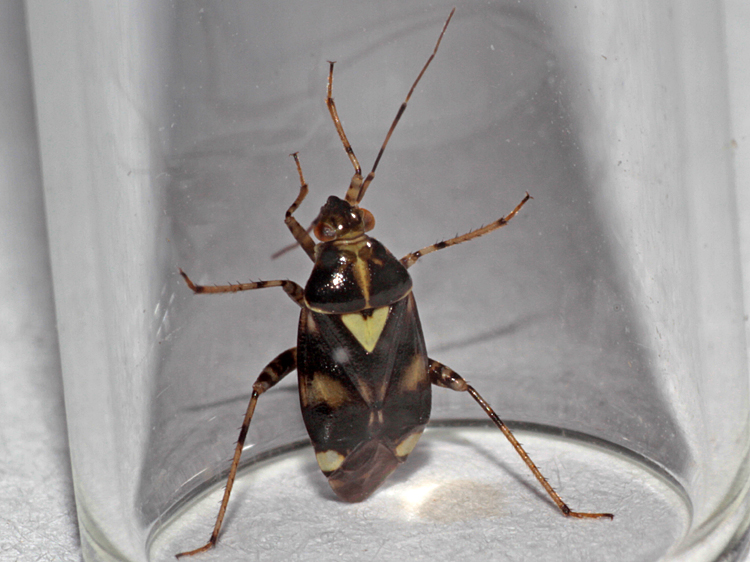
Limnephilus lunatus, Harlequin Ladybird and the following bugs:
Liocoris tripustulatus (which was new for the house),
Alebra albostriella (a leafhopper which I identified for the first time this July) and
Empoasca vitis (a very common tiny green leafhopper).
Liocrois tripustulatus, North Elmham, 2nd August
Alebra albostriella, North Elmham, 2nd August