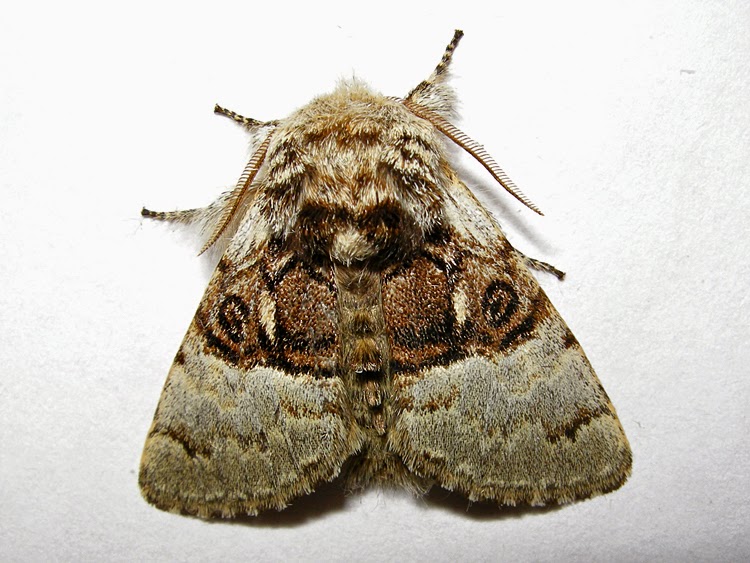
Description


A diary of my mothing activity covering highlights and photos from my moth trapping activities. Mainly Norfolk (UK), occasionally beyond. I may mention other wildlife sightings here, especially insects, but for birds see my birding diary.
Showing posts with label Nut-tree Tussock. Show all posts

Thursday, 8 April 2021

Review of 2019 and 2020 - Moths: Noctuids (Noctuidae) part 1: Plusias to Nut-tree Tussock

NOCTUIDS (NOCTUIDAE)


Spectacle Abrostola tripartita - Totals of 17 trapped here between 30th May and 29th August 2019 and 34 between 30th May and 22nd August 2020.  2019 was my worst year here since moving in (average 43 a year).  Elsewhere 4 at the meadows (from 25th May), one at Bintree Wood and 2 at Hellesdon.

Spectacle, North Elmham, 11th July 2020


Spectacle, North Elmham Cathedral Meadows, 18th July 2020


Dark Spectacle Abrostola triplasia - One in the garden moth trap on 14th June 2020.  This was my 7th here since moving in in 2014 and 2019 was my first blank year.


Dark Spectacle, North Elmham, 14th June 2020


Dewick's Plusia Macdunnoughia confusa - None.  I've never trapped this species but it's becoming so well established in Norfolk, including in parts of mid Norfolk, that it surely can't be long before it arrives here.


Burnished Brass Diachrysia chrysitis - Totals of 36 caught here between 18th June and 30th September 2019 and 19 between 21st May (my earliest ever) and 20th September 2020. The 2020 total was my worst in 6 years and both years were well below the average annual tally of 60.  Elsewhere 5 at the meadows, one at Whitwell Street and one at Hellesdon.

Burnished Brass, North Elmham Cathedral Meadows, 7th July 2019


Burnished Brass, North Elmham Cathedral Meadows, 21st May 2020


Silver Y Autographa gamma - Totals of 17 trapped in the garden between 3rd June and 19th September 2019 and 25 between 2nd June and 26th September 2020.  My average annual tally here is 16 and 2020's total was my highest yet.  Elsewhere 5 at the meadows, one at Bintree Wood, one at Row Heath (West Runton), 2 on Mull and 4 in Cornwall.

Silver Y, North Elmham, 3rd June 2019


Silver Y, North Elmham, 6th August 2020


Beautiful Golden Y Autographa pulchrina - 5 caught at Carsaig (Mull) between 9th and 13th June 2019.  This species is quite irregular here - I caught one in 2015, 4 in 2016, none in 2017, one in 2018 and none again in 2019 or 2020.

Beautiful Golden Y, Carsaig (Mull), 9th June 2019


Beautiful Golden Y, Carsaig (Mull), 10th June 2019


Plain Golden Y Autographa pulchrina - None in 2019 but one in the garden moth trap on 4th July 2020.  I've only caught 3 of these at home before, in 2015, 2016 and 2018.

Plain Golden Y, North Elmham, 4th July 2020


Gold Spot Plusia festucae - One to LEDs at the meadows on 31st May 2019.  I've caught this species at home twice, in 2015 and 2016.  I've never seen Lenpke's Gold Spot, though I have seen a couple of individuals that experienced moth recorders assured me were this species (but which I was doubtful about and on dissection they proved to be Gold Spots).

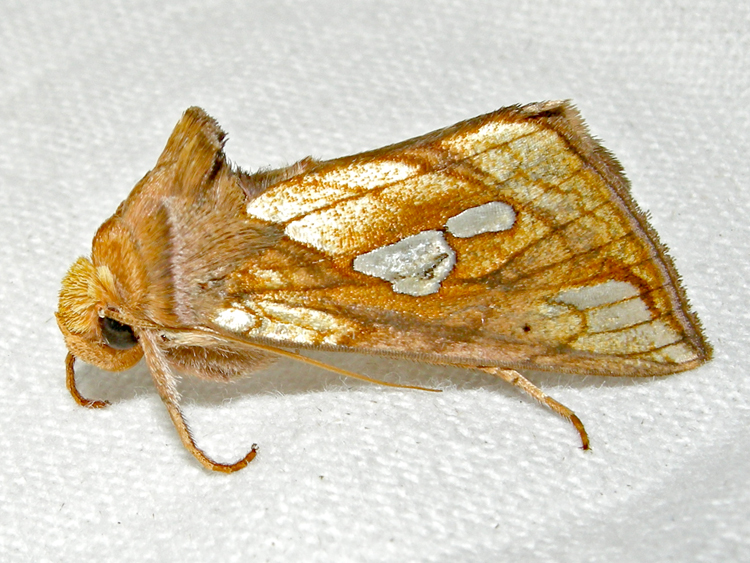
Gold Spot, North Elmham Cathedral Meadows, 31st May 2019


Marbled White Spot Deltote pygarga - 3 caught in the garden between 24th and 28th June 2019, the 3rd year out of 5 that I've caught 3 here - the other 2 years yielding 11 and 13.  None caught in the garden in 2020, my first blank year here, but singles at the meadows, Bintree Wood and Hills and Holes.

Marbled White Spot, North Elmham, 24th June 2019
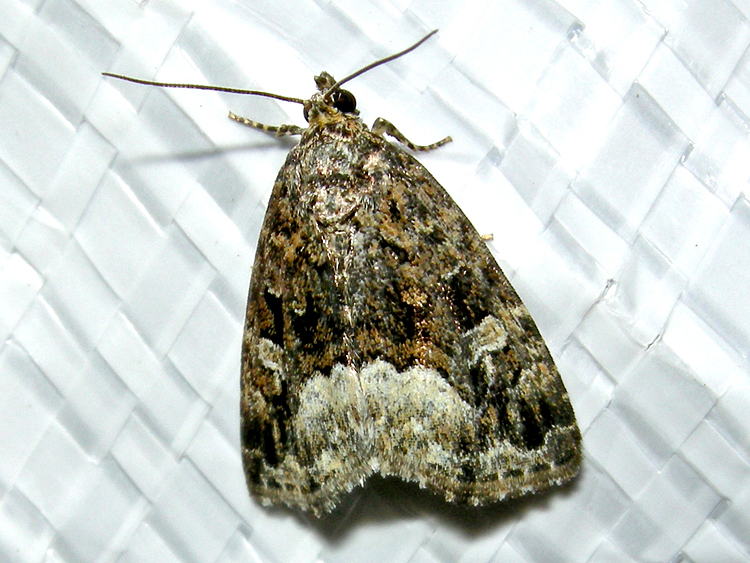

Marbled White Spot, North Elmham Cathedral Meadows, 23rd June 2020


Silver Hook Deltote uncula - At least 2 seen by day at different points along the footpath from Carsaig to Rubha Dubh on Mull on 10th June (both in damp grassland immediately up from the beach).  None in 2020 - I've only ever seen one of these in Norfolk and it doesn't occur locally.


Silver Hooks, Carsaig to Rubha Dubh (Mull), 10th June


Nut-tree Tussock Colocasia coryli - In 2019, 5 caught here between 8th and 29th April then at least 22 between 12th July and 5th August (not counted on 4 dates but only singles on surrounding dates).  I averaged 55 per year over the previous 4 years - safe to say this was my worst year so far.  2020 was a bit better with 7 between 6th April and 18th May and 52 between 8th July and 6th August.  Elsewhere one at the meadows, 2 at Bintree Wood and 3 at Sculthorpe Moor.

Nut-tree Tussock, North Elmham, 8th April 2019


Nut-tree Tussock, North Elmham Cathedral Meadows, 22nd April 2019


Next page: more Noctuidae

Wednesday, 9 May 2018

First moth-trapping at the meadows

I returned to the Cathedral Meadows early on 4th.  I found six species of moths on the wing: Oak Satin Lift Heliozela sericiella, Common Thorn Midget Phyllonorycter oxyacanthae, 6 Beech Midgets Phyllonorycter maestingella, 4 Horse Chestnut Leaf-miners Cameraria ohridella, Sulphur Tubic Esperia sulphurella and Vetch Piercer Grapholita jungiella.

Sulphur Tubic Esperia sulphurella, Cathedral Meadows, 4th May


Vetch Piercer Grapholita jungiella, Cathedral Meadows, 4th May


Oak Satin Lift Heliozela sericiella, Cathedral Meadows, 4th May


A variety of other things noted including Muntjac, Large Red Damselfly, Orange-tip, Hemerobius lutescens (a brown lacewing), 3 species of hoverfly (Melanostoma scalares, Syrphus ribesii and one that keys out as Eristalis tenax, looks very much like Eristalis tenax, but lacks any of the 3 characteristics listed in the guide for that species - not sure where I went wrong there or what else it might be!).  Also Small Black Ant Lasius niger, Garden Bumblebee and Common Carder Bees, Kentish Snail and a lifer for me in abundance running through the leaf-litter, Common Fox-spider Alopecosa pulverulenta.

Common Fox-spider Alopecosa pulverulenta, Cathedral Meadows, 4th May


Garden Bumblebee, Cathedral Meadows, 4th May


Does anyone know if the species of Oak Gall Wasp can be identified from these galls?

Oak galls, Cathedral Meadows, 4th May


Back at home a beetle dropped onto my outside window sill next to where I was sitting, so I duly potted it up for examination.  It proved to be my first Onthophagus similis.


Onthophagus similis, North Elmham, 4th May


With cloud forecast from before dusk after a warm sunny day I thought tonight would be a good one to have my first moth trapping session at the meadows.  By the time dusk came the arrival time of the cloud had pushed back to just after dusk, but it was still warm as it got dark and there wasn't much wind, so it promised good.  Sadly the cloud never arrived, at least not before half past midnight, and temperatures soon dropped resulting in a poorer catch than hoped - but not at all bad considering.

The first moth in was this Lunar Marbled Brown - a nice way to begin.

Lunar Marbled Brown, Cathedral Meadows, 4th May


One of the next up was this Knot Grass, a species I never used to encounter before I moved to North Elmham in 2014.  I see them every year now but still good to get so soon.

Knot Grass, Cathedral Meadows, 4th May


Also among the first 5 moths to arrive was this Powdered Quaker, my first this year as I don't get many at home (and never seem to get them for a while after others are reporting them).

Powdered Quaker, Cathedral Meadows, 4th May


By now things were really slow, but in the end I did notch up a semi-respectable (given the lack of warmth) 20 species, the others being: Common Oak Purple Dyseriocrania subpurpurella, Parornix sp., Pebble Hook-tip, Frosted Green, Red Twin-spot Carpet, Water Carpet, Small Phoenix, 2 Brindled Pugs, White-pinion Spotted, Iron Prominent, 2 Pebble Prominents, Red Chestnut, 3 Common Quakers, 2 Clouded Drabs, 2 Hebrew Characters, Angle Shades and 3 Nut-tree Tussocks.

Hawthorn Slender Parornix anglicella, Cathedral Meadows, 4th May


Pebble Hook-tip, Cathedral Meadows, 4th May


White-pinion Spotted, Cathedral Meadows, 4th May


Pebble Prominent, Cathedral Meadows, 4th May


Red Chestnut, Cathedral Meadows, 4th May


Nut-tree Tussock, Cathedral Meadows, 4th May


There were also 2 Mottled Sedges Glyphotaelius pellucidus (caddisflies) and 2 Black Sexton Beetles.  Nearby there were a couple of White-legged Snake Millipedes and a Common Striped Woodlouse among lots of Common Rough Woodlice.


Black Sexton Beetle, Cathedral Meadows, 4th May


Common Rough Woodlouse, Cathedral Meadows, 4th May


I didn't catch much at home that night, though Red Twin-spot Carpet was new for the year here.  The rest were Common Plume Emmelina monodactyla, 3 Lesser Swallow Prominents, Swallow Prominent, Muslin Moth and Hebrew Character (also Common Wasp).

Thursday, 9 April 2015

Depressing depressariid

This year hasn't been great for moths at home when I compare with what Dave's been getting in his suburbuan Dereham garden.  Far fewer macros (though comparable variety) and way, way fewer micros (with far less variety).  Tuesday night was no exception with a paltry macro total of March Moth, 4 Small Quakers, Common Quaker, Clouded Drab, 3 Hebrew Characters, 3 Early Greys and Chestnut.  It was the micros where the real damage was.  I think Dave said he had 21 or 22 micros of 7 species; I had 2.  Both were depressariids, the first got away but looked like Common Flat-body Agonopterix heracliana.

When I potted the second I thought it looked different.  

This paragraph is not what I originally posted here - I edited this in 2019.  To cut a long story short, after quite a convoluted process I eventually reached the conclusion, wrongly as I now know, that it was Broom Flat-body Agonopterix scopariella, a new species for me. Fast-forwards to 2019 when I'm dissecting moths from 2018, and I have a female moth which I was pretty sure was Ruddy Flat-body Agonopterix subpropinquella, but wanted to check the genitalia to make certain.  They were similar to, but not identical to, the image on Dissection Group website, so I also looked at the diagrams in MOGBI.  Likewise, similar but sufficiently different to warrant a more careful exclusion of other species.  None of the diagrams for other similar species had gentilia anything like it, except perhaps scopariella, at a bit of a stretch.  It wasn't that, but just to dot the i's and cross the t's I had a quick look at the Norfolk Moths page for that species, with a view to following links to see photos of its genitalia.  There staring me in the face was my own photo (below) of my only record of Agonopterix scopariella, and now with the best part of 4 more years' experience under my belt it looked worryingly similar to Agonopterix subpropinquella, and indeed the moth I was dissecting right now.  Surely I had stuffed up?  Fortunately I had set the genitalia on a microscope slide and therefore had the opportunity to re-visit it.  It was indeed Ruddy Flat-body Agonopterix subpropinquella.  I hadn't known, even until today, that this species could show tiny white spots, but it turns out it can.  Bummer.  As I've not seen another since that's one that I now have to delete from my list, and revise the submission while I'm at it.


Ruddy Flat-body Agonopterix subpropinquella (female, gen det), North Elmham, 7th April


Last night we went to the patch but just before dusk our search for lepidoptera or other interesting insects was completely useless.  Absolutely nothing on the trunks and only the odd fly flying.  As darkness fell nothing was showing in the headlights either.  Dave was getting in his car to go when he found the first moth of the evening, a nice Brown-letter Flat-body Agonopterix alstromeriana.  I then drove off finally seeing a few moths in the headlights, one of which I stopped to look at - a fine Water Carpet.


Water Carpet, Beetley, 8th April


Back at home it was true to form.  Not a single micro and not many macros.  One was new for the year though, a very smart Nut-tree Tussock.

Nut-tree Tussock, North Elmham, 8th April


The rest were 4 Small Quakers, 2 Clouded Drabs, 5 Hebrew Characters and 3 Early Greys.

Had this caterpillar the other night and can't identify it.  Anyone know what it is?


unidentified caterpillar, North Elmham, 7th April