Description


A diary of my mothing activity covering highlights and photos from my moth trapping activities. Mainly Norfolk (UK), occasionally beyond. I may mention other wildlife sightings here, especially insects, but for birds see my birding diary.
Showing posts with label Lime Hawkmoth. Show all posts

Saturday, 11 June 2016

Roydon Common

Dave and I rolled up to Roydon Common at 6 pm on Saturday, two and a half hours early for the organised Norfolk Moth Survey event.  We hoped to find some day-flying moths before putting the lights on, and I'm glad we made the effort.  We parked at the west end and walked through the woodland to the south-west corner, kicking up Diamond-back Moths Plutella xylostella on every footstep.  It's impossible to say how many we saw - I put down 2000 but wouldn't be surprised if it was more like 20,000.

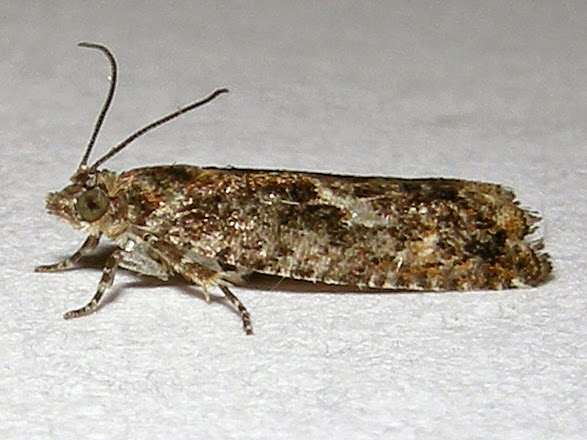
What was more surprising was the difficulty we found in finding anything else, although in the end we came up with some good stuff.  Fairly quickly we found a couple of Common Marbles Celypha lacunana and a more impressive 8 Brassy Tortrixes Eulia ministrana (doubling the total number I had ever seen before).  We found a Plain Fanner Glyphipterix fuscoviridella and a couple of Common Greys Scoparia ambigualis, and Common Groundhopper, a Kidney-spot Ladybird and the red-and-black bug Cercopis vulnerata, but in the first hour or so that was about the lot.

Brassy Tortrix Eulia ministrana, Roydon Common, 4th June


Common Groundhopper, Roydon Common, 4th June


Hoof Fungus, Roydon Common, 4th June


When we reached some small clearings in the woodland things stepped up a gear. They were so thick with Diamond-back Moths it was hard to pick out anything else and the most productive technique turned out to be just to swing the net a few times and then sift through the Diamond-backs in the net for anything else.  Not that we recorded a vast array of species deploying this technique, but we did start to see a bit more quality.  Best was my first ever White-headed Dwarf Elachista albifrontella.

White-headed Dwarf Elachista albifrontella, Roydon Common, 4th June


Also here were White Oak Midget Phyllonorycter harrisella, my second ever Speckled Fanner Glyphipterix thrasonella (like my first, belonging to the plain form), Yarrow Conch Aethes smeathmanniana and 2 Rush Marbles Bactra lancealana.

Speckled Fanner Glyphipterix thrasonella, Roydon Common, 4th June


We continued along the track running west along the southern edge of the common adding Cocksfoot Moth Glyphipterix simpliciella (our third Glyphipterix species of the evening) and Red Roller Ancylis mitterbacheriana.  With the north wind cutting across the heathland we were more exposed here and saw a reduction in Diamond-back numbers, though they were still very easy to find.

A couple more White Oak Midgets Phyllonorycter harrisella were found in the row of small Oaks along this track, and it was at this point we bumbed into Paul Cobb who had also arrived early, but mainly to look for Lacewings.  We were just leaving him to head back to the car park when he knocked a small moth out of the oaks and called us back. "This is one for you" he said, finding it to be a moth and not a Lacewing, so we headed back and had a look.  It was another white Phyllonorycter, but this one had orangey transverse fascias in the basal half.  I was immediately reminded of Scarce Oak Midget Phyllonorycter kuhlweiniella, and taken back to the extraordinary events of 2014 when I discovered several of this species in north Norfolk.  Back then I wrote: "This species was not recorded in the UK between 1949 and 1982 when a population was discovered in south Norfolk. Subsequently it was recorded in south Norfolk only up until 1996 and has been looked for since but not found. There have been 3 Suffolk records, the last in 2002. There have never been any records in north Norfolk. So it seems I've uncovered a hitherto unknown population of a Red Data Book moth that has been looked for but not found for over a decade even in the places where it was once known to occur."  I went on to find lots more at several sites, and others were soon finding them too that year.  But 2014 was an extraordinary year for many Phyllonorycter species and the population explosion clearly allowed this very scarce species to be detected in places where it had presumably been hanging on undetected in small numbers all along.  Last year was back to normal and there were no more records in Norfolk (I don't know about elsewhere but haven't heard of any).  So had we got another, at another new location for the species?  Or is there another similar-looking oak-feeding species?  I couldn't remember for sure so took it home with me to confirm.  It was on its last legs and by the time it got home it had expired, but it was indeed another Scarce Oak Midget Phyllonorycter kuhlweiniella.  Nice one!

daed Scarce Oak Midget Phyllonorycter kuhlweiniella, Roydon Common, 4th June


We returned to the car park and moved round to the meeting place before deciding where to place our traps.  Some traps were set south of the western car park while others went on near the bog myrtle on the southern side in the hope of finding Light Knot Grass.  But it was pretty exposed there and I thought we ought to set some up in the more sheltered woodland on the east side, even though this is technically not part of the NWT reserve.  Dave, Richard and I set up in a clearing here, joined by Peter and Paul, and some of the others joined us for a while.  I'm glad we opted for this as we caught far more moths than the other sites I think, and no-one found the target Light Knot Grass.

The highlight for us was a White Colon, a species none of us were expecting and which Dave had arranged to search for in NW Norfolk later this week.  Apparently the group at the west end caught one too.

White Colon, Roydon Common, 4th June


Other decent macros included 2 Small Seraphims, Peacock Moth, Bordered White, 2 Lime Hawkmoths, Small Elephant Hawkmoth, 3 Lobster Moths, 2 Great Prominents and Dog's Tooth.

Peacock Moth (male, gen det), Roydon Common, 4th June


Dog's Tooth, Roydon Common, 4th June


Bordered White, Roydon Common, 4th June


Small Seraphim, Roydon Common, 4th June


Small Elephant Hawkmoth, Roydon Common, 4th June


Lime Hawkmoths, Roydon Common, 4th June


Lobster Moth, Roydon Common, 4th June


The remaining macros included 2 Common Swifts, Pebble Hook-tip, Common Carpet, Common Marbled Carpet, Grey Pine Carpet, 4 Green Carpets, 2 Mottled Pugs, Common Pug, Grey Pug, 2 Clouded Borders, Tawny-barred Angle, Pale Oak Beauty, White-pinion Spotted, Iron Prominent, 2 Lesser Swallow Prominents, Coxcomb Prominent, Pale Prominent, 2 Marbled Browns, 3 Pale Tussocks, 8 Orange Footmen, Least Black Arches, 2 Flame Shoulders, Large Yellow Underwing, Small Square-spot, Setaceous Hebrew Character, 2 Rustic Shoulder-knots, Brown Rustic, Angle Shades, Middle-barred Minor, Treble Lines and Straw Dot.

Grey Pug (female, gen det), Roydon Common, 4th June


There weren't nearly as many Diamond-back Moths coming to light as we'd seen in the clearing earlier, but other micros included Yellow-barred Long-horn Nemophora degeerella, 4 Common Marbles Celypha lacunana, Triple-blotched Bell Notocelia trimaculana, Grey Gorse Piercer Cydia ulicetana, Hook-streaked Grass-Veneer Crambus lathoniellus, Meadow Grey Scoparia pyralella and 20 Common Greys Scoparia ambigualis.

Yellow-barred Long-horn Nemophora degeerella, Roydon Common, 4th June


Additionally this very dark Cnephasia had us stumped.  I recognised the Cnephasia pattern but have never seen such a dark individual before (I think it looks paler in the photo than it did in life).  It turned out to be Flax Tortrix Cnephasia asseclana.

Flax Tortrix Cnephasia asseclana (male, gen det), Roydon Common, 4th June


Among the caddisflies was my first Plectrocnemia conspersa.  No photos of that alive but here are a couple of other caddisflies recorded: Grammotaulius nigropunctatus and Limnephilus sparsus.

Grammotaulius nigropunctatus (male), Roydon Common, 4th June


Limnephilus sparsus (female), Roydon Common, 4th June


Other inverts included 2 Common Striped Woodlice Philoscia muscorum and the mirid bug Stenodema laevigata.

Common Striped Woodlouse Philoscia muscorum, Roydon Common, 4th June


Stenodema laevigata, Roydon Common, 4th June


Sunday, 5 June 2016

Diamond-back invasion

I should imagine most of my readers will be aware that we are amidst an impressive invasion of migrant Diamond-back Moths Plutella xylostella.  These have been the dominant species in my moth trap over the last few nights.  It started last Sunday night, though I only saw one that night.  A pale indidivual, as many have been this invasion.

Diamond-back Moth Plutella xylostella, North Elmham, 29th May


The best moth on Sunday night was this Dark Spectacle.

Dark Spectacle, North Elmham, 29th May


Also new for the year were Heart and Dart and Tawny Marbled Minor.

Tawny Marbled Minor (male, gen det), North Elmham, 29th May


Heart and Dart, North Elmham, 29th May


Other moths on Sunday night were Yellow-faced Bell Notocelia cynosbatella, Common Swift, Silver-ground Carpet, 2 Common Pugs, Scalloped Hazel, Poplar Hawkmoth, Coxcomb Prominent, 5 White Ermines, Cinnabar, 2 Shuttle-shaped Darts, 4 Flame Shoulders, Light Brocade, Angle Shades and 6 Treble Lines.

Yellow-faced Bell Notocelia cynosbatella, North Elmham, 29th May


Glyphotaelius pellucidus and Limnephilus auricula were the only Caddisflies.

On Monday night Lime Hawkmoth was new for the house and Clouded Silver new for the year.

Lime Hawkmoth, North Elmham, 30th May


Clouded Silver, North Elmham, 30th May


Not many other moths but 11 Diamond-back Moths Plutella xylostella, Brindled Flat-body Agonopterix arenella, Cinnabar, 2 Shuttle-shaped Darts, 2 Flame Shoulders and Treble Lines. Two hoverflies in the trap both proved to be species I'd not identified before (though common): Eupeodes corollae and Syrphus torvus.

Eupeodes corollae, North Elmham, 30th May


Syrphus torvus, North Elmham, 30th May


By far the most dominant feature of Tuesday night was an impressive 135 Diamond-back Moths Plutella xylostella, my peak count up to the time of writing.

Diamond-back Moths Plutella xylostella, North Elmham, 31st May


They weren't the only migrants - this Silver Y sneaked in too.

Silver Y, North Elmham, 31st May


A Vine's Rustic was new for the year but the only other moths were Brimstone Moth and 5 Treble Lines.  Also a caddisfly Limnephilus auricula.

Vine's Rustic, North Elmham, 31st May


A quick look round the garden on Wednesday evening got me White Oak Midget Phyllonorycter harrisella, new for the house, and Common Marble Celypha lacunana, new for the year here.

White Oak Midget Phyllonorycter harrisella, North Elmham, 1st June


In and around the trap that night there was a slight reduction to 120 Diamond-back Moths Plutella xylostella.  The only other moths were Narrow-winged Grey Eudonia angustea, 2 Common Swifts, Poplar Hawkmoth, Muslin Moth, 2 Flame Shoulders and 5 Treble Lines. This Mayfly, a Pond Olive Cloeon dipterum was new for the year, one of the few Mayflies I had identified prior to this year.

Pond Olive Cloeon dipterum, North Elmham, 1st June


If you're a Snail and there's a big Snail in the way, what do you do?  Go round it?  Nope, you go over it.  This Kentish Snail (I think) walked straight over the top of a Garden Snail.  Also 2 Strawberry Snails and Brown-lipped Snails in the garden.


Kentish Snail (I think) walking all over a Garden Snail, North Elmham, 1st June


Thursday night produced 63 Diamond-back Moths Plutella xylostella, White-shouldered House Moth Endrosis sarcitrella, Common Marble Celypha lacunana, Common Swift, 2 Garden Carpets, Common Marbled Carpet, Green Carpet, Poplar Hawkmoth, 3 Flame Shoulders, Clouded-bordered Brindle, 4 Treble Lines, Silver Y, Cockchafer and antoher Eupeodes corollae (Hoverfly).

Garden Carpet and Common Marbled Carpet, North Elmham, 2nd June


Clouded-bordered Brindle, North Elmham, 2nd June


There will be more to say about Diamond-backs in a post covering Saturday when I didn't catch so many in the trap but saw 10s if not 100s of 1000s in the field.

Monday, 25 May 2015

A decent evening at last

Warm, calm and cloudy - a perfect recipe for moths.  For the first time this year all three were in play on Friday night (well, not quite calm, but no more than a light breeze) and we were sure to enjoy the best night of the year so far.  Indeed it proved, though I think I've had better nights at this time of year in better years.

A little bit of dusking on the patch secured Skin Moth Monopis laevigella, Swan-feather Dwarf Elachista argentella and Hook-streaked Grass-Veneer Crambus lathoniellus in the Beetley area. 

Swan-feather Dwarf Elachista argentella, Rawhall Wood, 22nd May


Then I set up the light at Creaking Gate Lake where things got off to a slower start than I had anticipated.  Eventually it picked up and a reasonable selection was accrued.

The highlight was a new moth for me, Downland Marble Endothenia oblongana.There are very few inland records of this moth and it's not an easy ID to separate from the slightly more frequently-recorded Teasel Marble Endothenia gentianaeana.  Size was just about within range for a small gentianaeana and I thought at first I could detect the small pale mark beyond the post median fascia that is supposed to be shown by that species.  But it had little grey/violet irrotation in the base, no violet near the tip and the pattern of the apical region seemed better for oblongana - indeed one of the oblongana shown on Lepiforum looked  a very good match for my moth.  They're not the easiest to gen det either, but all internal features I could see seemed to support oblongana.


Downland Marble Endothenia oblongana, Creaking Gate Lake, 22nd May


Other highlights included Figure of Eighty, a species I've only seen occasonally, and my first Lime Hawkmoth of the year.

Figure of Eighty, Creaking Gate Lake, 22nd May


Lime Hawkmoth, Creaking Gate Lake, 22nd May


The supporting cast were 3 Carrion Moths Monopis weaverella, 2 Ribwort Slenders Aspilapteryx tringipennella, 2 Dark-barred Tortrices Syndemis musculana, Common Birch Bell Epinotia immundana, Hook-streaked Grass-Veneer Crambus lathoniellus, Garden Pebble Evergestis forficalis, Common Swift, Pebble Hook-tip, 2 Silver-ground Carpets, 3 + Green Carpets, May Highflyer, Brindled Pug, Treble-bar, Brimstone Moth, Scalloped Hazel, Common White Wave, Iron Prominent, 2 Pebble Prominents, Coxcomb Prominent, 3 Pale Tussocks, Orange Footman, 2 White Ermines, Cinnabar, Least Black Arches, Shuttle-shaped Dart, Flame Shoulder, Hebrew Character, Angle Shades and Nut-tree Tussock.

Common Swift, Creaking Gate Lake, 22nd May


May Highflyer, Creaking Gate Lake, 22nd May


Silver-ground Carpet, Creaking Gate Lake, 22nd May


Common Birch Bell Epinotia immundana, Creaking Gate Lake, 22nd May


Non-lepidopteran interest was kept up with a bug-lifer, Harpocera thoracica.

 Harpocera thoracica, Creaking Gate Lake, 22nd May


Among the beetles were a couple I can't identify and a couple I've tenatively identified - let me know if you can help.  Also Cream-spot Ladybird and, once again, 16 Cockchafers - seems to be a good year for them, unfortunately.


unidentified Beetle, Creaking Gate Lake, 22nd May


unidentified Beetle, Creaking Gate Lake, 22nd May


probable Athous haemorrhoidalis, Creaking Gate Lake, 22nd May


apparent Cantharis nigricans, Creaking Gate Lake, 22nd May


Plenty of other insects there too, including the first Bramble Sawfly that I recall seeing.

Bramble Sawfly Arge cyanocrocea, Creaking Gate Lake, 22nd May


Birch Shieldbugs, Creaking Gate Lake, 22nd May


Chloeon diperum, Creaking Gate Lake, 22nd May


Downlooker Snipefly Rhagio scolopaceus, Creaking Gate Lake, 22nd May


Micropterna lateralis (I think), Creaking Gate Lake, 22nd May


I gave up shortly after midnight and returned home at which point it started drizzling.  The garden was heaving with moths.  I ended up with 68 moths of 41 species - including no less than 16 that were new for the year for the garden.  Those were Carrion Moth Monopis weaverella, Bird’s-nest Moth Tinea trinotella, Ribwort Slender Aspilapteryx tringipennella, Yarrow Conch Aethes smeathmanniana, Many-plumed Moth Alucita hexadactyla, Hook-streaked Grass-Veneer Crambus lathoniellus, Common Grey Scoparia ambigualis, Water Carpet, Grey Pine Carpet, May Highflyer, Sandy CarpetWhite-pinion Spotted, 2 Orange Footmen, Shears and Rustic Shoulder-knot.

Shears, North Elmham, 22nd May


Grey Pine Carpet, North Elmham, 22nd May


May Highflyer, North Elmham, 22nd May


Orange Footman, North Elmham, 22nd May


Rustic Shoulder-knot, North Elmham, 22nd May


White-pinion Spotted, North Elmham, 22nd May


Yarrow Conch Aethes smeathmanniana, North Elmham, 22nd May


Hook-streaked Grass-Veneer Crambus lathoniellus, North Elmham, 22nd May


Bird's-nest Moth Tinea trinotella, North Elmham, 22nd May


Common Grey Scoparia ambigualis, North Elmham, 22nd May


Water Carpet, North Elmham, 22nd May


Sandy Carpet, North Elmham, 22nd May


Among the others another Fen Flat-body Depressaria ultimella was notable, as were Pale Pinion and Herald.

Fen Flat-body Depressaria ultimella, North Elmham, 22nd May


Pale Pinion, North Elmham, 22nd May


Herald, North Elmham, 22nd May


5 Waved Umbers was my highest count ever of this species.


Waved Umbers, North Elmham, 22nd May


The others were Little Dwarf Elachista canapennella, Common Flat-body Agonopterix heracliana, Common Marble Celypha lacunana, Yellow-faced Bell Notocelia cynosbatella, Narrow-winged Grey Eudonia angustea, 2 Bee Moths Aphomia sociella, 2 Chinese Characters, Blood-vein, 2 Red Twin-spot Carpets, Green Carpet, 9 Common Pugs, Treble-bar, 7 Brimstone Moths, 2 Scalloped Hazels, Buff-tip, 2 Pale Tussocks, White Ermine, 2 Cinnabars, Shuttle-shaped Dart, Bright-line Brown-eye, Angle Shades and 3 Treble Lines.

Angle Shades, North Elmham, 22nd May


Cinnabar, North Elmham, 22nd May


Treble-bar, North Elmham, 22nd May


Other insects included a Birch Shieldbug here too:

Birch Shieldbug, North Elmham, 22nd May


This caddisfly is a new one for me, I think - though I'm not 100% sure if the ID is correct or if there are other similar species that should be considered.


probable Ecnomus tenellus, North Elmham, 22nd May