Description


A diary of my mothing activity covering highlights and photos from my moth trapping activities. Mainly Norfolk (UK), occasionally beyond. I may mention other wildlife sightings here, especially insects, but for birds see my birding diary.
Showing posts with label Harlequin Ladybird. Show all posts

Thursday, 1 December 2016

Beetley Common by torchlight and now caught up

I'd recently acquired a new headtorch with a very bright beam so on the relativly mild evening of 28th October I decided to have a wander round Beetley Common to see if it was any good for mothing.  In the first few yards 3 moths passed through the torchbeam, two of which I managed to net: White-triangle Slender Caloptilia stigmatella and Nut Leaf Blister Moth Phyllonorycter coryli.

White-triangle Slender Caloptilia stigmatella, Beetley Common, 29th October


Nut Leaf Blister Moth Phyllonorycter coryli, Beetley Common, 29th October


After that things went downhill as the temperature dropped - just one more moth which I didn't manage to catch and a Green Lacewing Chrysoperla carnea agg. (actually they go brown in the winter, but they're still Green Lacewings not Brown Lacewings...).  It will be interesting to see how effective this method is when there are more moths about - my impression is that with a good beam it will make finding and catching flying moths easier although I'm not sure it actually attracts them to the light.  On the downside the light was noticeably dimmer after just a couple of quick circuits of the common so battery life doesn't seem particularly good, plus I'm not sure how comfortable it will be if it attracts lots of midges to my forehead!

The light was good at picking out certain types of fungi (although others were much harder to see than in daylight).  This Fly Agaric was nice and easy to identify.

Fly Agaric, Beetley Common, 29th October


This Stinkhorn was covered in flies - anyone know what sort of fly?


Stinkhorn with flies, Beetley Common, 29th October


I'd tentatively identified these as Parasol Mushrooms though noted that they were smaller and in different habitat from other Parasols I'd seen.  Big thanks to James for putting me right... they are in fact False Death Caps.


False Death Caps, Beetley Common, 29th October


I'd considered Penny Bun and Bay Bolete for these, but James thinks they're Bay Boletes...


Bay Boletes, Beetley Common, 29th October


At home that night I caught my first December Moth of the autumn.

December Moth, North Elmham, 29th October


This Currant Pug was a surprise being about a month later than my previous latest.

Currant Pug, North Elmham, 29th October


I find separation of Currant Pugs and Wormwood Pugs tricky - there are supposed to be differences in the prominence of the wing markings but I can't personally find any consistent differences.  The way they hold their wings also seems to be variable although size can be a good indicator on many, though they're close enough and with enough overlap that I now measure them all and check the genitalia of the ones that aren't clear.  With a forewing of 9.5-10 mm this individual was too small for Wormwood Pug but I checked it anyway.  The aedeagus was indeed that of a Currant Pug with three cornuti arranged in a band at the tip, so I'm sure the ID must be correct, but the 8th sternite was long and notched like on a Wormwood Pug!

8th sternite of Currant Pug resembling that of a Wormwood Pug, North Elmham, 29th October


Also late was my second October record of Common Marble Celypha lacunana.  There was also a bit of an Epirrita fest with 8 November Moths, 5 Pale November Moths and 2 unidentified (1 female, 1 escaped).  Also 2 Yellow-line Quakers, Barred Sallow and Angle Shades.

Pale November Moth (male, 8th sternite checked), North Elmham, 29th October


This cluster of 4 Harlequin Ladybirds seem to think my study is a good place to hibernate.

Harlequin Ladybird, North Elmham, 29th October


Next night there were Red-green Carpet, November Moth, Pale November Moth, 2 Yellow-line Quakers, Beaded Chestnut and 2 Angle Shades.

The last night of October produced a female Epirrita sp., 4 Feathered Thorns, Black Rustic, Green-brindled Crescent, Yellow-line Quaker and Beaded Chestnut.

November started very quietly on the moth front with Feathered Thorn and 2 Sprawlers on 1st, Sprawler and Beaded Chestnut on 2nd, just one Feathered Thorn on 3rd and nothing at all on 4th.

It continued poor for a week or so with just 1 Sprawler on 5th and 2 Sprawlers on 8th.  Slightly milder conditions on 11th produced Feathered Thorn and 2 Sprawlers and then the next evening produced my first Scarce Umber of the year along with Yellow-line Quaker.

Scarce Umber, North Elmham, 12th November


Seven moths the following night making it the best night for a fortnight - 2 Feathered Thorns and 5 Sprawlers.  Things continued to improve on 14th with Light Brown Apple Moth Epiphyas postvittana, 2 December Moths, Pale November Moth, another unidentified Epirrita sp., 6 Feathered Thorns and 2 Sprawlers.

The species count was even better on 15th (though still short of double figures) with Light Brown Apple Moth Epiphyas postvittana, December Moth, November Moth, another unidentified Epirrita sp., 3 Feathered Thorns, Scarce Umber, 5 Sprawlers, Yellow-line Quaker and Beaded Chestnut. Also the caddisflies Rhyacophila dorsalis and Limnephilus lunatus plus the mirid bug Pinalitus cervinus.

Things then returned to normal for November with Feathered Thorn, 3 Sprawlers and Yellow-line Quaker on 16th, an Epirrita sp. and a Sprawler on 16th.  No more moths for a few nights but these fungi - I can identify the Candlesnuff (I think) but not sure about the others.

Candlesnuff, Thetford, 19th November


unidentified mushrooms, 19th Thetford, November


The next moths were Sprawler and Black Rustic on 20th followed by 3 Feathered Thorns and a Sprawler on 21st, December Moth, Mottled Umber and Yellow-line Quaker on 22nd, just Feathered Thorn on 23rd, December Moth and Angle Shades on 24th, Feathered Thorn and Scarce Umber on 25th and December Moth on 26th.  Also caddisflies on 26th: 3 Limnephilus lunatus and Halesus radiatus.

Halesus radiatus, North Elmham, 26th November


My first Winter Moth of the winter appeared with a Sprawler on 27th.

Winter Moth, North Elmham, 27th November


Unsurprisingly given the subzero conditions, nothing on 28th or 29th.  The following night, last night, fell below zero too but started fractionally milder, enough for a Winter Moth to appear at one of the windows.

And that, for the first time in months, brings me bang up to date!

Wednesday, 2 November 2016

Agriphila latistria, Red Underwings and ANOTHER basaltinella

The night of 25th August was nearly as good as the previous three nights in terms of numbers and variety, if not quite so.  Only one moth was new for the year though, but a fairly decent one that was also new for the house - White-streak Grass-veneer Agriphila latistria.  A lot of people have been reporting this species in places it doesn't normally turn up recently - whether they are migrants or the species is just having a good year locally I'm not sure

White-streak Grass-veneer Agriphila latistria, North Elmham, 25th August


The other micros were Golden Argent Argyresthia goedartella, 2 Little Ermels Swammerdamia pyrella, 2 Diamond-back Moths Plutella xylostella, Woundwort Case-bearer Coleophora lineolea, Long-horned Flat-body Carcina quercana, Black-headed Conch Cochylis atricapitana, 2 Light Brown Apple Moths Epiphyas postvittana, Dover Shade Cnephasia genitalana, 2 Dark-triangle Buttons Acleris laterana, 3 Garden Rose Tortrixes Acleris variegana, Barred Marble Celypha striana, 4 Common Marbles Celypha lacunana, 2 Rush Marbles Bactra lancealana, Red Piercer Lathronympha strigana, Marbled Piercer Cydia splendana, Pearl Veneer Agriphila straminella, 4 Common Grass-veneers Agriphila tristella, 9 Elbow-stripe Grass-veneers Agriphila geniculea, Chequered Grass-veneer Catoptria falsella, Water Veneer Acentria ephemerella, Narrow-winged Grey Eudonia angustea, 2 Ringed China-marks Parapoynx stratiotata, 5 Garden Pebbles Evergestis forficalis, 4 Mother of Pearls Pleuroptya ruralis, Double-striped Tabby Hypsopygia glaucinalis, 2 Grey Knot-horns Acrobasis advenella, White Plume Pterophorus pentadactyla and Common Plume Emmelina monodactyla.

Macros consisted of 2 Orange Swifts, Blood-vein, Red Twin-spot Carpet, Common Carpet, 5 Green Carpets, Sharp-angled Carpet, Maple Pug, Lime-speck Pug, 2 Double-striped Pugs, 2 Treble-bars, 16 Brimstone Moths, 3 Canary-shouldered Thorns, 6 Dusky Thorns, 3 Willow Beauties, Common White Wave, 5 Poplar Hawkmoths, 2 Sallow Kittens, 2 Iron Prominents, Lesser Swallow Prominent, 2 Swallow Prominents, 2 Shuttle-shaped Darts, 17 Flame Shoulders, 19 Large Yellow Underwings, 4 Lesser Yellow Underwings, 9 Lesser Broad-bordered Yellow Underwings, Small Square-spot, 9 Setaceous Hebrew Characters, 2 Six-striped Rustics, 13 Square-spot Rustics, Cabbage Moth, 4 Common Wainscots, Straw Underwing, Dun-bar, Dark Arches, Common Rustic, 10 Flounced Rustics, Burnished Brass, Spectacle, 37 Straw Dots and 3 Snouts.

Atrhripsodes albifrons, North Elmham, 25th August


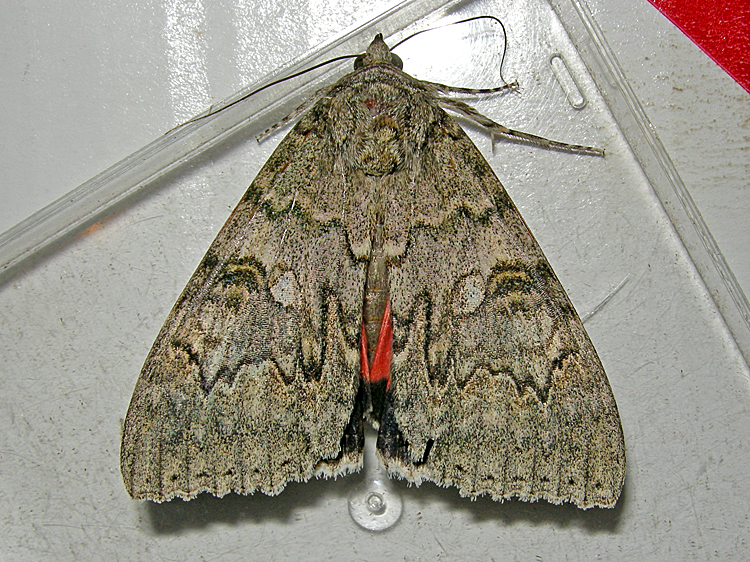
Not one but 2 Red Underwings were the highlight of the following night.


Red Underwings, North Elmham, 26th August


It was otherwise much quieter than recent nights with Diamond-back Moth Plutella xylostella, Small Clover Case-bearer Coleophora alcyonipennella, Little Dwarf Elachista canapennella, Chamomile Conch Cochylidia implicitana, 3 Light Brown Apple Moths Epiphyas postvittana, 2 Garden Rose Tortrixes Acleris variegana, Barred Marble Celypha striana, 2 Common Marbles Celypha lacunana, Marbled Piercer Cydia splendana, Pearl Veneer Agriphila straminella, 2 Common Grass-veneers Agriphila tristella, 3 Elbow-stripe Grass-veneers Agriphila geniculea, 4 Ringed China-marks Parapoynx stratiotata, 2 Garden Pebbles Evergestis forficalis, 3 Mother of Pearls Pleuroptya ruralis, 2 Common Plumes Emmelina monodactyla, 2 Single-dotted Waves, Red Twin-spot Carpet, 5 Green Carpets, Currant Pug, Double-striped Pug, Yellow-barred Brindle, 2 Brimstone Moths, 2 Canary-shouldered Thorns, 2 Dusky Thorns, Poplar Hawkmoth, Iron Prominent, 2 Lesser Swallow Prominents, Coxcomb Prominent, Dingy Footman, Shuttle-shaped Dart, 18 Flame Shoulders, Large Yellow Underwing, 11 Lesser Yellow Underwings, 2 Lesser Broad-bordered Yellow Underwings, 3 Small Square-spots, 10 Setaceous Hebrew Characters, Square-spotted Clay, Six-striped Rustic, 9 Square-spot Rustics, 2 Common Wainscots, Centre-barred Sallow, 14 Flounced Rustics, Vine's Rustic, Silver Y, Spectacle and 18 Straw Dots.

Chamomile Conch Cochylidia implicitana, North Elmham, 26th August


The following night I joined the Norfolk Moth Survey at Church Marsh, Surlingham.  I will do a separate post about that shortly, probably tomorrow, but in the meantime here's what I had at home that night.  There were a few more moths than the night before, and more variety, but none were new for the year.  The rarest in Norfolk terms, if not in my garden terms, was another Thatch Groundling Scoparia basaltinella, bringing my garden total, and the entire county total, up to 5.

Thatch Groundling Bryotropha basaltinella (male, gen det), North Elmham, 27th August


Other micros were Bordered Carl Coptotriche marginea, Horse Chestnut Leaf-miner Cameraria ohridella, Bird-cherry Ermine Yponomeuta evonymella, Little Ermel Swammerdamia pyrella, Woundwort Case-bearer Coleophora lineolea, 4 Brown House Moths Hofmannophila pseudospretella, Brown-spot Flat-body Agonopterix alstromeriana, House Groundling Bryotropha domestica, Dingy Dowd Blastobasis adustella, Chamomile Conch Cochylidia implicitana, Chequered Fruit-tree Tortrix Pandemis corylana, Light Brown Apple Moth Epiphyas postvittana, Maple Button Acleris forsskaleana, Acleris laterana agg., 7 Garden Rose Tortrixes Acleris variegana, Common Marble Celypha lacunana, Rush Marble Bactra lancealana, Plum Fruit Moth Grapholita funebrana, Pale-streak Grass-veneer Agriphila selasella, 4 Elbow-stripe Grass-veneers Agriphila geniculea, 2 Chequered Grass-veneers Catoptria falsella, Narrow-winged Grey Eudonia angustea, Ringed China-mark Parapoynx stratiotata, 2 Garden Pebbles Evergestis forficalis, Rush Veneer Nomophila noctuella, 6 Mother of Pearls Pleuroptya ruralis, 3 Grey Knot-horns Acrobasis advenella and Common Plume Emmelina monodactyla.

Brown-spot Flat-body Agonopterix alstromeriana, North Elmham, 27th August


The macros were 2 Orange Swifts, Maiden's Blush, Single-dotted Wave, Riband Wave, Red Twin-spot Carpet, 3 Common Carpets, Common Marbled Carpet, 5 Green Carpets, Double-striped Pug, 2 Treble-bars, Yellow-barred Brindle, Clouded Border, 20 Brimstone Moths, 3 Dusky Thorns, 2 Common Waves, 2 Light Emeralds, Poplar Hawkmoth, 2 Lesser Swallow Prominents, Dingy Footman, Shuttle-shaped Dart, 15 Flame Shoulders, 23 Large Yellow Underwings, 8 Lesser Yellow Underwings, 5 Lesser Broad-bordered Yellow Underwings, 2 Small Square-spots, 13 Setaceous Hebrew Characters, 2 Six-striped Rustics, 12 Square-spot Rustics, Common Wainscot, Angle Shades, Dark Arches, 7 Flounced Rustics, 4 Burnished Brasses, 19 Straw Dots and 3 Snouts.

Maiden's Blush, North Elmham, 27th August


Other bits and pieces included the Green Lacewing Cunctochrysa albolineata, 3 Forest Bugs (Red-legged Shieldbugs), this Harlequin Ladybird and my first Hornet of the year.

Harlequin Ladybird, North Elmham, 27th August

Sunday, 31 January 2016

Mainly Early Moths

Just a few moths over the last few nights: A Spring Usher and an Early Moth on Wednesday night, another Early Moth on Thursday, Dotted Border and Dark Chestnut on Friday and 3 Early Moths on Saturday.

I also found yet another Harlequin trying to hibernate in my study - this one now evicted. 


Harlequin Ladybird, North Elmham, 28th January


Lastly for now, this bracket fungus from the Broads last weekend seems to be Turkeytail, one of the commonest species apparently.

Turkeytail, Ormesby Little Broad, 24th January

Saturday, 9 January 2016

First lifer of the year - a surprise Viburnum Button

When I came in from checking the moth trap this morning a small moth flew on to the patio window and was duly potted for closer examination.  Presumably it had been attracted to the light overnight but rested outside of the trap and I'd disturbed it as I came away.  My first impression was that it was a broad-winged greyish Acleris species, presumably Ashy Button Acleris sparsana.  But that's not supposed to hibernate so shouldn't be flying at this time of year, and on second look it didn't look quite as broad-shouldered as I'd thought at first.  I went through a number of other options with nothing coming out as entirely convincing so, still expecting nothing out of the ordinary, I checked its genitalia.  They didn't match any of the suspects at all, nor any other Acleris species that has been recorded in Norfolk in winter.  A bit more searching and I found it, the genitalia were a match but the external appearance was unlike most examples of this species.  I turned to Lepiforum for a broader image search and sure enough there was one much like mine.  It was a Viburnum Button Acleris schalleriana, a new species for me.

I certainly didn't expect to get a new moth this early in the year, so very happy with that! Acleris schalleriana has two generations, one in summer which seems to be responsible for all of the dated Norfolk records, and one in autumn to spring that presumably hibernates through most winters.  It seems to be fairly scarce (said to be rare but undoubtedly under-recorded) with no records in the Norfolk database yet for the whole of last year.


Viburnum Button Acleris schalleriana (male, gen det), North Elmham, 8th January


There was one moth in the trap itself, my first Chestnut of the year.  And I didn't expect there to be any moths last night!  Always worth putting the trap out just in case...

Chestnut, North Elmham, 8th January


This Harlequin ladybird has been hibernating in my study but woke up this morning.

Harlequin, North Elmham, 9th January