Description


A diary of my mothing activity covering highlights and photos from my moth trapping activities. Mainly Norfolk (UK), occasionally beyond. I may mention other wildlife sightings here, especially insects, but for birds see my birding diary.
Showing posts with label Grammotaulius nigropunctatus. Show all posts

Sunday, 31 January 2021

Review of 2019 and 2020 - Caddisflies: Goeridae, Lepidostomidae and part 1 of Limnephilidae

Family GOERIDAE


Medium Sedge Goera pilosa - A total of 8 in the garden trap between 23rd June and 30th July 2019 and 11 between 17th June and 8th August 2020; also one at the meadows on 22nd August 2019.

male Medium Sedge Goera pilosa, North Elmham, 23rd June 2019


female Medium Sedges Goera pilosa, North Elmham, 10th July 2019


female Medium Sedge Goera pilosa, North Elmham, 24th July 2019


female Medium Sedge Goera pilosa, North Elmham, 17th June 2020


female Medium Sedge Goera pilosa, North Elmham, 20th June 2020


Silo nigricornis - None.  There are loads of records of this species in Norfolk so it is perhaps surprising that I haven't come across it yet.

Silo pallipes - Female in the garden trap on 10th July 2019 and 25th June 2020.  I'd caught this species twice before, both in 2017.

female Silo pallipes, North Elmham, 10th July 2019


female Silo pallipes, North Elmham, 25th June 2020


-----------------------------------


Family LEPIDOSTOMATIDAE


Crunoecia irrorata - Singles caught in the garden on 21st July and 25th August 2019 and 18th and 31st July 2020.  Also a male netted between Carsaig and Rubha Dubh on Mull on 10th June 2019.

male Crunoecia irrorata, between Carsaig and Rubha Dubh (Mull), 10th June 2019


male Crunoecia irrorata, North Elmham, 21st July 2019


female Crunoecia irrorata, North Elmham, 25th August 2019


male Crunoecia irrorata, North Elmham, 18th July 2020 - showing distinctive genital capsule


female Crunoecia irrorata, North Elmham, 31st July 2020


Small Silver Sedge Lepidostoma hirtum - 3 caught in the garden on consecutive nights 27th to 29th August 2019 and 6 between 14th August and 8th September; elsewhere one at Swanton Great Wood on 27th August 2019 and 2 at the meadows on 8th September 2020.  All 12 were females and I didn't alwasys find it easy to eliminate Lepidostoma basale (although as far as I know that species doesn't occur in East Anglia).  The Barnard and Ross Handbook points to a single feature on its diagrams of the genitalia, the shape of the subgenital plate, and on at least a few individuals (especially the first one in 2020) this looked better for basale.  But there are other differences in the diagrams, although when they're not arrowed or drawn attention to in the text I'm never sure if these are differences between the species or just differences between the specimens used as a basis for the diagram.  Anyway, hirtum is illustrated with wide shoulders (not a technical term!) before the tip of the abdomen, and all mine shared this characteristic - the basale diagram in the Handbook shows much less of a step.  When I first encountered this problem I found a photo of hirtum genitalia online that looked similar (I can't find it now - maybe it was on the defunct website but I thought it was more recent than that), so given basale is so unlikely here I think it's safe to call them all hirtum.  Photos of the genitalia of the most troublesome individual are below, along with a more straightforward one.  Please let me know if you disagree.

female Small Silver Sedge Lepidostoma hirtum, Swanton Great Wood, 27th August 2019


female Small Silver Sedge Lepidostoma hirtum, North Elmham, 28th August 2019


female Small Silver Sedge Lepidostoma hirtum, North Elmham, 29th August 2019


presumed female Small Silver Sedge Lepidostoma hirtum, North Elmham, 14th August 2020 - showing what looks like a very flat rounded tip to the subgenital plate (as on L basale); this happened to be the first time I've found the corpus bursae on a caddisfly - the ductus bursae is very thin and delicate so I assume this normally breaks and gets lost during the preparation (as far as I know this isn't helpful for identification but was of interest to me


female Small Silver Sedge Lepidostoma hirtum, North Elmham, 24th August 2020 - this one shows a subgenital plate with a longer more narrowly rounded tip as I would expect on L hirtum


female Small Silver Sedge Lepidostoma hirtum, North Elmham, 30th August 2020


female Small Silver Sedge Lepidostoma hirtum, North Elmham Cathedral Meadows, 8th September 2020


-----------------------------------


Family APATANIIDAE


Apatania muliebris - None.  Judging from the NBN Atlas maps this species occurs in the Wensum Valley but I've not come across it here or anywhere else yet.


-----------------------------------


Family LIMNEPHILIDAE


Drusus annulatus - None.  The NBN Atlas maps indicate that this species has occurred nearby but I haven't found it yet.


Brown Sedge Anabolia nervosa - One caught in the garden on 22nd October 2019 and 4 between 21th and 21st October (I had caught 8 here in 2018).  Elsewhere 2 caught at the meadows on 12th October and 4 there on 1st November 2019 and 2 at Stiffkey on 16th October 2020.  The other member of this genus, Anabolia brevipennis, occurs in Norfolk but there are no records on the NBN Atlas for the Wensum Valley area.

male Brown Sedge Anabolia nervosa, North Elmham Cathedral Meadows, 12th October 2019


male Brown Sedge Anabolia nervosa, North Elmham, 21st October 2019


male Brown Sedge Anabolia nervosa, North Elmham Cathedral Meadows, 1st November 2019


Brown Sedge Anabolia nervosa, North Elmham, 12th October 2020<


Brown Sedge Anabolia nervosa, Stiffkey, 16th October 2020


Mottled Sedge Glyphotaelius pellucidus - A total of 56 between 1st May 31st October 2019 and 39 between 8th May and 29th October 2020.  A total of 22 at the meadows on 7 dates including 15 on 25th May 2020 and elsewhere singles at Swanton Great Wood, Row Heath (West Runton), Whitwell Street and Tresidder (in Cornwall).  My records of this species show two clear peaks, one from May to early June and one from late July to October (especially late August to late September) but I've had a few odd records throughout the diapause in June-July.

Mottled Sedge Glyphotaelius pellucidus, North Elmham, 1st May 2019


Mottled Sedge Glyphotaelius pellucidus, North Elmham Cathedral Meadows, 25th May 2019


Mottled Sedge Glyphotaelius pellucidus, North Elmham Cathedral Meadows, 15th May 2020


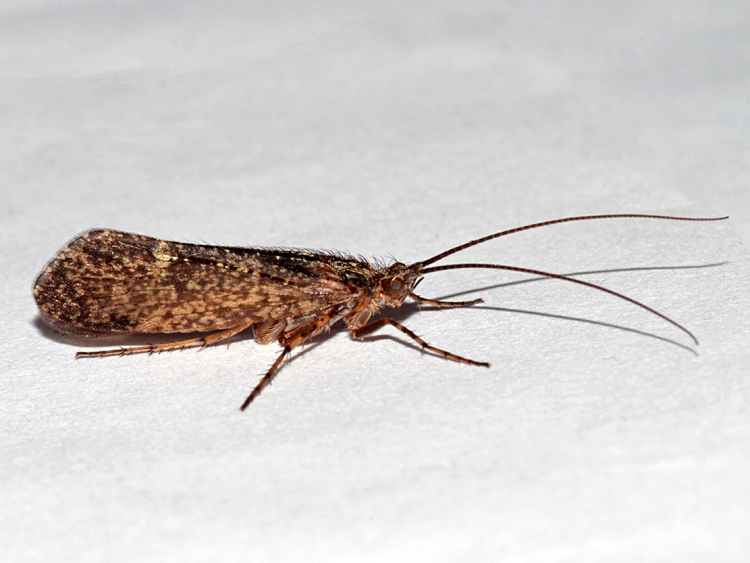
Grammotaulius nigropunctatus - Singles caught in the garden trap on 12th September 2019 and 11th and 23rd April 2020 (I'd had 3-4 in each of the previous 3 years).  Also one at Hills and Holes on 21st May 2020.  There are no records of the much scarcer Grammotaulius nitidus showing in the NBN Atlas for the Wensum Valley although it does occur in the Broads and has been recorded in the Norwich area.

male Grammotaulius nigropunctatus, North Elmham, 12th September 2019


male Grammotaulius nigropunctatus, Hills and Holes, 21st May 2020


Next page: more Limnephilidae

Or return to Caddisfly index

Sunday, 20 May 2018

Battered new moths for the year and a new beetle

Last Saturday night (12th May) produced a few moths with Flame Carpet, Spruce Carpet, 2 V-Pugs, Scalloped Hazel and White Ermine being new for the year.  It's always nice at this time of year when new species are appearing that you see them looking at their best, pristine fresh insects just emerged.  Well I don't know what's going on at the moment but they all seem to be coming out looking like they're on their last legs already.  Apart from the Spruce Carpet none of the above were especially smart, the V-Pugs and White Ermine were particularly well-worn already.

Flame Carpet, North Elmham, 12th May


Spruce Carpet, North Elmham, 12th May


V-Pug, North Elmham, 12th May


Other moths were Pointed Groundling Scrobipalpa acuminatella, Red Twin-spot Carpet, Common Pug, Brindled Pug, Double-striped Pug, Muslin Moth and Shuttle-shaped Dart.

Pointed Groundling Scrobipalpa acuminatella, North Elmham, 12th May


A Pond Olive Cloeon dipterum (a mayfly) was new for the year.

Pond Olive Cloeon dipterum, North Elmham, 12th May


It was a good night for caddisflies too.  The majority (11) were Limnephilus auricula but there were also Grammotaulius nigropunctatus and 2 Limnephilus sparsus, both new for the year.

Grammotaulius nigropunctatus (female), North Elmham, 12th May


Limnephilus sparsus (female top, male bottom), North Elmham, 12th May


Although it was a clear evening on Sunday the forecast promised it would cloud over at dusk so I thought it might be a good night for moths.  I should have learnt from last time and gone to the meadows before dark to see what was flying in the evening sunshine but instead went for the light-trapping option.  On arrival at dusk it was still clear and the forecast had pushed back the arrival time of the cloud, but it wasn't going to be long so I set up.  As I did so the forecast moved the cloud's arrival time back another hour and I could already feel the temperatures dropping.  I gave it a little time but there was hardly anything flying and the estimated arrival time of the cloud was still pushing back even later.  Instead of cloud, mist was forming, and just after 11pm I gave up with just 5 species of moths (most of which were seen in torchlight rather than coming to light).  They were Dark-barred Twin-spot Carpet, 4 Green Carpets, White-pinion Spotted, 4 Flame Shoulders and Powdered Quaker.

Flame Shoulder, North Elmham Cathedral Meadows, 13th May


Slightly better from my perspective was a new species of hoverfly for me, though a common one that I have almost certainly overlooked: Melanostoma mellinum.

Melanostoma mellinum, North Elmham Cathedral Meadows, 13th May


A wander round with the headtorch resulted in the discovery of a few caterpillars which I believe are Common Footmen (at least on algae-covered fences) and a Broad-bordered Yellow Underwing, on a rusty gate.


Common Footmen larvae, North Elmham Cathedral Meadows, 13th May


Broad-bordered Yellow Underwing larva, North Elmham Cathedral Meadows, 13th May


Unsurprisingly, not many moths in the trap at home either: just Little Dwarf Elachista canapennella, Red Twin-spot Carpet, Common Pug, Coxcomb Prominent, Pale Prominent, Chocolate-tip and White Ermine. But there was a beetle that I haven't identified before, Leistus rufomarginatus (but see edit below).

Edit 2nd June: hmm, maybe this beetle isn't Leistus after all.  I've just attempted to key out another beetle which also keyed to Leistus rufomarginatus, but I noticed it was a little on the large side for this species and looked again.  Seems what I thought were dilated mandibles and long palps may not have been quite enough to point to Leistus, as Nebria brevicollis was a better fit.  I haven't still got the specimen for this one to double-check but I think it's probably also Nebria brevicollis, not Leistus rufomarginatus and not a new species...

probable Nebria brevicollis (and probably not Leistus rufomarginatus as given before), North Elmham, 13th May

Friday, 29 September 2017

Honeysuckle Moth and more

Tuesday 15th August was a quiet nigth with just the following trapped: Woundwort Case-bearer Coleophora lineolea, Dingy Dowd Blastobasis adustella, Common Marble Celypha lacunana, Marbled Piercer Cydia splendana, 16 Common Grass-veneers Agriphila tristella, Brimstone Moth, Pale Prominent, Dingy Footman, Flame Shoulder, Large Yellow Underwing, 2 Small Square-spots, 3 Setaceous Hebrew Characters, Common Wainscot, Flounced Rustic and Straw Dot; also the beetle Bradycellus verbasci. There was also Brown House Moth Hofmannophila pseudospretella and Black Sexton Beetle in the house.

Next day was much better with 47 species of moth including no less than 5 new for the year: Honeysuckle Moth Ypsolopha dentella (not quite annual here), Rusty-dot Pearl Udea ferrugalis (a migrant), Tawny Speckled Pug, Narrow-winged Pug (mainly a heathland species but I've had singles at home in each of the last 3 years) and Straw Underwing.

Honeysuckle Moth Ypsolopha dentella, North Elmham, 16th August


Rusty-dot Pearl Udea ferrugalis, North Elmham, 16th August


Tawny Speckled Pug, North Elmham, 16th August


Narrow-winged Pug, North Elmham, 16th August


Straw Underwing, North Elmham, 16th August


Other moths that night were Carrion Moth Monopis weaverella, Woundwort Case-bearer Coleophora lineolea, 2 Brown House Moths Hofmannophila pseudospretella, House Groundling Bryotropha domestica, 2 Dingy Dowds Blastobasis adustella, Yarrow Conch Aethes smeathmanniana, 3 Light Brown Apple Moths Epiphyas postvittana, Dark-triangle Button Acleris laterana, Garden Rose Tortrix Acleris variegana, 3 Common Marbles Celypha lacunana, Rush Marble Bactra lancealana, 3 Marbled Piercers Cydia splendana, Pale-streak Grass-veneer Agriphila selasella, Pearl Veneer Agriphila straminella, 14 Common Grass-veneers Agriphila tristella, Elbow-stripe Grass-veneer Agriphila geniculea, Pale Straw Pearl Udea lutealis, 5 Mother of Pearls Pleuroptya ruralis, Maiden's Blush, Single-dotted Wave, 2 Garden Carpets, Common Carpet, Green Carpet, Currant Pug, 9 Brimstone Moths, Early Thorn, 3 Willow Beauties, Common White Wave, Light Emerald, Pale Prominent, Dingy Footman, 3 Flame Shoulders, 7 Large Yellow Underwings, 6 Lesser Broad-bordered Yellow Underwings, 2 Small Square-spots, 10 Setaceous Hebrew Characters, 2 Square-spotted Clays, 2 Common Wainscots, Flounced Rustic, 2 Burnished Brasses, 3 Straw Dots and 2 Snouts.

Two of the 4 species of caddisflies were new for the year: Crunoecia irrorata and Grammotaulius nigropunctatus; the others were Hydropsyche pellucidula and 2 Limnephilus lunatus.

Crunoecia irrorata (male), North Elmham, 16th August


Grammotaulius nigropunctatus (female), North Elmham, 16th August


A Chrysoperla lucasina was only my second example of this green lacewing; there was also a female Chrysoperla carnea agg.  There were 3 Pond Olives Cloeon dipterum (mayflies), a Forest Bug, the leafhopper Empoasca vitis and a new beetle for the house: Acorn Weevil Curculio glandium.

Chrysoperla lucasina, North Elmham, 16th August


Acorn Weevil Curculio glandium, North Elmham, 16th August